Their or There: Meaning and Examples
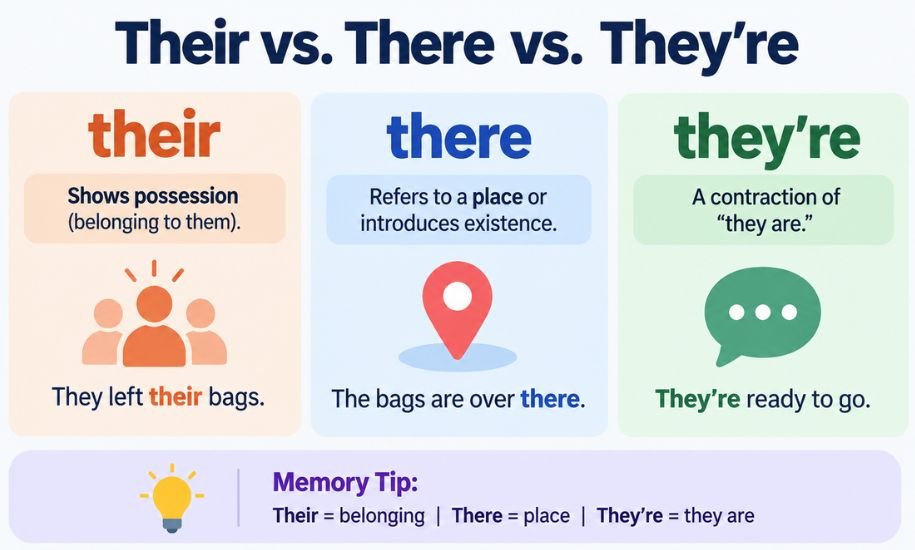
If you are unsure whether to write their or there, the answer depends on what you mean. Both are correct English words, but they have completely different jobs in a sentence. Their shows possession or a relationship to people, while there usually refers to a place or helps introduce something that exists. A third word, they’re, sounds the same in most speech but means “they are.” Understanding these three forms makes it much easier to choose the right one in writing.
Their and there are both correct, but they have different meanings. Their shows possession or association, while there refers to a place or is used in expressions such as “there is” and “there are.” Don’t confuse either one with they’re, which means “they are.”
Their vs. There: Quick Comparison
| Word | Main function | Meaning | Example |
|---|---|---|---|
| their | Possessive determiner | Belonging to or associated with them | They left their bags here. |
| there | Adverb/pronoun in common constructions | A place or the existence of something | Your bags are over there. |
| they’re | Contraction | They are | They’re waiting outside. |
The easiest way to distinguish the first two is to ask what the sentence is doing. If it describes who something belongs to, use their. If it identifies a place or introduces something that exists, use there.
What Does “Their” Mean?
Their is a possessive determiner. It normally comes before a noun and indicates that something belongs to, is connected with, or is associated with them.
For example:
- The students collected their books.
- The players celebrated their victory.
- The neighbors painted their house.
- The children packed their lunches.
In each sentence, their answers a question such as “Whose?”
Whose books did the students collect?
Their books.
Their can refer to one person, too
Modern English also uses their with singular they, particularly when a person’s gender is unknown, unspecified, or when they use singular they.
For example:
Someone left their jacket in the classroom.
Here, their refers to one unspecified person. This is a standard and widely accepted use of singular they.
What Does “There” Mean?
There has several grammatical uses, but two are especially important.
There can refer to a place
When there refers to a location, it is often the opposite of here.
Examples:
- Your keys are over there.
- We went there after lunch.
- Please put the box there.
- I saw your brother standing there.
A useful test is to replace there with a specific location.
The children are playing there.
The children are playing outside.
If the word refers to a location, there is appropriate.
There can introduce existence
You will also see there in constructions such as there is, there are, there was, and there were.
Examples:
- There is a problem with the printer.
- There are several books on the desk.
- There was a strange noise outside.
- There were two empty seats.
In these sentences, there does not necessarily mean a particular physical location. Instead, it helps introduce the existence or presence of something.
The Key Difference
The simplest distinction is:
Their = belonging to them
There = a place or existence
Compare these sentences:
They left their coats by the door.
The coats belong to or are associated with them.
Their coats are over there.
Now their shows possession, while there identifies a location.
Another example:
The students finished their assignment, and there was enough time to check it.
The first word indicates association with the students. The second introduces the existence of enough time.
What About “They’re”?
The confusion becomes easier to understand when they’re is included.
They’re is a contraction of they are.
Examples:
- They’re ready. → They are ready.
- They’re coming tomorrow. → They are coming tomorrow.
- They’re very excited. → They are very excited.
Whenever you think they’re might be correct, expand it to they are. If the sentence still makes sense, you have probably chosen the right form.
For example:
They’re going to the concert.
Expanding it gives:
They are going to the concert.
That works, so they’re is correct.
Examples in Sentences
Seeing the words in different contexts is one of the best ways to understand the distinction.
Examples with “their”
- The employees returned to their offices.
- The twins brought their own cameras.
- The company changed their website design.
- Everyone should bring their identification.
- The birds returned to their nest.
Examples with “there”
- Your notebook is over there.
- We stayed there for two hours.
- There is something under the table.
- There are several ways to solve the problem.
- I have never been there before.
Examples with all three
They’re taking their bicycles over there.
Each form has a different role:
- They’re = they are
- their = belonging to them
- there = that place
This is a useful sentence to remember when the three forms become confusing.
Common Mistakes to Avoid
1. Using “there” for possession
Incorrect:
The students forgot there homework.
Correct:
The students forgot their homework.
The homework is associated with the students, so their is required.
2. Using “their” for a location
Incorrect:
Please put the chairs over their.
Correct:
Please put the chairs over there.
The word refers to a location, so there is correct.
3. Confusing “there” with “they’re”
Incorrect:
There going to arrive soon.
Correct:
They’re going to arrive soon.
Here, they’re means they are.
4. Confusing “their” with “they’re”
Incorrect:
They’re house is near the park.
Correct:
Their house is near the park.
A house cannot be preceded by they’re because they’re means they are. The possessive form is their.
5. Writing “their’s”
The possessive determiner is their, without an apostrophe.
Their car is outside. ✓
When the possessive pronoun is needed on its own, use theirs:
The car is theirs. ✓
Their’s is not the standard spelling.
An Easy Way to Remember the Difference
Try these three simple associations:
Their → possession
Think:
their = belonging to them
Their house
Their books
Their decision
There → place
Connect there with here:
here → there
If you can point to a place, there may be the word you need.
Put it there.
They’re → they are
Use the expansion test:
They’re = They are
If replacing the word with they are works, use they’re.
A Simple Three-Word Test
When you are unsure, ask three questions:
1. Does it show possession?
Use their.
The children brought their toys.
2. Does it refer to a place or introduce something that exists?
Use there.
The toys are over there.
There are five toys.
3. Does it mean “they are”?
Use they’re.
They’re playing with their toys.
This quick test can solve most everyday mistakes.
Their, There, or They’re in Formal Writing
All three forms are standard English when used correctly. The important issue is not formality but grammar and meaning.
For example:
The researchers presented their findings.
Correct.
There are several explanations for the result.
Correct.
They’re preparing another report.
Correct.
In formal writing, the main thing to avoid is substituting one form for another simply because they sound alike.
Frequently Asked Questions
Is “their” or “there” correct?
Both are correct words. Their is used mainly to indicate possession or association, while there commonly refers to a place or appears in constructions such as “there is” and “there are.” The correct choice depends on the meaning of the sentence.
What is the easiest way to remember their and there?
Remember their = belonging to them and there = a place. You can also associate there with here, since both can refer to locations. If the word means “they are,” use they’re.
Is “their” always plural?
No. Their can be used with singular they, as in “Someone forgot their phone.” It can therefore refer to one person when the person’s identity or gender is unspecified or when singular they is being used.
Is “there” a possessive word?
No. There is not the possessive form of they. The possessive determiner is their, as in “their house.” There can refer to a location or appear in existential constructions such as “there is a problem.”
Is “they’re” the same as “their”?
No. They’re is a contraction of they are, while their indicates possession or association. For example, “They’re bringing their books” means “They are bringing the books associated with them.”
Is “their’s” correct?
No. Their’s is not the standard spelling. Use their before a noun, as in “their car,” or theirs when the possessive pronoun stands alone, as in “The car is theirs.”
The Bottom Line
Their, there, and they’re may sound alike, but they have distinct grammatical functions. Use their for possession or association, there for a place or constructions that introduce existence, and they’re when you mean they are. Once you connect each form with its function, choosing the correct word becomes much easier. Grammarifyr is here to help make these small but important English distinctions clear.
You may also Read : Tries or Trys: Correct Spelling and Grammar