Drier or Dryer: Meaning and Usage Explained
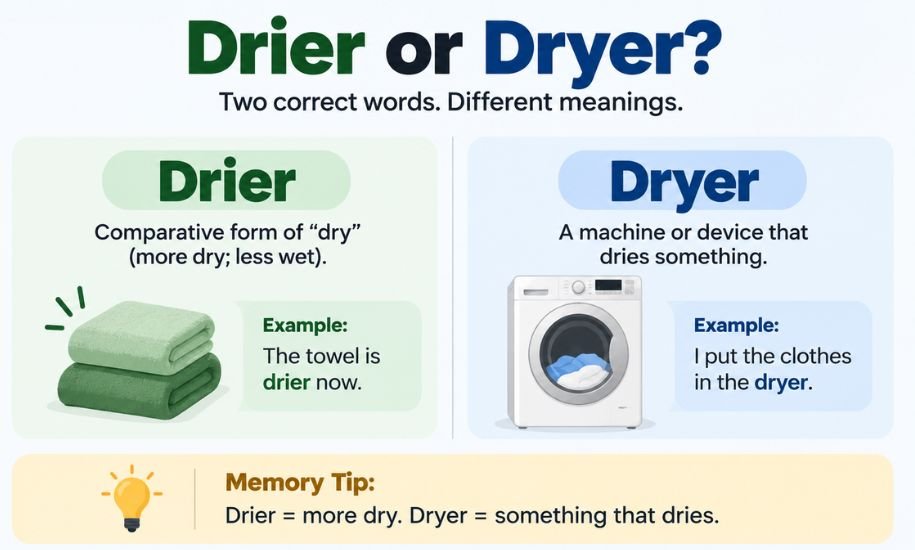
If you are unsure whether to write drier or dryer, the answer depends on what you mean. The two words look and sound very similar, but they usually serve different purposes. Drier is normally the comparative form of the adjective dry, meaning “more dry” or “less wet.” Dryer is commonly a noun for a machine or device that dries something, such as a clothes dryer or hair dryer. Once you know this distinction, choosing the right spelling becomes much easier.
Drier means “more dry” and is the usual comparative form of dry. Dryer usually refers to a machine or device that dries something, such as a clothes dryer or hair dryer. Both are correct words, but they are generally used in different contexts.
Drier vs. Dryer: The Basic Difference
The simplest way to distinguish these words is to look at their meaning:
| Word | Common meaning | Example |
|---|---|---|
| drier | More dry; less wet | The towel is drier now. |
| dryer | A machine or device that dries | Put the towel in the dryer. |
So, if you are comparing the level of dryness, use drier:
This towel is drier than the other one.
If you are naming an appliance or device, use dryer:
The dryer is running.
This distinction covers most everyday uses.
What Does “Drier” Mean?
Drier is generally the comparative form of the adjective dry.
The usual progression is:
dry → drier → driest
It means that something has less moisture or is more dry than something else.
Examples of “drier”
- The weather is drier this week.
- This towel feels drier than the one on the floor.
- The soil became drier after several sunny days.
- My skin gets drier during the winter.
- The northern region has a drier climate.
Notice that drier describes a condition. It tells us that something is more dry than another thing or than it was previously.
Why is it spelled “drier”?
When dry takes the comparative ending -er, the final y changes to i:
- dry → drier
- easy → easier
- happy → happier
- noisy → noisier
Therefore, when you mean “more dry,” the standard spelling is drier.
What Does “Dryer” Mean?
Dryer is commonly used as a noun for a machine or device that removes moisture.
You might encounter it in expressions such as:
- clothes dryer
- hair dryer
- hand dryer
- food dryer
For example:
I put the wet clothes in the dryer.
She used a hair dryer before leaving.
The bathroom has an electric hand dryer.
In these sentences, dryer is not describing something as “more dry.” It is naming a device designed to dry something.
Clothes Drier or Dryer?
When you are referring to the household appliance used to dry clothes, clothes dryer is the standard modern choice.
For example:
We bought a new clothes dryer last month.
The clothes dryer stopped working.
Please take the towels out of the dryer.
The phrase clothes drier can occasionally be encountered, particularly because drier can have noun uses in some dictionaries and varieties of English. However, clothes dryer is the familiar and widely used term for the appliance in contemporary standard English.
There is another common term, especially in British English:
tumble dryer
So, when the question is specifically about the appliance, dryer is generally the clearest choice.
Is It “Drier” or “Dryer” When Describing Something?
When you are describing something as having become more dry, choose drier.
Correct:
The clothes are drier now.
The air is drier in the afternoon.
This bread is drier than yesterday’s.
Usually incorrect for this meaning:
The clothes are dryer now.
The air is dryer in the afternoon.
This bread is dryer than yesterday’s.
The reason is grammatical: the comparative form of dry is normally drier.
Think of the sentence as:
dry → more dry → drier
The word dryer has a different common function: it identifies something that performs the drying.
Is It “Dryer” or “Drier” for an Appliance?
When you mean a device that dries something, dryer is normally the appropriate choice.
Examples include:
- clothes dryer
- hair dryer
- hand dryer
- nail dryer
- blow dryer
For example:
My clothes are still in the dryer.
The hair dryer is in the bathroom.
The public restroom has a hand dryer.
Here, replacing dryer with drier would not be the normal modern choice for the named appliance.
This gives you a useful contrast:
The clothes are drier.
The clothes are in the dryer.
The first sentence describes the clothes. The second names the machine.
Why Are These Words So Easy to Confuse?
The confusion is understandable because drier and dryer are extremely similar in appearance and pronunciation.
There is also a natural connection between their meanings. A dryer makes something drier, so it is easy to assume that the words can be spelled the same way.
However, their grammatical roles are different in ordinary usage:
- drier → comparative adjective
- dryer → usually a noun referring to a drying device
The spelling difference becomes especially important in writing because pronunciation alone may not tell you which form is intended.
Examples in Everyday Sentences
Here are some examples showing the difference in context.
When “drier” is correct
The towels are drier than they were this morning.
The desert has a drier climate than the coastal region.
My hands become drier when the weather gets cold.
The grass is drier after several days without rain.
This cake is drier than the one we made last week.
In every example, drier means “more dry.”
When “dryer” is correct
The clothes are in the dryer.
We need to repair the dryer.
She bought a new hair dryer.
The hotel bathroom has a hand dryer.
The clothes dryer uses a lot of electricity.
In these sentences, dryer refers to an object or appliance.
A Simple Rule to Remember
Use this two-part rule:
Drier = more dry.
Dryer = a thing that dries.
You can also remember the grammatical pattern:
dry → drier
If you are comparing how dry two things are, you need the comparative form drier.
If you are naming a machine that makes something dry, you generally need dryer.
For example:
The towel is drier because I used the dryer.
That single sentence demonstrates both words correctly.
Common Mistakes to Avoid
1. Using “dryer” as the comparative of “dry”
❌ The air is dryer today.
✅ The air is drier today.
The standard comparative form is drier.
2. Calling the appliance a “clothes drier”
△ clothes drier
✅ clothes dryer
Although drier has some noun usage, clothes dryer is the conventional modern term for the appliance.
3. Assuming one word is always correct
Neither word is simply a universal replacement for the other.
Both drier and dryer are legitimate English words. The intended meaning determines which spelling fits.
4. Forgetting the comparative spelling rule
Because dry ends in y, its normal comparative form changes the y to i:
dry → drier
This is the same spelling pattern seen in words such as happy → happier.
Is There a British and American Difference?
The distinction between drier and dryer should not generally be treated as a simple American-versus-British spelling difference.
Both varieties use drier as the normal comparative form of dry, and dryer is widely used for a drying machine or device.
There are some differences in terminology. For example, tumble dryer is particularly familiar in British English, while clothes dryer is especially common in American English.
The important point is that the basic distinction remains useful regardless of which variety of English you are writing.
Drier or Dryer: Which One Should You Choose?
Ask yourself what role the word plays in your sentence.
If you mean “more dry”:
Use drier.
The towels are drier now.
If you mean “a machine that dries”:
Use dryer.
The towels are in the dryer.
If you are naming a device:
Use dryer in familiar terms such as:
- hair dryer
- clothes dryer
- hand dryer
If you are comparing levels of dryness:
Use drier:
- drier air
- drier weather
- drier soil
- drier skin
- drier clothes
Once you separate the condition from the device, the spelling is much easier to choose.
Frequently Asked Questions
Is “drier” a correct word?
Yes. Drier is a standard English word and is normally the comparative form of dry. It means “more dry” or “less wet,” as in “The towel is drier now.”
Is “dryer” a correct word?
Yes. Dryer is also a standard English word. It is commonly used as a noun for a machine or device that dries something, such as a clothes dryer or hair dryer.
Is it “clothes drier” or “clothes dryer”?
Clothes dryer is the conventional modern term for the appliance. Drier can have noun uses in some contexts, but clothes dryer is the clearer and more familiar choice when referring to the household machine.
Is it “drier weather” or “dryer weather”?
Use drier weather when you mean weather that is more dry or has less moisture. For example: “The region experiences drier weather during the summer.”
Is “hair drier” or “hair dryer” correct?
Hair dryer is the standard modern expression for the electrical device used to dry hair. The word dryer is naming the device rather than comparing how dry something is.
How can I remember the difference between drier and dryer?
Remember: drier = more dry; dryer = something that dries. If you can replace the word with “more dry,” choose drier. If it names an appliance or device, dryer is usually the right choice.
Final Verdict: Drier or Dryer?
Drier and dryer are both correct words, but they normally have different jobs. Use drier when you mean “more dry,” as in drier weather or a drier towel. Use dryer when referring to a machine or device, as in clothes dryer or hair dryer. For more clear explanations of confusing English words, Grammarifyr helps you know the difference and use the right words.
You may also Read : Women or Woman: Meaning and Grammar