Flies or Fly: Meaning and Grammar Explained
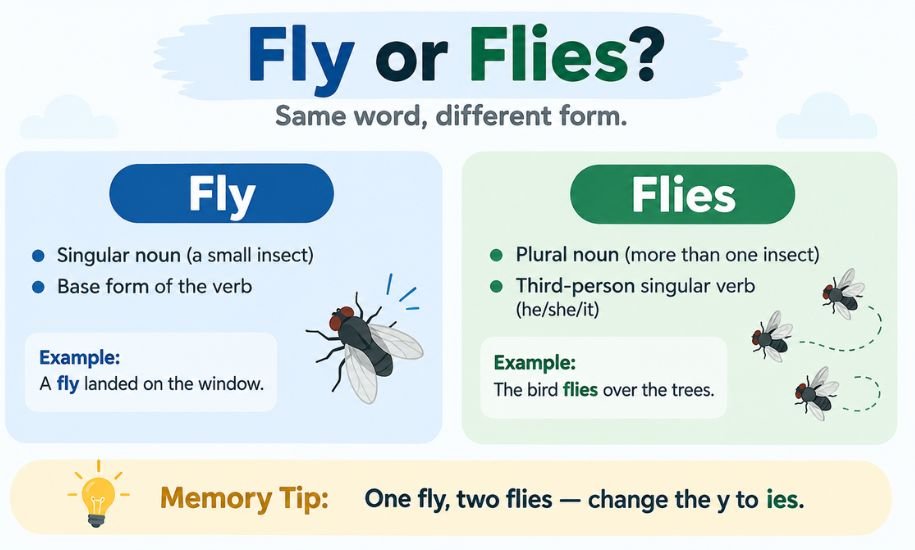
The words fly and flies are both correct, but they do different jobs in a sentence. Fly can be a noun referring to an insect, or a verb meaning to move through the air. Flies can be the plural of the noun or the third-person singular form of the verb. The confusion becomes especially noticeable in phrases such as “time flies,” where some writers incorrectly use flys. Understanding the simple spelling and grammar rules behind these forms makes the difference easy to remember.
Fly and flies are both correct forms, but they are used differently. Fly is the singular noun and the base form of the verb, while flies is the plural noun or the third-person singular present-tense verb. The correct expression is “time flies,” not “time flys.”
Fly vs. Flies: A Quick Comparison
| Form | Main use | Example |
|---|---|---|
| fly | Singular noun | A fly landed on the window. |
| fly | Base verb | Birds fly south in winter. |
| flies | Plural noun | Several flies were near the food. |
| flies | Third-person singular verb | The bird flies over the lake. |
| flys | Standard English? | No, not for these ordinary uses. |
The key point is that flies is not simply an alternative spelling of fly. It is a different grammatical form.
What Does “Fly” Mean?
Fly has several uses, but two are especially important for this comparison.
Fly as a noun
A fly is a small flying insect.
Examples:
- A fly landed on the table.
- I saw a fly near the window.
- The fly kept buzzing around the room.
When you have more than one, the plural becomes flies:
One fly → two flies
Fly as a verb
As a verb, fly means to move through the air or travel by aircraft.
Examples:
- Birds fly across the sky.
- We fly to Chicago tomorrow.
- Eagles fly high above the mountains.
However, when the subject is he, she, it, or another singular third-person subject in the present tense, the form changes to flies:
I fly every month.
She flies every month.
That spelling change is central to understanding the difference.
What Does “Flies” Mean?
Flies has two common grammatical roles.
1. Flies as a plural noun
The plural of fly is flies.
Examples:
- There are several flies in the kitchen.
- The flies gathered around the fruit.
- We need to keep the food covered to prevent flies from landing on it.
The spelling follows a standard English rule: when a noun ends in a consonant plus y, the y usually changes to i before -es is added.
So:
fly → flies
The same pattern appears in words such as:
- baby → babies
- city → cities
- country → countries
- story → stories
2. Flies as a verb
Flies is also the third-person singular present form of fly.
Compare:
- I fly
- You fly
- We fly
- They fly
- He flies
- She flies
- The plane flies
For example:
The plane flies over the city every evening.
Here, flies is a verb, not a plural noun.
Why Does “Fly” Become “Flies”?
The spelling is based on the familiar consonant + y rule.
When a word ends in a consonant followed by y, the y generally changes to i when forming certain plural or third-person singular forms.
For example:
- fly → flies
- try → tries
- cry → cries
- study → studies
- carry → carries
This is why flys is not the standard form for the ordinary plural or third-person singular verb.
There is an important contrast with words ending in a vowel plus y:
- boy → boys
- toy → toys
- day → days
- play → plays
So fly follows the same general spelling pattern as try and cry, rather than play and enjoy.
Is It “Flys” or “Flies”?
For standard modern English, use flies in the ordinary situations covered by this article.
Correct:
The bird flies over the trees.
Incorrect in standard usage:
The bird flys over the trees.
Correct:
There are three flies in the room.
Incorrect:
There are three flys in the room.
The form flys may occasionally appear in names, titles, brands, usernames, or other deliberately stylized contexts. That does not make it the standard spelling of the ordinary grammatical forms of fly.
“Time Flies” or “Time Flys”?
The correct expression is:
Time flies.
Not:
❌ Time flys.
The reason is grammatical. Time is a singular subject, so the present-tense verb fly takes its third-person singular form:
time + flies
The phrase “time flies” means that time seems to pass quickly.
For example:
Time flies when you’re having fun.
I can’t believe it’s already December. Time flies!
Time flies when you’re busy.
The same rule applies to other singular subjects:
- Life flies by.
- The year flies past.
- The summer flies away.
So if you are wondering about time flys or time flies, choose time flies.
How Time Flies or Flys?
The correct expression is:
How time flies!
This is an exclamation expressing surprise that time has passed quickly.
Examples:
- How time flies! It seems like yesterday.
- How time flies when you’re having fun!
- Another year has passed. How time flies!
The incorrect version is:
❌ How time flys!
The verb must be flies because time is a singular third-person subject.
Common Mistakes With Fly and Flies
Mistake 1: Using “flys” as the plural
❌ I saw two flys near the door.
✅ I saw two flies near the door.
The plural form changes y to i and adds -es.
Mistake 2: Using “flys” after a singular subject
❌ The bird flys over the lake.
✅ The bird flies over the lake.
A singular third-person subject requires flies in the present tense.
Mistake 3: Writing “time flys”
❌ Time flys when you’re having fun.
✅ Time flies when you’re having fun.
This is one of the most noticeable spelling errors involving the word.
Mistake 4: Changing every “fly” to “flies”
Not every sentence should use flies.
❌ Birds flies south in winter.
✅ Birds fly south in winter.
The subject birds is plural, so the base verb fly is required.
Compare:
The bird flies south.
The birds fly south.
A Simple Way to Remember the Difference
Think of fly as the basic form:
One fly
I fly
They fly
When you need the plural noun or the third-person singular verb, use:
flies
So:
one fly → two flies
and
I fly → she flies
A useful spelling pattern is:
consonant + y → ies
For example:
fly → flies
try → tries
cry → cries
This makes it easier to remember why flys is not the standard spelling.
Fly, Flies, and Other Forms
Understanding the complete set of forms can make the pattern clearer.
| Form | Example |
|---|---|
| fly | Birds fly south. |
| flies | The bird flies south. |
| flew | The bird flew away. |
| flown | The bird has flown away. |
| flying | The bird is flying. |
Notice that flies is only one of several forms of the verb.
For example:
She flies to Boston every week.
But:
She flew to Boston yesterday.
And:
She has flown to Boston many times.
The form flys does not belong in this standard verb pattern.
Correct Examples in Sentences
Here are some natural examples showing the different uses:
Singular noun:
A fly landed on my notebook.
Plural noun:
Several flies were buzzing around the window.
Base verb:
Birds fly south during the colder months.
Third-person singular verb:
The eagle flies above the valley.
Time expression:
Time flies when you’re enjoying yourself.
Exclamation:
How time flies!
These examples show why the correct form depends on the grammatical role and the subject.
What About “Fly’s”?
It is also useful to distinguish flies from fly’s.
Fly’s usually indicates possession:
The fly’s wings are delicate.
Here, the wings belong to one fly.
By contrast:
The flies are near the window.
Here, flies is the plural noun.
There is also a possible contraction:
The fly’s on the wall.
In that context, fly’s can mean fly is, although the wording may sound unusual depending on the context.
The apostrophe therefore changes the grammatical function:
- fly = singular noun/base verb
- flies = plural noun/third-person singular verb
- fly’s = possessive or contraction
Frequently Asked Questions
Is “flys” a correct spelling?
Flys is not the standard spelling for the ordinary plural of fly or the third-person singular present form of the verb. In standard English, use flies: “two flies” and “the bird flies.”
Is it “time flies” or “time flys”?
The correct phrase is “time flies.” The subject time is singular, so the verb fly becomes flies in the present tense.
Is “how time flies” correct?
Yes. “How time flies!” is a standard English expression used to show surprise at how quickly time has passed.
Is “flies” singular or plural?
It can be either, depending on its grammatical role. Flies is plural when referring to more than one insect, as in “three flies.” It is singular in grammatical agreement when it is the verb, as in “the bird flies.”
Why is “flys” wrong?
In ordinary standard English, fly follows the consonant-plus-y spelling pattern. The y changes to i before -es, producing flies, not flys.
Should I write “birds fly” or “birds flies”?
Write “birds fly.” Birds is plural, so it takes the base verb fly. With a singular subject, use flies: “The bird flies.”
The Bottom Line
Fly and flies are both correct, but they are not interchangeable. Use fly for the singular insect and the base form of the verb; use flies for multiple insects and with a singular third-person subject. The standard expressions are “time flies” and “how time flies,” not “time flys.” For more clear explanations of confusing English forms, Grammarifyr helps you know the difference and use the right words.
You may also Read : Drier or Dryer: Meaning and Usage Explained


One Comment