Seperate or Separate: Correct Spelling Explained
If you have ever hesitated over the spelling of separate, you are not alone. The word contains an unstressed vowel sound that can make its spelling less obvious, which is why “seperate” is a frequent mistake. But there is a straightforward answer: separate is the standard spelling in English, while seperate is a misspelling. Once you remember where the two a’s occur, the correct form becomes much easier to recognize and use.
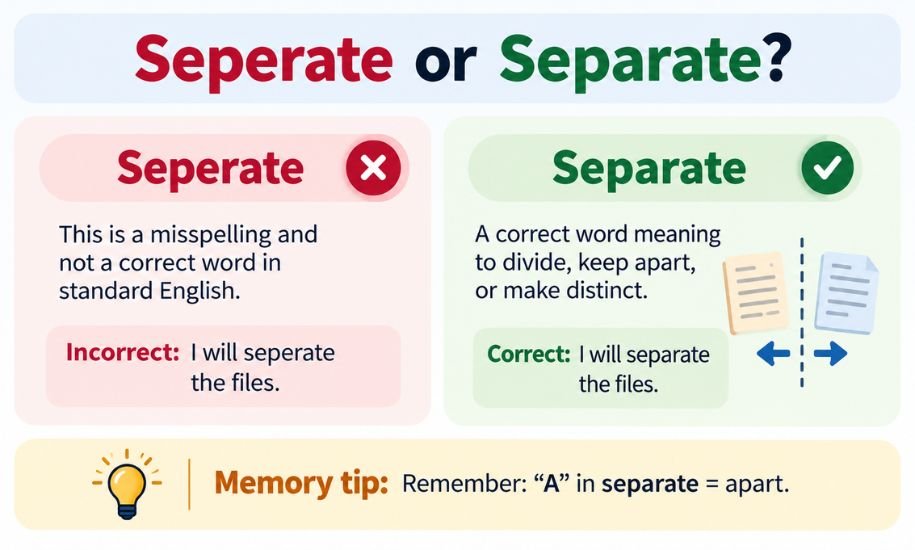
Separate is the correct spelling. Seperate is a common misspelling and should be avoided in standard English. The correct word can be an adjective, verb, or noun depending on the context.
Separate or Seperate: Which Is Correct?
The correct spelling is separate, with an a in the middle:
separate ✅
seperate ❌
The difference is only one letter, but that letter matters. In standard written English, use separate when you mean “apart,” “distinct,” or “to divide.”
For example:
- We have separate offices.
- Please keep these documents separate.
- The teacher asked the students to separate into two groups.
- It is important to separate facts from opinions.
“Seperate” does not represent a different English word. It is simply a misspelling of separate.
A Quick Comparison
| Feature | Separate | Seperate |
|---|---|---|
| Standard spelling? | Yes | No |
| Meaning | Apart, distinct, or to divide | — |
| Part of speech | Adjective, verb, noun | — |
| Used in formal writing? | Yes | No |
| Example | Keep the two files separate. | Incorrect spelling |
The important thing to remember is that separate is the form you should use in emails, essays, reports, academic writing, professional documents, and everyday communication.
What Does “Separate” Mean?
Separate has several related meanings. Its basic idea is that something is apart rather than joined or combined.
Separate as an adjective
As an adjective, separate describes people or things that are distinct or not together.
Examples:
- The children have separate bedrooms.
- We booked separate tables.
- The company has two separate departments.
- Keep raw meat and cooked food in separate containers.
In these examples, the word tells us that the things mentioned are distinct from one another.
Separate as a verb
As a verb, separate means to divide, move apart, or distinguish between things.
Examples:
- Please separate the recyclable materials.
- The fence separates the two gardens.
- We need to separate the useful information from the irrelevant details.
- The referee had to separate the two players.
As a verb, the pronunciation also changes slightly from the adjective form.
Separate as a noun
The noun separate is less common but is used in particular contexts, especially in clothing. A “separate” can refer to an item of clothing designed to be worn with other items rather than as part of a matching outfit.
For most everyday writing, however, you are much more likely to encounter separate as an adjective or verb.
Why Is “Seperate” So Easy to Misspell?
The spelling can be confusing because the way separate sounds does not always make every vowel obvious.
When used as an adjective, the word is generally pronounced approximately:
SEP-uh-rut
When used as a verb, it is pronounced approximately:
SEP-uh-rayt
The weak vowel in the middle can make writers think the word contains an e rather than an a. This can lead to the incorrect spelling seperate.
There is also a visual reason for the mistake. English contains many words in which vowel patterns are not easily predicted from pronunciation, so spelling a word purely by sound can sometimes produce the wrong form.
The Easy Way to Remember the Spelling
A simple memory trick is to focus on the two a’s:
sep-A-r-A-te
Another useful mnemonic is:
There is “A RAT” in sepARATe.
Look at the middle of the word:
sep A rat e
You do not need to memorize a complicated spelling rule. Simply remembering that separate has two a’s can help you avoid the most common error.
You can also connect it with related words:
- separate
- separated
- separately
- separation
Notice that these forms use the same a spelling.
Correct and Incorrect Examples
Seeing the two forms side by side makes the difference clear.
Correct
The two teams trained at separate facilities.
Incorrect
The two teams trained at seperate facilities.
Correct
Please separate the blue forms from the yellow ones.
Incorrect
Please seperate the blue forms from the yellow ones.
Correct
The files should be stored in separate folders.
Incorrect
The files should be stored in seperate folders.
Correct
They decided to live separately.
Incorrect
They decided to live seperately.
The same spelling pattern continues in related forms, so learning the root word correctly is useful.
Separate vs. Separated vs. Separately
One reason this spelling can cause additional mistakes is that separate has several common related forms.
Separate
Use this for the basic adjective or verb:
The rooms are separate.
Please separate the papers.
Separated
Use separated as the past tense or past participle of the verb:
The two groups were separated by a barrier.
Separately
Use separately when you need the adverb:
The items are sold separately.
Notice that none of these forms changes the a in the root:
separate → separated → separately
A common error is to write seperated or seperately, but these forms are also misspellings.
Separate Pronunciation in UK and US English
Pronunciation is relevant because it helps explain why the spelling can be difficult.
As an adjective, separate is pronounced with a weaker final syllable, approximately like SEP-uh-rut.
As a verb, the final syllable is pronounced more clearly, approximately like SEP-uh-rayt.
British and American pronunciations differ slightly in their phonetic details, but the spelling remains the same:
separate
There is no British spelling seperate and American spelling separate distinction. Separate is the standard spelling in both varieties.
Is “Seperate” a Real Word?
No. In standard modern English, seperate is not the accepted spelling of the word meaning “apart” or “to divide.”
If you see it in an informal message, online comment, draft, or other piece of writing, it is normally an error rather than an alternative form.
For formal and edited writing, replace it with:
separate
This is also why you should not treat the two forms as synonyms. They are not two different words with slightly different meanings.
Common Mistakes With Separate
1. Writing “seperate”
This is the main spelling error.
Incorrect: Please keep the records seperate.
Correct: Please keep the records separate.
2. Writing “seperated”
The correct past form is separated.
Incorrect: The students were seperated into groups.
Correct: The students were separated into groups.
3. Writing “seperately”
The correct adverb is separately.
Incorrect: The products are sold seperately.
Correct: The products are sold separately.
4. Assuming pronunciation tells you the spelling
The middle vowel can sound weak, so spelling the word exactly as it sounds can lead to an error. It is better to remember the written form.
5. Treating it as a UK/US spelling difference
This is not an American-versus-British issue. Separate is the standard spelling in both British and American English.
A Short Spelling Quiz
Choose the correct form in each sentence.
1. Please keep the two documents ___.
A. seperate
B. separate
Answer: B. separate
2. The teacher ___ the class into three groups.
A. seperated
B. separated
Answer: B. separated
3. The ingredients should be measured ___.
A. separately
B. seperately
Answer: A. separately
4. Which spelling is standard?
A. seperate
B. separate
Answer: B. separate
The pattern is consistent: the a in separate stays there in its common related forms.
How to Choose the Correct Form
When writing, use separate whenever you mean that something is distinct, apart, or divided.
A quick check is to ask yourself:
Does the word mean “apart,” “distinct,” or “divide”?
If yes, the spelling you want is almost certainly:
separate
Then check for the two a’s:
sep-a-r-a-te
That visual reminder is often enough to prevent the error.
Frequently Asked Questions
Is “seperate” or “separate” correct?
Separate is correct. Seperate is a misspelling. Use separate in standard English, including formal, academic, professional, and everyday writing.
Why do people spell separate as “seperate”?
The unstressed vowel sounds in the word can make its spelling difficult to infer from pronunciation. Writers may therefore remember an e where the spelling actually contains an a.
Is “seperate” accepted in British English?
No. Seperate is not the standard British spelling. British English uses separate, just as American English does.
How do you remember how to spell separate?
Remember that separate has two a’s. You can break it visually into sep-A-r-A-te. The related words separated, separately, and separation also retain the same spelling pattern.
Is “separated” or “seperated” correct?
Separated is correct. The spelling follows the root separate: separate → separated. Seperated is a misspelling.
Is separate pronounced differently as a noun, adjective, and verb?
The most noticeable difference is between the adjective and verb. The adjective has a weaker final sound, while the verb ends with a sound similar to “-rate.” The spelling remains separate.
The Bottom Line
When choosing between seperate or separate, the answer is simple: separate is the correct standard spelling. Seperate is a misspelling, not an alternative British or American form. Remember the two a’s in sep-a-r-a-te, and the same pattern will help you spell separated and separately correctly. For more clear explanations of commonly confused English words, Grammarifyr helps you know the difference and use the right words.
You may also Read : Among or Amongst: Meaning and Correct Usage