Among or Amongst: Meaning and Correct Usage
If you have ever paused over among or amongst, you are not alone. Both words appear in standard English, and in most situations they mean essentially the same thing. The real difference is mainly one of frequency and style: among is more common and neutral, while amongst is less common and can sound more formal or traditional. Neither is simply a misspelling of the other. Understanding this small distinction can help you choose the form that sounds most natural for your audience and context.
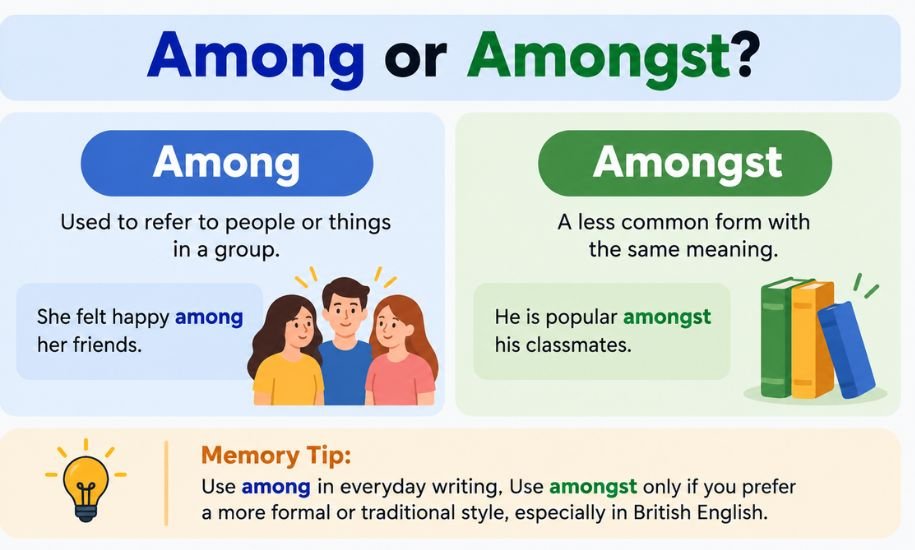
Among and amongst are both correct English words with essentially the same meaning. Among is more common in modern English and is usually the best neutral choice, while amongst is less common and may sound more formal or traditional.
Among vs. Amongst: What’s the Difference?
The central difference is not meaning but usage and style.
Both among and amongst are prepositions. They can describe someone or something being surrounded by a group, included within a group, or distributed within a group.
| Feature | Among | Amongst |
|---|---|---|
| Correct word? | Yes | Yes |
| Part of speech | Preposition | Preposition |
| Basic meaning | In, surrounded by, or included in a group | Same |
| Frequency | More common | Less common |
| Style | Neutral and everyday | Often more formal or traditional |
| British English | Common | Also used |
| American English | Common | Less common |
| Formal writing | Appropriate | Appropriate, depending on style |
For example:
- She sat among her friends.
- She sat amongst her friends.
Both sentences are grammatically correct and communicate essentially the same idea.
If you are unsure which one to choose, among is generally the safest option because it is widely used across varieties of modern English.
What Does “Among” Mean?
Among is a preposition that commonly means in or surrounded by a group of people or things.
It can also indicate that someone or something is included as part of a group.
Consider these examples:
- The cabin was hidden among the trees.
- She was standing among a crowd of spectators.
- He was among the finalists.
- The disease is more common among older adults.
- The money was divided among the three children.
In each case, among establishes a relationship between something and a group.
The word can also be used when discussing a shared action or relationship:
The students discussed the problem among themselves.
Here, the students are discussing it within their own group.
What Does “Amongst” Mean?
Amongst has essentially the same meaning as among.
It can describe being surrounded by something, being part of a group, or existing within a group.
For example:
- The cottage stood amongst the hills.
- She felt comfortable amongst her colleagues.
- He was amongst the first people to arrive.
- The issue caused concern amongst local residents.
None of these sentences requires amongst instead of among. In most cases, you could replace it with among without changing the basic meaning.
The main consideration is tone. Amongst can have a somewhat more formal, literary, or traditional feel, although it is still a normal English word.
When Should You Use “Among”?
Use among when you want the most natural and widely understood form.
It works particularly well in everyday conversation, general writing, educational material, journalism, and formal prose.
For example:
The teacher walked among the students.
The survey identified differences among the participants.
She found an old photograph among her belongings.
There was considerable disagreement among the members.
There is no need to use amongst simply to make a sentence sound more sophisticated. In many modern contexts, among sounds cleaner and more straightforward.
When Is “Amongst” Appropriate?
Amongst is also correct, so there is no grammatical problem with choosing it.
It may be appropriate when it fits the writer’s preferred style, the surrounding language, or a particular variety of English. It is also encountered in expressions such as:
- amongst other things
- amongst themselves
- amongst friends
- amongst the trees
- amongst the crowd
For example:
The committee discussed the proposal amongst themselves.
This is perfectly grammatical. However, the version below is also completely natural:
The committee discussed the proposal among themselves.
In contemporary general writing, the second version will often be the more straightforward choice.
Among or Amongst in British English
Both forms are used in British English.
It is sometimes assumed that amongst is the British form and among is the American form, but that distinction is too simple. British speakers and writers use among frequently, while amongst is also established in British English.
For example, both of these are acceptable:
The village lies among the hills.
The village lies amongst the hills.
The choice often comes down to individual preference and style rather than a strict British grammar rule.
If you are writing for a British audience, you do not need to replace among with amongst simply because you want your writing to sound British.
What About American English?
Among is particularly common in American English.
Amongst is still understandable and grammatically valid, but it occurs less frequently and can sound more formal or traditional to some American readers.
For general American writing, therefore, among is usually the more natural choice:
The decision caused concern among employees.
This does not mean that amongst is incorrect in American English. It simply means that writers looking for a neutral, contemporary style will generally find among more natural.
Among or Amongst in Academic Writing
Both forms can occur in academic writing, but among is usually the more neutral choice.
For example:
The researchers found significant differences among the three groups.
The study examined attitudes among university students.
Variation among participants was relatively high.
Using amongst would not automatically make these sentences grammatically incorrect. However, academic writing generally benefits from clear, direct wording, so among is often preferable when there is no stylistic reason to choose the longer form.
The important point is consistency. If you choose among, there is no need to alternate with amongst simply for variation.
Among vs. Between: Are They the Same?
Another source of confusion is the difference between among and between.
A traditional rule says that between is used for two things and among for three or more. This can be useful for beginners, but it is not a complete rule.
Among is generally used when something is considered as part of a group:
The child was hiding among the trees.
Between is often used when separate people, objects, or parties are being considered individually:
The agreement was between the three companies.
So between can be used with more than two entities when those entities are clearly treated as distinct parties or relationships.
For basic everyday usage, remember this:
- among → within or surrounded by a group
- between → involving distinct people, things, or relationships
Among Other Things vs. Amongst Other Things
Both expressions are correct.
Among other things is the more common and neutral expression. It means that something is one of several things being mentioned or considered.
For example:
The job involves writing reports and, among other things, organising meetings.
You may also encounter:
The job involves writing reports and, amongst other things, organising meetings.
The meaning is essentially unchanged.
If you are writing in a straightforward modern style, among other things is usually the better default.
Among Themselves vs. Amongst Themselves
Both constructions are grammatically possible:
The players discussed the decision among themselves.
The players discussed the decision amongst themselves.
The first is more neutral and common, while the second may give the sentence a slightly more formal or traditional tone.
The same principle applies to similar expressions:
- among friends / amongst friends
- among colleagues / amongst colleagues
- among family members / amongst family members
- among the trees / amongst the trees
In each pair, the basic meaning remains the same.
Examples in Sentences
Here are some natural examples showing how the two forms work.
Examples with “Among”
- She was sitting among her classmates.
- The house was hidden among the trees.
- He was among the first people to arrive.
- The prize money was divided among the winners.
- The issue remains controversial among researchers.
Examples with “Amongst”
- She was sitting amongst her classmates.
- The house was hidden amongst the trees.
- He was amongst the first people to arrive.
- The prize money was divided amongst the winners.
- The issue remains controversial amongst researchers.
The important observation is that changing among to amongst does not normally change the meaning.
Common Mistakes to Avoid
Mistake 1: Assuming “amongst” is wrong
Incorrect idea:
“Amongst” is a spelling mistake.
Correct understanding:
Amongst is a legitimate English word. It is an alternative form of among.
Mistake 2: Assuming “among” is only American
Among is not exclusively American English. It is widely used in British English as well.
Mistake 3: Using “amongst” simply because it sounds more sophisticated
A longer word is not automatically more formal or more appropriate. In many contexts, among is the clearer and more natural choice.
Mistake 4: Treating “among” and “amongst” as words with different definitions
For ordinary usage, they have essentially the same meaning. Their main distinction is stylistic and related to frequency.
Mistake 5: Thinking the choice changes the grammar of the sentence
Both words function as prepositions and can generally appear in the same grammatical structures.
An Easy Way to Remember the Difference
The easiest rule is:
Among = standard, common choice
Amongst = alternative, less common choice
If you are writing a sentence and cannot decide, choose among. You will normally have a natural, grammatically correct sentence.
For example:
The students gathered among their friends.
There is no need to change among to amongst unless the latter fits your preferred style.
Is “Amongst” More Formal?
It can sound more formal or traditional, but it is better not to treat this as an absolute rule.
The context matters. A writer may use amongst because it fits the tone of a sentence, personal writing style, or a particular variety of English. It does not automatically make a sentence more formal.
Compare:
The flowers grew among the rocks.
The flowers grew amongst the rocks.
Both are correct. The second may feel slightly more literary to some readers, but the grammatical meaning is the same.
Frequently Asked Questions
Is “among” or “amongst” correct?
Both among and amongst are correct English words. They generally have the same meaning. Among is more common and is usually the safest neutral choice, while amongst is less common and may sound more formal or traditional.
Is “amongst” British English?
Amongst is used in British English, but it is not exclusively British. Among is also very common in British English. American English uses among much more frequently, although amongst is still recognised as a valid form.
Is “amongst” acceptable in formal writing?
Yes. Amongst is grammatically acceptable in formal writing. However, if you want a neutral and contemporary style, among is generally the more straightforward option.
Can I use “among” for three or more people?
Yes. Among is commonly used when someone or something is part of a group of three or more people or things. For example, “The decision was discussed among the committee members.”
Which is better: “among other things” or “amongst other things”?
Both are correct, but among other things is generally the more common and neutral expression. Use amongst other things when it fits the style of your writing.
What is the easiest way to remember which one to use?
Think of among as the default modern form. If there is no particular reason to choose amongst, use among. The meaning will normally remain exactly what you intend.
The Bottom Line
Among and amongst are both correct. They can normally be substituted for one another without changing the meaning of a sentence. The main difference is that among is more common and neutral, while amongst is less common and can have a more formal, traditional, or literary feel. For most everyday, academic, and professional writing, among is the simplest choice. For more clear explanations of confusing English words and usage questions, Grammarifyr helps you know the difference and use the right words.
You may also Read : Loose or Lose: Meaning, Examples and Usage
One Comment