Loose or Lose: Meaning, Examples and Usage
If you are unsure whether to write loose or lose, you are dealing with two different English words, not two spellings of the same word. They look and sound similar, which makes them easy to mix up, especially in phrases such as “lose weight” and “loose clothing.” The good news is that the difference is straightforward once you connect each word with its main meaning. Loose usually describes something that is not tight, firmly attached, or controlled, while lose is a verb meaning to misplace something, fail to win, or no longer have something.
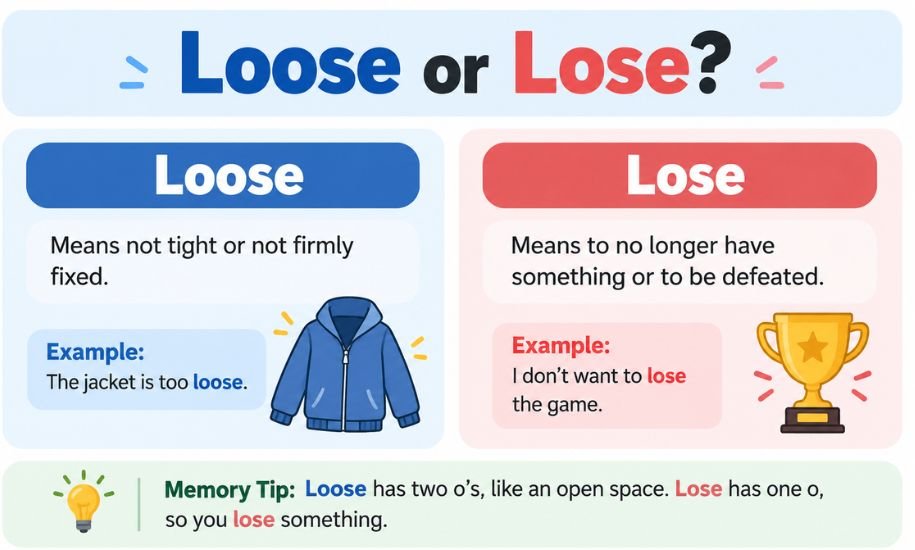
Loose and lose are both correct words, but they have different meanings. Loose usually means “not tight” or “not firmly fixed,” while lose means to misplace, fail to win, or no longer have something. For example, you lose weight, but you may wear loose clothing.
Loose or Lose: The Key Difference
The simplest way to distinguish these words is to look at what the sentence is trying to express.
Loose is most often an adjective. It describes something that is not tight, securely fastened, closely fitted, or firmly controlled.
Lose is a verb. It describes an action or situation in which you no longer have something, fail to win something, or experience a reduction.
| Word | Main role | Meaning | Example |
|---|---|---|---|
| loose | Adjective | Not tight, fixed, or secure | My jacket is loose. |
| lose | Verb | Misplace, fail to win, or no longer have | I might lose my keys. |
This distinction explains why loose weight is incorrect when you mean reducing body weight, while loose clothing is perfectly correct.
What Does “Loose” Mean?
Loose commonly describes something that is not tight or firmly attached.
For example:
- The handle is loose.
- He prefers loose shirts.
- There is a loose wire under the desk.
- Her ponytail became loose.
- The dog broke loose from its leash.
The word can describe physical objects, clothing, hair, connections, and even things that are not under control.
Loose in Different Contexts
A few common combinations make the meaning especially clear:
Loose clothing means clothing that does not fit tightly.
She wore a loose sweater on a cool evening.
Loose screw means a screw that is not firmly secured.
One of the screws is loose.
Loose hair means hair that is not tied or secured.
She wore her hair loose.
Loose ball refers to a ball that is not currently controlled by a player or team.
The defender quickly grabbed the loose ball.
So when the idea is “not tight” or “not securely held,” loose is generally the word you need.
What Does “Lose” Mean?
Lose is a verb with several common meanings.
One meaning is to no longer have something because you misplaced it:
I don’t want to lose my phone.
Another meaning is to fail to win:
Our team could lose the game.
It can also mean to experience a reduction:
She wants to lose weight.
Or it can mean to no longer have a particular feeling, quality, or state:
He began to lose interest in the project.
Other common expressions include:
- lose money
- lose time
- lose control
- lose hope
- lose confidence
- lose patience
- lose balance
- lose focus
The common idea is that something is gone, reduced, or no longer possessed or maintained.
Loose or Lose Weight?
The correct phrase is lose weight.
I am trying to lose weight.
Not:
I am trying to loose weight.
Here, lose is the verb because the sentence describes a reduction in body weight.
The word loose can appear in a sentence about clothing after weight loss, but it has a different function:
My old jeans are now loose.
In this example, loose describes how the jeans fit.
A useful comparison is:
lose weight = reduce your weight
loose clothes = clothes that are not tight
The extra o in loose does not belong in the expression lose weight.
Loose or Lose a Game?
The correct expression is lose a game.
We don’t want to lose the game.
Not:
We don’t want to loose the game.
Because lose is a verb meaning to fail to win.
The distinction becomes particularly interesting in sports because both words can appear in the same context:
The players tried to control the loose ball so they would not lose the game.
Here, loose describes the ball, while lose describes the result the players want to avoid.
Other examples include:
- The team could lose the match.
- Nobody wants to lose the final.
- The goalkeeper recovered the loose ball.
- The player nearly lost possession.
Loose or Lose Time?
The usual expression is lose time.
We cannot afford to lose time.
The delay caused us to lose valuable time.
Here, lose means to waste, miss, or no longer have available a period of time.
Loose time does not normally express this meaning.
Compare:
We lost time because the train was delayed.
with:
The loose cable caused the equipment to stop working.
The first sentence concerns time that was wasted or lost. The second uses loose to describe something that was not securely attached.
Loose or Lose Control?
The correct expression is lose control.
The driver began to lose control of the vehicle.
Try not to lose control of the situation.
The verb lose works here because the person is no longer maintaining control.
Loose is not a substitute for lose in this expression.
Other examples include:
- He felt that he was losing control of the situation.
- The manager did not want to lose control of the project.
- She nearly lost control of her emotions.
Loose vs. Lose Pronunciation
Pronunciation can help explain why these words are confused.
Although the two words are similar in appearance, their final sounds are different:
- loose is pronounced /luːs/
- lose is pronounced /luːz/
A simple approximation is:
loose → “looss”
lose → “looz”
The vowel sound is similar, but the ending changes from an /s/ sound to a /z/ sound.
This difference can be useful when learning to recognize the words in spoken English, although spelling and meaning are still the most reliable ways to choose the correct word when writing.
Loose and Lose Examples
Seeing the words side by side makes the distinction easier to remember.
Examples with “loose”
- The screw is loose.
- I prefer loose clothing in hot weather.
- The horse broke loose from the fence.
- Her hair was hanging loose around her shoulders.
- We found a loose button on the coat.
- The defender picked up the loose ball.
Examples with “lose”
- Don’t lose your keys.
- I don’t want to lose my wallet.
- Our team may lose the game.
- She hopes to lose weight gradually.
- We cannot lose any more time.
- He started to lose interest in the subject.
Correct vs. Incorrect Usage
Some mistakes are especially common because the words are so similar.
| Incorrect | Correct |
|---|---|
| I want to loose weight. | I want to lose weight. |
| We might loose the game. | We might lose the game. |
| Don’t loose your keys. | Don’t lose your keys. |
| He began to loose control. | He began to lose control. |
| We cannot loose time. | We cannot lose time. |
| The shirt is lose. | The shirt is loose. |
| The screw is lose. | The screw is loose. |
The pattern is simple: lose describes an action or change, while loose normally describes a condition.
Why Are These Words Confused?
The main reason is their similar spelling and pronunciation.
Both begin with lo-, contain the same basic vowel sound, and differ by only one letter. In fast typing, it is easy to add an extra o to lose, especially because loose is itself a correctly spelled English word.
Another source of confusion is that both words can occur in everyday expressions:
- lose weight
- loose clothes
- lose control
- loose wire
- lose a game
- loose ball
Because both forms are legitimate words, a spell-checker may not catch a substitution. If you type loose when you mean lose, the result may still look like a correctly spelled word even though the sentence is grammatically or semantically wrong.
An Easy Way to Remember
A practical memory trick is:
Loose has an extra “o” because there is extra space.
Think:
loose → extra o → not tight
And:
lose → one o → something is gone or not won
So:
- loose shirt → the shirt has extra room
- lose weight → your weight becomes less
- loose screw → the screw is not tight
- lose a game → you do not win
This is not a grammar rule, but it is a useful spelling association.
Loose, Lose, and Loosen
There is one more word worth knowing: loosen.
These three words have different functions:
- loose = not tight
- loosen = make something less tight
- lose = no longer have, misplace, fail to win, or reduce
Consider these sentences:
The knot is loose.
Please loosen the knot.
Don’t lose the rope.
The words look related, but they should not be substituted for one another.
Common Mistakes to Avoid
1. Writing “loose weight”
Use lose weight when referring to reducing body weight.
2. Writing “loose a game”
Use lose a game because losing is the opposite of winning.
3. Writing “loose your keys”
Use lose your keys when you mean you cannot find them.
4. Using “lose” for physical looseness
If something is not tight, use loose:
The bolt is loose.
Not:
The bolt is lose.
5. Forgetting that “loose” can describe clothing
These trousers are too loose.
Here, loose is correct because the trousers are not tight.
Quick Rule for Choosing the Right Word
When deciding between the two, ask what you mean.
If you mean not tight, not firmly attached, or having too much space, choose loose.
If you mean misplace, fail to win, no longer have, reduce, or waste, choose lose.
A quick test:
Is the object not tight? → loose
Is something gone, reduced, or not won? → lose
More examples
Loose:
The lid is loose.
He wore a loose shirt.
A loose wire was causing the problem.
Lose:
Don’t lose the receipt.
They could lose the match.
She doesn’t want to lose focus.
Frequently Asked Questions
Is “loose or lose” a spelling difference?
No. Both loose and lose are correctly spelled English words. The issue is choosing the word that matches the intended meaning. Loose usually describes something that is not tight or secure, while lose is a verb associated with misplacing, failing to win, or no longer having something.
Should I write “lose weight” or “loose weight”?
The correct phrase is lose weight. The verb lose means to experience a reduction in something, including body weight. Loose is used when describing something that is not tight, such as loose clothing.
Is it “lose a game” or “loose a game”?
The correct expression is lose a game. Lose is the verb used when someone fails to win a game, match, competition, or contest.
Is it “lose control” or “loose control”?
The correct expression is lose control. It means to stop having or maintaining control over something. For example: “The driver began to lose control of the car.”
How do you pronounce “loose” and “lose”?
Loose ends with an /s/ sound, while lose ends with a /z/ sound. They are commonly pronounced approximately like “looss” and “looz,” respectively.
What is an easy way to remember the difference?
Think of the extra o in loose as representing extra space. A loose shirt has extra room, while lose has one “o” and refers to something being gone, reduced, or not won.
The Bottom Line
Loose and lose are both correct words, but they perform different jobs. Use loose for something that is not tight, firmly attached, or secure. Use lose when something is misplaced, reduced, no longer possessed, or not won. Once you connect loose with “not tight” and lose with “something gone or reduced,” phrases such as lose weight, lose a game, lose control, and loose clothing become much easier to remember. For more clear explanations of commonly confused English words, Grammarifyr follows the same simple principle: Know the Difference. Use the Right Words.
You may also Read : Analysis or Analyses: Meaning and Usage