Colon or Semicolon: How to Know Which One to Use
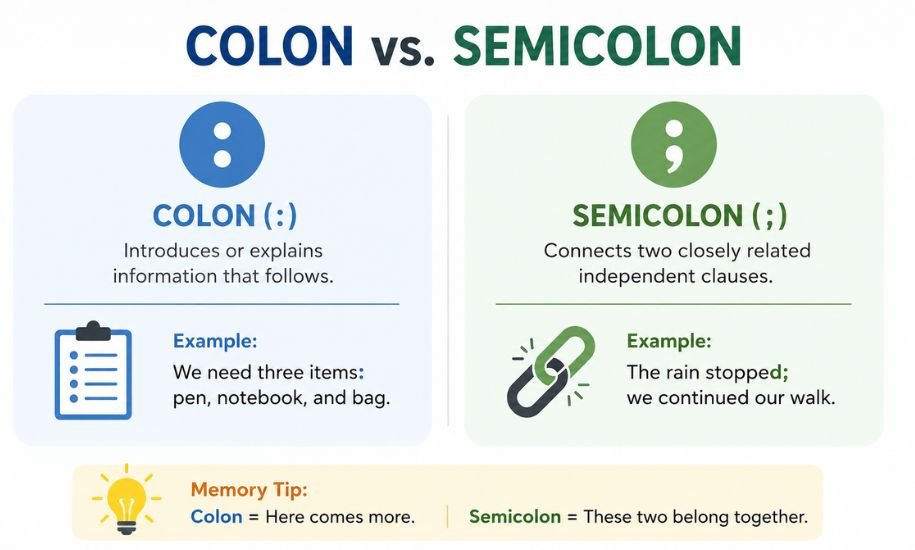
Choosing between a colon (:) and a semicolon (;) can feel confusing because both punctuation marks create a stronger pause than a comma. However, they do different jobs. A colon usually introduces or explains information that follows, while a semicolon generally connects two closely related independent clauses.
The easiest way to remember the distinction is this: a colon points forward, while a semicolon connects two complete thoughts. Once you understand that relationship, deciding when to use a colon or semicolon becomes much easier.
Use a colon (:) to introduce a list, explanation, example, quotation, or other information that expands on what comes before it. Use a semicolon (;) to connect two closely related independent clauses or to separate complicated list items that already contain commas.
Colon or Semicolon: What’s the Difference?
Both marks are correct punctuation, but they signal different relationships between ideas.
| Feature | Colon (:) | Semicolon (;) |
|---|---|---|
| Main purpose | Introduces or explains | Connects related thoughts |
| Can introduce a list? | Yes | No |
| Can introduce an explanation? | Yes | No |
| Can connect independent clauses? | Sometimes, when the second explains the first | Yes |
| Can separate complex list items? | No | Yes |
| Example | She brought three things: food, water, and a map. | She brought the map; I carried the food. |
A colon tells the reader that something important is about to follow. A semicolon tells the reader that the two parts on either side are closely connected but could function as separate sentences.
What Is a Colon?
A colon (:) is punctuation used to introduce information that explains, identifies, illustrates, or expands on the preceding statement.
For example:
Marcus had one goal: finish the project before Friday.
The words after the colon explain what Marcus’s goal was.
A colon is also frequently used before a list:
We need four supplies: paper, ink, envelopes, and stamps.
The phrase before the colon is complete: We need four supplies. The colon then introduces the specific supplies.
When to Use a Colon
A colon is especially useful in these situations.
1. Before a list
Use a colon when a complete thought introduces a list.
She packed everything she needed: a jacket, a flashlight, and a first-aid kit.
However, do not automatically place a colon before every list.
Incorrect:
She packed: a jacket, a flashlight, and a first-aid kit.
The words “She packed” do not form a complete statement that naturally calls for a colon.
Better:
She packed a jacket, a flashlight, and a first-aid kit.
Or:
She packed three essentials: a jacket, a flashlight, and a first-aid kit.
2. Before an explanation
A colon can introduce an explanation of the statement before it.
There was one problem: the keys were missing.
The second part explains what the problem was.
3. Before an example or elaboration
Some habits improve concentration: taking regular breaks can help you stay focused.
The information after the colon expands on the preceding idea.
4. Before a quotation
A colon can introduce a formal quotation when the words before it form a complete sentence.
The coach gave the team one final instruction: “Stay focused until the final whistle.”
For short, informal quotations, other punctuation may be more appropriate depending on the sentence and style.
5. In titles and subtitles
Colons commonly separate a title from a subtitle:
Better Writing: A Practical Guide to Grammar
This use is different from the sentence-level rules above, but the colon still signals that the second part adds information about the first.
What Is a Semicolon?
A semicolon (;) is used primarily to connect two independent clauses that are closely related.
An independent clause is a group of words that can stand alone as a complete sentence.
Consider:
The rain stopped; we continued our walk.
Both sides are complete:
- The rain stopped.
- We continued our walk.
A semicolon connects them while showing that the ideas belong together.
You could also write:
The rain stopped. We continued our walk.
The semicolon simply creates a closer connection between the two thoughts.
When to Use a Semicolon
There are three especially useful situations to remember.
1. Between closely related independent clauses
The store was closing; we hurried to the checkout.
I wanted to call her; it was already too late.
The experiment failed; the researchers started again.
In each example, both sides can stand as complete sentences.
2. Before words such as “however” and “therefore”
A semicolon is often used before a conjunctive adverb when it connects two independent clauses.
The instructions looked simple; however, the task was surprisingly difficult.
We had limited time; therefore, we chose the quickest route.
Notice the punctuation:
independent clause ; however, independent clause
The semicolon belongs before however, while a comma normally follows it.
3. Between complicated list items
Semicolons can separate items in a list when the items themselves contain commas.
For example:
The tour visited Austin, Texas; Denver, Colorado; and Portland, Oregon.
The semicolons make the individual locations easier to distinguish.
Without them, the commas inside the city-and-state combinations could make the list difficult to read.
When to Use a Colon or Semicolon
If you are unsure when to use a colon or semicolon, first look at the relationship between the two parts of your sentence.
Ask yourself:
Is the second part introducing, explaining, or expanding on the first?
If yes, a colon may be appropriate.
She had one concern: the deadline was approaching.
The second part explains the concern.
Now ask:
Are these two complete, closely related thoughts?
If yes, a semicolon may work.
The deadline was approaching; she worked late every evening.
The second part is another complete thought connected to the first.
This simple test is often more useful than trying to memorize a long list of punctuation rules.
Colon vs. Semicolon Examples
Seeing the two marks side by side makes the distinction clearer.
Colon: introduction or explanation
He had one request: please arrive on time.
The words after the colon explain the request.
There was only one option: start again.
The second part identifies the option.
She brought three things: water, snacks, and a blanket.
The colon introduces a list.
Semicolon: related complete thoughts
He wanted to arrive early; traffic made that difficult.
Both sides are independent clauses.
The restaurant was crowded; we decided to eat elsewhere.
Again, both parts could stand alone.
Compare the meaning
Consider these two sentences:
The road was dangerous: ice covered the entire surface.
Here, the second part explains why the road was dangerous.
Now compare:
The road was dangerous; the driver slowed down.
The second part presents a related action or thought rather than simply explaining the first.
That difference is the heart of the colon-versus-semicolon question.
Can a Colon Join Two Complete Sentences?
Yes, a colon can sometimes appear between two independent clauses, but the relationship needs to be appropriate.
The second clause should generally explain, illustrate, or follow logically from the first.
She knew exactly what she needed to do: she had to apologize.
The second part explains what she needed to do.
A semicolon would also be grammatically possible in some contexts, but it would present the two clauses more as closely related statements of equal grammatical status:
She knew exactly what she needed to do; she had to apologize.
The colon creates a stronger sense that the second part supplies the answer or explanation.
Common Mistakes With Colons and Semicolons
Mistake 1: Putting a colon after an incomplete introduction
Incorrect:
My favorite activities are: reading, hiking, and cooking.
Better:
My favorite activities are reading, hiking, and cooking.
Or:
I have three favorite activities: reading, hiking, and cooking.
The colon should not normally separate a verb from its complement.
Mistake 2: Using a semicolon before a dependent clause
Incorrect:
Because the weather was bad; we stayed inside.
“Because the weather was bad” cannot stand alone as a complete sentence, so a semicolon is inappropriate.
Correct:
Because the weather was bad, we stayed inside.
Mistake 3: Using a comma instead of a semicolon
Incorrect:
The meeting ended, everyone left.
This creates a comma splice because two independent clauses have been joined with only a comma.
Correct:
The meeting ended; everyone left.
Or:
The meeting ended, and everyone left.
Mistake 4: Using a semicolon to introduce an ordinary list
Incorrect:
I bought three fruits; apples, oranges, and bananas.
Correct:
I bought three fruits: apples, oranges, and bananas.
A colon introduces the list; a semicolon does not.
Mistake 5: Using a semicolon when a period would be clearer
A semicolon is useful, but it is not required whenever two sentences are related.
The presentation ended. Everyone thanked the speaker.
This is perfectly correct. A semicolon is an option when you want to emphasize the connection:
The presentation ended; everyone thanked the speaker.
Good punctuation is not about creating the longest possible sentence. It is about making the relationship between ideas clear.
Colon or Semicolon: An Easy Rule to Remember
Try this quick memory rule:
Colon = “Here comes more.”
Semicolon = “These two belong together.”
If the second part gives a list, explanation, example, answer, or elaboration, think colon.
I need one thing: your help.
If the second part is another complete thought closely connected to the first, think semicolon.
I need your help; the deadline is tomorrow.
Another useful test is to replace the punctuation with a period.
If both sides can independently form complete sentences, a semicolon may be possible. If the second part mainly explains or identifies the first, a colon is often the better choice.
Is It “Semicolon” or “Semi-Colon”?
The standard spelling is semicolon, written as one word.
Correct: semicolon
Less standard: semi-colon
You may occasionally encounter the hyphenated form in older or less consistent writing, but semicolon is the normal form to use in modern standard English.
The punctuation mark itself is written as ;.
Frequently Asked Questions
When do you use a colon or semicolon?
Use a colon when the material that follows introduces or explains what came before it. Use a semicolon when connecting two closely related independent clauses. Semicolons can also separate complicated list items containing internal commas.
Can a colon and semicolon be used in the same sentence?
Yes, but they usually perform different jobs. For example: “She had one goal: finish the report; her manager needed it by noon.” The colon introduces the goal, while the semicolon connects two related complete thoughts.
Is “semicolon” or “semi-colon” correct?
Semicolon is the standard modern spelling. The hyphenated form “semi-colon” can be found in some older or inconsistent usage, but it is generally better to use the single-word spelling.
Do you need a complete sentence before a colon?
In ordinary sentence construction, the material before a colon should generally be a complete independent clause. Avoid using a colon between a verb and its object, as in “She bought: apples and oranges.”
Can a semicolon introduce a list?
Not normally. A colon is the punctuation mark generally used to introduce a list. A semicolon is useful for separating individual items when the list is complicated and those items already contain commas.
How can I quickly remember the difference?
Think of a colon as saying “here is the explanation” or “here are the details.” Think of a semicolon as saying “these are two related complete thoughts.” That distinction will solve most everyday punctuation choices.
The Bottom Line
A colon (:) introduces information, while a semicolon (;) connects closely related complete thoughts. Use a colon for lists, explanations, examples, and similar additions; use a semicolon between independent clauses or to separate complex list items.
When deciding semicolon or colon, focus on the relationship between the ideas rather than the size of the pause. If the second part explains or expands on the first, reach for the colon. If both parts are complete and closely connected, a semicolon is usually the better choice. For more clear, practical guidance on confusing grammar choices, Grammarify helps you know the difference and use the right words.
You may also Read : Advise or Advice: What’s the Difference?