Wether or Whether: Meaning and Correct Usage
English has several words that sound alike but have completely different meanings, and whether and wether are a good example. The confusion is understandable because both are pronounced similarly, but they are not interchangeable. In everyday writing, the word you usually need is whether, especially when talking about a choice, possibility, or uncertainty. Wether is also a genuine English word, but it has a very specific meaning related to sheep. There is a third word, weather, that is often pulled into the same spelling mix-up.
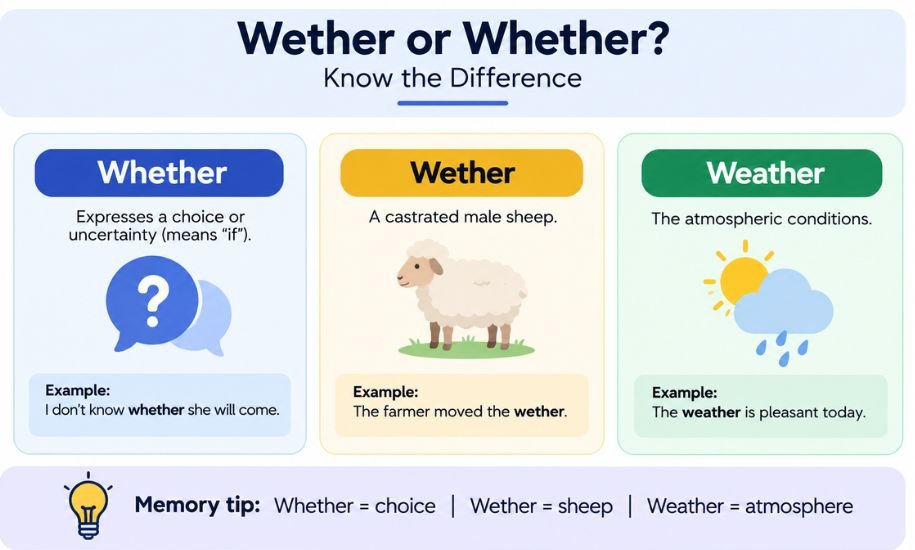
Whether is the correct word when you mean “if,” express a choice, or discuss two possibilities. Wether is a real but uncommon noun meaning a castrated male sheep. If you are talking about rain, sunshine, temperature, or other atmospheric conditions, the correct word is weather.
The Difference at a Glance
| Word | Meaning | Typical Use | Example |
|---|---|---|---|
| whether | A choice, possibility, or uncertainty | Grammar and everyday writing | I don’t know whether she’ll come. |
| wether | A castrated male sheep | Farming and animal-related contexts | The farmer moved the wether to another pen. |
| weather | Atmospheric conditions | Rain, wind, temperature, storms, etc. | The weather is pleasant today. |
The important point is that wether is not simply a misspelling of whether. It is a legitimate word, although most people rarely need it in ordinary conversation or writing.
What Does “Whether” Mean?
Whether is a conjunction used to introduce a choice, possibility, or indirect question. It is the word you need in expressions such as “whether or not” and “whether to.”
For example:
- I don’t know whether he is coming.
- She hasn’t decided whether to accept the offer.
- We need to determine whether the plan will work.
- Tell me whether you agree.
In many indirect questions, whether can be replaced by if:
I don’t know whether she is ready.
I don’t know if she is ready.
However, whether is particularly useful when presenting alternatives or before a to-infinitive:
We need to decide whether to stay or leave.
I can’t decide whether to buy it.
What Does “Wether” Mean?
Wether is a noun referring to a castrated male sheep. It is a correct English word, but it is relatively uncommon outside agricultural or animal-related contexts.
For example:
- The farmer bought three young wethers.
- The wether was kept with the rest of the flock.
- The shepherd separated the wethers from the breeding animals.
So if you are writing about sheep, wether may be exactly the right word. In almost every other context where you are expressing uncertainty or a choice, you probably mean whether.
Whether or Wether: Which Should You Use?
A simple test is to look at the meaning of your sentence.
If you could replace the word with “if,” you almost certainly need whether.
Correct:
I wonder whether they will arrive on time.
You could also say:
I wonder if they will arrive on time.
If you are referring to a particular kind of male sheep, use wether.
Correct:
The farmer inspected the wether before moving it.
This distinction also answers questions such as “is it whether or wether?” If the sentence concerns a decision, possibility, or uncertainty, choose whether.
Whether, Wether, or Weather?
The third word makes this trio more confusing.
Whether
Use whether for alternatives, uncertainty, or indirect questions.
I don’t know whether it will happen.
Wether
Use wether for a castrated male sheep.
The wether was grazing near the fence.
Weather
Use weather for conditions in the atmosphere.
The weather looks stormy.
You can even use two of these words in the same sentence:
We don’t know whether the weather will improve.
Here, whether introduces uncertainty, while weather refers to atmospheric conditions.
Whether or Not: How Do You Spell It?
The correct expression is:
whether or not
Not:
wether or not
And not:
weather or not
For example:
- I’ll go whether or not you come.
- We will continue whether or not it rains.
- She hasn’t decided whether or not to apply.
- Whether or not they agree, the project will proceed.
The expression means that the outcome remains the same regardless of which possibility is true.
If you are wondering how to spell “wether” as in whether or not, the answer is that the word in this phrase is actually spelled whether: W-H-E-T-H-E-R.
Common Mistakes With These Words
1. Using “wether” for uncertainty
Incorrect:
I don’t know wether she will come.
Correct:
I don’t know whether she will come.
2. Using “weather” in an indirect question
Incorrect:
I’m not sure weather he agreed.
Correct:
I’m not sure whether he agreed.
3. Confusing “whether” with “weather”
Incorrect:
The whether is getting colder.
Correct:
The weather is getting colder.
4. Misspelling “whether or not”
Incorrect:
Wether or not we win, we’ll try again.
Correct:
Whether or not we win, we’ll try again.
Whether vs. If
One reason whether can be confusing is that if often works in similar sentences.
Compare:
I don’t know whether he is coming.
I don’t know if he is coming.
Both are grammatical.
But before a to-infinitive, use whether:
I don’t know whether to go.
Not:
I don’t know if to go.
Whether is also the natural choice when explicitly presenting alternatives:
We need to decide whether to drive or take the train.
This makes whether especially useful in formal and careful writing.
An Easy Way to Remember the Difference
Use this three-word rule:
Whether = choice
Wether = sheep
Weather = atmosphere
You can think of whether as the word connected with a question or decision:
Whether to stay or leave?
Think of weather as something you experience outdoors:
Sunny weather, rainy weather, cold weather.
And reserve wether for the specific sheep-related meaning.
Examples in Sentences
Here are a few examples that show the differences naturally:
Whether
She hasn’t decided whether she wants to move.
We need to find out whether the store is open.
I can’t decide whether to call now or later.
Wether
The farmer moved the wether into a separate enclosure.
Several wethers were grazing in the field.
Weather
The weather changed suddenly.
Bad weather delayed the flight.
Whether + weather
We don’t know whether the weather will improve tomorrow.
This last example is particularly useful because it shows why the two spellings cannot be treated as interchangeable.
Frequently Asked Questions
Is “wether” a correct word?
Yes. Wether is a legitimate English noun meaning a castrated male sheep. It is uncommon in everyday writing, so if you are using it in a sentence about a choice or uncertainty, you probably mean whether.
Is it “whether or not” or “wether or not”?
The correct expression is whether or not. For example: “I will go whether or not you come.” Wether does not belong in this expression because it refers specifically to a sheep.
What is the difference between weather and whether?
Weather refers to atmospheric conditions such as rain, wind, heat, or snow. Whether introduces a choice, possibility, or uncertainty. For example, “The weather is cold” and “I don’t know whether he is coming.”
Can “whether” and “weather” appear in the same sentence?
Yes. For example: “We don’t know whether the weather will improve.” The first word expresses uncertainty, while the second refers to atmospheric conditions.
Is “whether” the same as “if”?
In many indirect questions, whether and if can both be used. However, whether is required in certain structures, including before a to-infinitive: “I don’t know whether to stay.” “I don’t know if to stay” is not standard English.
The Bottom Line
Use whether when you’re talking about a choice, possibility, or uncertainty; use wether only when referring to a castrated male sheep. If you’re describing rain, sunshine, temperature, or other atmospheric conditions, choose weather. Remembering “whether = choice, wether = sheep, weather = atmosphere” will help you choose the right word quickly. That kind of practical distinction is exactly what Grammarify aims to make easier: know the difference, then use the right word.
You may also Read : Engrained or Ingrained: Which Spelling Is Correct?