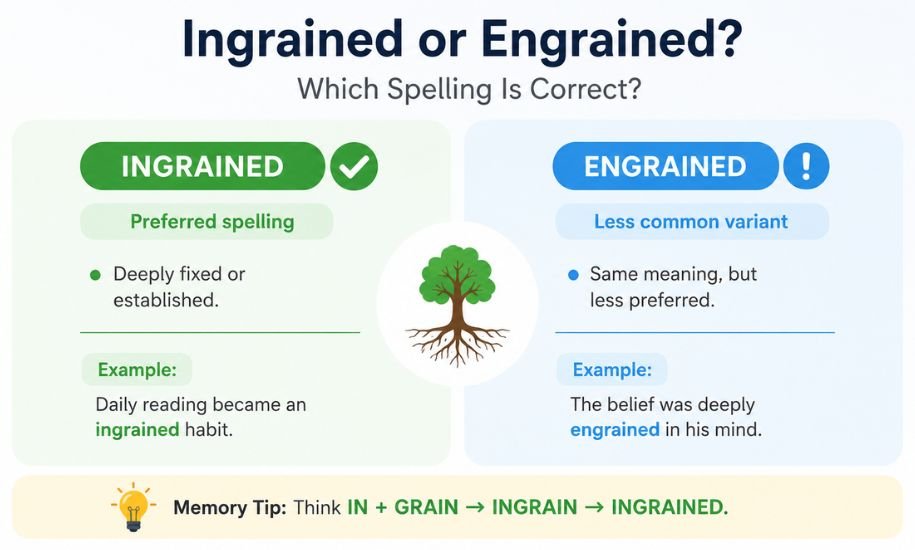
Engrained or Ingrained: Which Spelling Is Correct?
If you have ever hesitated between engrained and ingrained, you are not alone. The two forms look almost identical, sound the same, and are used to describe something deeply fixed or established. The good news is that the choice is straightforward for most modern writing: ingrained is the standard and preferred form. However, engrained is not simply a made-up spelling; major dictionaries recognize it as a less common variant. Understanding that distinction helps you choose the clearest form for everyday, academic, and professional writing.
Ingrained is the preferred spelling in modern English. Engrained is also recognized as a less common variant, so it is not simply an invented word. If you want the safest choice for formal or general writing, use ingrained.
Ingrained or Engrained: What’s the Difference?
The two forms have essentially the same meaning when they are used as adjectives. Ingrained is the form you will most often want.
| Feature | Ingrained | Engrained |
|---|---|---|
| Standard preferred form | Yes | Less common variant |
| Meaning | Deeply fixed or established | Same basic meaning |
| Part of speech | Adjective | Adjective |
| Common use | Habits, beliefs, attitudes, customs | Same contexts |
| Best choice for general writing | Yes | Usually avoid in favor of ingrained |
Merriam-Webster lists engrained as a “less common” variant of ingrained, while Collins also recognizes ingrained or engrained.
So the distinction is mainly one of preferred usage, rather than a simple correct-versus-nonexistent-word rule.
What Does “Ingrained” Mean?
Ingrained is an adjective meaning deeply fixed, established, or difficult to change. It can describe an idea, habit, belief, attitude, behavior, or characteristic that has become firmly established.
Collins describes ingrained habits and beliefs as difficult to change or remove, while Merriam-Webster defines the word in terms of something being deep-seated or worked into the grain or fiber.
Examples of “ingrained”
- Checking her phone became an ingrained habit.
- His respect for his teachers was deeply ingrained.
- The tradition is ingrained in the local culture.
- Years of practice had made the movement ingrained.
- Some attitudes can become so ingrained that changing them takes time.
The word is especially common with phrases such as deeply ingrained, ingrained habit, ingrained beliefs, ingrained attitudes, and ingrained culture.
Is “Engrained” a Real Word?
Yes. This is where many simple spelling explanations become misleading.
Engrained is a recognized variant of ingrained, although it is less common. Merriam-Webster explicitly lists engrained and engrain as less common spellings of ingrained and ingrain.
Collins likewise gives engrained as a variant of ingrained. Dictionary.com also identifies engrain as a variation of ingrain.
That means calling engrained an outright spelling error is too strong. It exists in English, but ingrained is the better default choice.
For example:
- Preferred: “The belief was deeply ingrained.”
- Variant: “The belief was deeply engrained.”
Both can be understood with the same meaning, but the first is the form you should normally choose.
Ingrain or Engrain: Which Verb Should You Use?
The same issue appears with the base verbs ingrain and engrain.
Ingrain means to establish something deeply or firmly in someone’s mind, nature, or character. Merriam-Webster lists engrain as a less common variant.
Examples
- Parents often try to ingrain good habits in their children.
- Repetition can ingrain a particular response.
- Years of training ingrained discipline into the team.
- Teachers can help ingrain effective study habits.
Engrain can be used as a variant, but ingrain is the safer and more widely preferred choice.
Collins also recognizes engrain as a variant of ingrain, particularly in British English.
Why Are These Spellings Confused?
The confusion is easy to understand because the forms differ by only one letter:
ingrain → ingrained
engrain → engrained
They also have the same pronunciation in ordinary use and overlap in meaning.
There is another interesting reason for the confusion: engrain is not merely a modern typing mistake. Dictionary.com notes historical connections between the forms and explains that ingrain ultimately relates to the idea of something being fixed deeply, much like a dye worked into fabric.
For modern writers, however, there is no need to worry about the historical distinction. When you mean something deeply established, ingrained is the straightforward choice.
Correct Usage Examples
Here are some natural examples showing how the preferred form works.
Habits
Daily exercise became an ingrained habit.
Beliefs
The belief was deeply ingrained from childhood.
Culture
Hospitality is ingrained in the community’s culture.
Behavior
Years of training had ingrained the proper technique.
Attitudes
Some workplace attitudes can become deeply ingrained over time.
A useful pattern to remember is:
deeply ingrained + belief/habit/attitude/value/tradition
For example:
“She has a deeply ingrained fear of failure.”
Common Mistakes to Avoid
1. Treating “engrained” as completely nonexistent
This is the biggest mistake. Dictionaries recognize engrained as a variant, although it is less common.
2. Using “engrain” when “ingrain” is the safer choice
If you are writing an essay, report, website, or professional document, ingrain is the better default.
3. Forgetting the adjective form
The adjective is:
ingrain → ingrained
For example:
“The behavior became deeply ingrained.”
Not:
“The behavior became deeply ingrain.”
4. Using “ingrained” for something that is merely familiar
Something being familiar does not necessarily make it ingrained. The word suggests that a habit, belief, or characteristic is firmly established or deeply rooted.
An Easy Way to Remember the Preferred Spelling
When you are unsure, remember:
IN + GRAIN → INGRAIN → INGRAINED
Think of something being worked into a material or deeply established in the mind. The spelling with in- is the standard form to reach for.
You do not need to remember a complicated rule. Simply use ingrained whenever you want the conventional modern spelling.
Which Form Should You Use in Formal Writing?
For formal writing, ingrained is the clear choice.
Use it in:
- academic essays
- business writing
- reports
- articles
- educational material
- professional correspondence
- general-purpose websites
This does not mean engrained is incomprehensible or necessarily ungrammatical. Rather, ingrained is the more established default, and choosing it avoids distracting readers who expect the standard form.
Frequently Asked Questions
Is “ingrained” or “engrained” correct?
Ingrained is the preferred modern spelling. Engrained is also recognized by major dictionaries as a less common variant. For most writing, especially formal writing, ingrained is the better choice.
Is “engrained” a misspelling?
Not necessarily. Dictionaries including Merriam-Webster and Collins recognize engrained as a variant of ingrained. However, it is less common, so writers generally benefit from using ingrained.
Is it “ingrain” or “engrain”?
Ingrain is the preferred verb. Engrain is a recognized variant, but it is less common. For standard general writing, choose ingrain.
What does “deeply ingrained” mean?
“Deeply ingrained” means firmly established and difficult to change or remove. It is commonly used for habits, beliefs, attitudes, values, and behaviors.
Can I use “engrained” in an essay?
You can encounter engrained in dictionaries and published English, but ingrained is the safer choice for an essay. Using the preferred form keeps your spelling conventional and avoids unnecessary questions about the variant.
The Bottom Line
Ingrained is the spelling to choose when you want the standard modern form. Engrained is a legitimate but less common variant, so it should not automatically be labeled a spelling error. The same preference applies to ingrain over engrain. For clear, polished writing, Grammarify recommends sticking with ingrained unless you have a specific reason to use the variant.
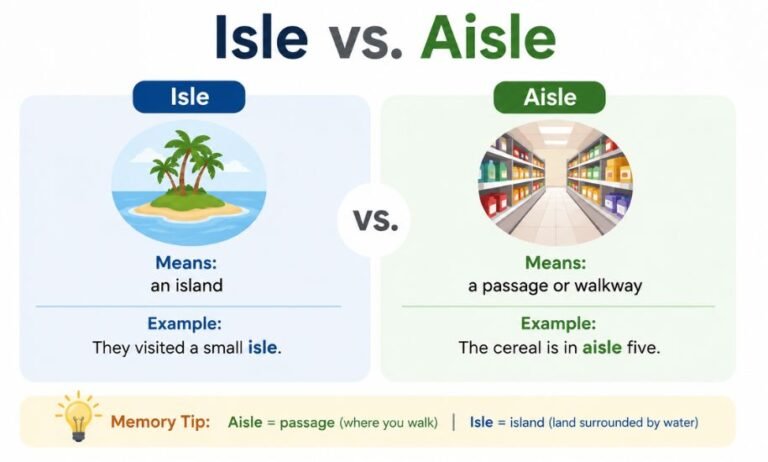
You may also Read : Isle or Aisle: Meaning, Spelling and Examples