Towards or Toward: Meaning, Difference and Examples
If you have ever paused over phrases such as “walk ___ the door” or “work ___ a solution,” you may have wondered whether toward or towards is the correct choice. The good news is that this is not a case of one being a spelling mistake. Both forms are standard English and generally have the same meaning. The difference is mainly regional: American English tends to favor toward, while British English commonly uses towards. Understanding that distinction makes it much easier to choose the form that fits your writing.
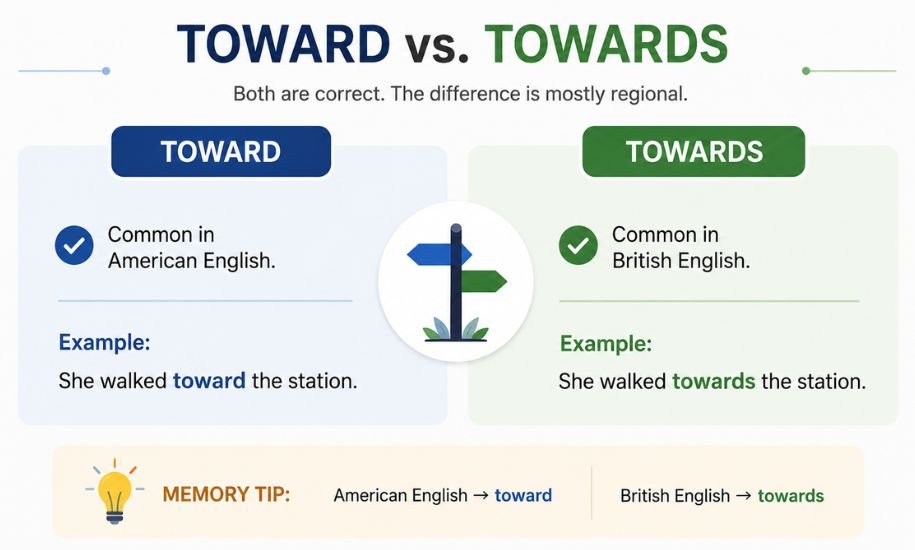
Toward and towards are both correct. They usually mean the same thing, such as “in the direction of” or “in relation to.” Toward is more common in American English, while towards is more common in British English and some other varieties.
Toward vs. Towards: The Key Difference
There is no major difference in meaning between these two forms. Both function primarily as prepositions and can describe direction, movement, a relationship, an approximate point in time or space, or progress toward a goal.
| Feature | Toward | Towards |
|---|---|---|
| Correct? | Yes | Yes |
| Part of speech | Usually a preposition | Usually a preposition |
| Basic meaning | In the direction of; in relation to | In the direction of; in relation to |
| Common preference | American English | British English |
| Example | She walked toward the station. | She walked towards the station. |
So, if you are asking “is it toward or towards?”, the answer is: either can be correct. Your choice should usually depend on the variety of English you are using and the style you want to maintain consistently.
What Does “Toward” Mean?
Toward means “in the direction of” or “in the direction of a particular goal or result.” It can also describe an attitude or relationship to someone or something.
Direction and movement
- The dog ran toward the gate.
- We drove toward the mountains.
- She took a few steps toward the window.
Progress toward a goal
- The team is working toward an agreement.
- He is saving money toward a new car.
- These changes are a step toward greater efficiency.
Attitude or relationship
- She has always been respectful toward her teachers.
- His attitude toward the proposal has changed.
In American English, toward is generally the preferred form in these constructions.
What Does “Towards” Mean?
Towards has essentially the same meanings as toward. It is particularly common in British English.
For example:
- The children ran towards the playground.
- We are moving towards a solution.
- She showed kindness towards her neighbors.
- They walked towards the back of the building.
None of these sentences changes meaning if towards is replaced with toward.
For example:
The train is moving toward London.
and
The train is moving towards London.
Both are grammatically acceptable.
American English vs. British English
The easiest practical rule is to consider your audience.
American English generally favors “toward.”
The company is moving toward its goal.
British English generally favors “towards.”
The company is moving towards its goal.
This is a preference rather than an absolute grammar rule. British writers can use toward, and American writers can encounter or use towards. Neither form should automatically be labeled incorrect simply because it is less common in a particular variety.
If you are writing for an American audience, toward will usually sound more natural. If you are following British English conventions, towards is often the better choice.
The most important thing is consistency. Avoid switching between the two without a reason.
When to Use Toward or Towards
There is no special grammatical situation where you must add the -s. Both forms can appear in the same types of sentences.
Consider these pairs:
Direction
- The cyclist headed toward the bridge.
- The cyclist headed towards the bridge.
Goals
- We are working toward a better future.
- We are working towards a better future.
Time
- It happened toward the end of the meeting.
- It happened towards the end of the meeting.
Attitude
- He was generous toward his employees.
- He was generous towards his employees.
The choice is therefore mainly one of regional usage and editorial preference.
Common Expressions With Both Forms
Some phrases appear frequently with either version. The meaning remains unchanged.
“Toward(s) the end”
Both toward the end and towards the end are correct.
- The weather improved toward the end of the week.
- The weather improved towards the end of the week.
“Work toward(s)”
Both forms work when describing progress toward an objective.
- We are working toward a solution.
- We are working towards a solution.
“Move toward(s)”
Both forms can describe physical or figurative movement.
- The negotiations moved toward an agreement.
- The negotiations moved towards an agreement.
“Go toward(s)”
Both are possible when describing movement or contribution.
- The money will go toward the project.
- The money will go towards the project.
Does Earnest Money Go Toward the Down Payment or Closing Costs?
This question combines the word-choice issue with a real-estate concept.
In a typical U.S. home purchase, earnest money is a deposit showing the buyer’s good-faith intention to purchase the property. If the transaction closes, the deposit is generally credited toward amounts due at closing. Depending on the purchase agreement and circumstances, it may be applied toward the down payment, closing costs, or other permitted costs.
From a grammar perspective, both constructions are correct:
The earnest money goes toward the down payment.
The earnest money goes towards the down payment.
For American English, toward is generally the more natural choice.
The exact financial treatment of earnest money depends on the contract and transaction, so the grammar of the sentence should not be confused with a universal real-estate rule.
Do Arteries Carry Blood Toward or Away From the Heart?
This is a different use of toward, but it provides a useful example of directional language.
Arteries carry blood away from the heart. Veins generally carry blood toward the heart.
A simple way to remember it is:
Arteries = away.
Veins = toward the heart.
The rule concerns the direction of blood flow relative to the heart, not whether the word should be spelled toward or towards.
Common Mistakes to Avoid
1. Calling “towards” incorrect
It is incorrect to assume that towards is simply a misspelling of toward. It is a standard English form, particularly common in British English.
2. Treating the two forms as different in meaning
In ordinary modern usage, adding -s does not create a substantially different meaning. The regional preference is much more important than any semantic distinction.
3. Mixing regional conventions unnecessarily
Using both forms in the same piece is not necessarily a grammar error, but consistent style usually looks cleaner. If your article follows American English, choosing toward throughout is sensible.
4. Assuming one form is always more formal
Neither toward nor towards is inherently more formal. Formality does not determine the choice; regional variety and editorial style generally do.
An Easy Way to Remember
Use this simple rule:
American English → toward
British English → towards
Think of the extra s as a common feature of the British form. This is only a preference guide, not a rule that makes the other form grammatically wrong.
If you are unsure and writing for a U.S. audience, toward is usually the safest choice.
Frequently Asked Questions
Is “toward” or “towards” correct?
Both are correct. Toward is generally preferred in American English, while towards is more common in British English. They normally have the same meaning and perform the same grammatical function.
Is “towards” grammatically correct in American English?
Yes. Although toward is generally more common in American English, towards is still an established and understandable English form. A writer should not treat it as a spelling error.
Is “toward” British or American?
Toward is especially common in American English, but it is not exclusively American. British English also uses it. Towards is generally more characteristic of British English.
Should I write “toward the end” or “towards the end”?
Both are correct. Choose according to your preferred variety of English. For American English, toward the end is generally the more natural choice; British English commonly uses towards the end.
Are “work toward” and “work towards” both correct?
Yes. Both mean to make progress in the direction of a goal or objective. American writing commonly uses work toward, while British writing often uses work towards.
Is “toward” a preposition?
Yes. Toward is primarily used as a preposition, as in “walk toward the door” or “work toward a solution.” Towards functions in the same way.
The Bottom Line
Toward and towards are both correct forms of the same word. The principal difference is regional preference: American English generally favors toward, while British English commonly favors towards. When choosing between them, consider your audience and keep your writing consistent. For more clear, practical explanations of confusing English forms, Grammarify helps you know the difference and use the right words.
You may also Read : Wether or Whether: Meaning and Correct Usage