Labeller or Labeler: US and UK Spelling Explained
If you have ever hesitated over the spelling of labeller or labeler, you are dealing with a genuine difference between varieties of English—not simply a right-versus-wrong spelling. Both forms are used to describe a person, device, or machine that applies labels. The main distinction is regional: labeler is the standard American English spelling, while labeller is the usual British English spelling.
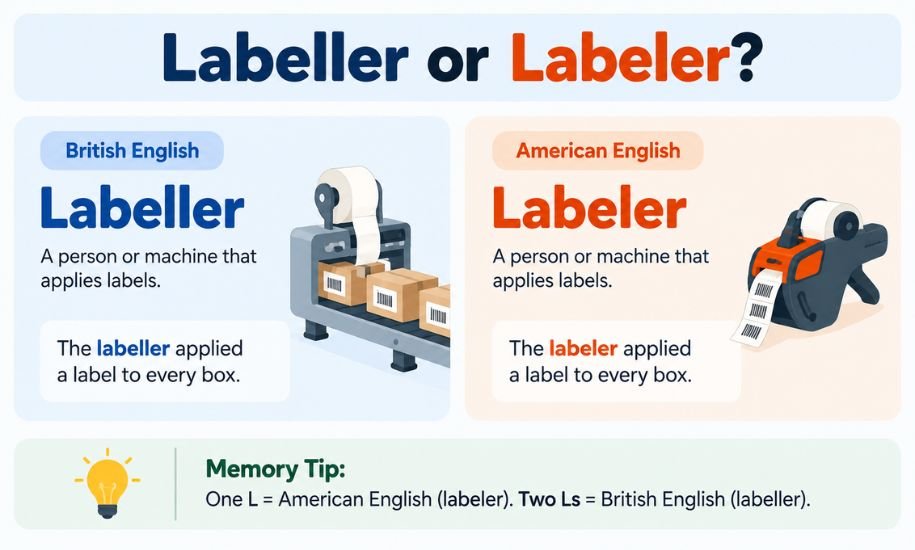
Both labeller and labeler are correct. Labeler is the usual American English spelling, while labeller is the British English form. They have the same meaning, so choose the spelling that matches the variety of English you are using.
Labeller vs Labeler: What’s the Difference?
The difference is primarily spelling, not meaning.
Both words are nouns formed from the verb label. They can describe someone who puts labels on objects or, depending on context, a device or machine that applies labels.
| Feature | Labeller | Labeler |
|---|---|---|
| Status | Correct | Correct |
| Main variety | British English | American English |
| Meaning | A person, device, or machine that labels something | A person, device, or machine that labels something |
| Related form | labelling | labeling |
| Past-tense form | labelled | labeled |
Collins lists labeler as the US spelling of labeller, confirming that the two forms have the same basic meaning.
So, if a British writer says, “The labeller needs repairing,” and an American writer says, “The labeler needs repairing,” they are talking about the same kind of thing.
What Does “Labeller” Mean?
Labeller is the spelling commonly used in British English. It can refer to a person who applies labels or to a piece of equipment that performs that task.
For example:
- The labeller applied a sticker to every package.
- The factory installed a new automatic labeller.
- She works as a product labeller.
- The bottle labeller stopped working during the afternoon shift.
The word can therefore be used in both human and mechanical contexts. A labeller machine is typically equipment designed to apply labels to products or containers.
The spelling fits the wider British pattern seen in related forms such as labelling and labelled.
What Does “Labeler” Mean?
Labeler has the same meaning but is the standard American English spelling.
It may describe a person who labels objects or a device that automatically applies labels.
Examples include:
- The labeler checked each package before shipment.
- The factory purchased an automatic labeler.
- The warehouse uses a handheld labeler for its boxes.
- The new machine works as both a printer and a labeler.
Dictionaries recognize the word as an English noun. Wiktionary defines labeler as a person or device that produces or affixes labels and gives labeller as an alternative form.
When Should You Use “Labeller”?
Choose labeller when you are writing in British English or following a British-style spelling system.
For example:
The manufacturer replaced the old labeller with a faster model.
This spelling is especially natural in UK-focused writing, where other related forms also tend to retain the double l:
- labeller
- labelling
- labelled
- relabelling
- relabelled
If the rest of your document follows British spelling, labeller will usually be the more consistent choice.
When Should You Use “Labeler”?
Use labeler when writing in American English.
For example:
The company bought a new labeler for its packaging line.
American English generally uses the single l in the related forms:
- labeler
- labeling
- labeled
- relabeling
- relabeled
The choice is therefore not about changing the meaning. It is about maintaining a consistent regional spelling system.
Labeler Machine and Labeller Machine
The word also appears frequently when talking about packaging equipment.
A labeler machine is a machine that applies labels to products, containers, packages, or other items. In British English, the same equipment may be called a labeller machine.
For example:
American English:
The factory purchased an automatic labeler machine.
British English:
The factory purchased an automatic labeller machine.
The terminology used by manufacturers can vary, so you may encounter both spellings in technical and commercial material.
The important point is that the additional l does not indicate a different type of machine. The distinction remains primarily regional.
Why Are the Words Spelled Differently?
The difference comes from broader spelling conventions used in American and British English.
The base word is label. When an ending such as -er, -ing, or -ed is added, British English commonly retains or doubles the final l in forms such as:
- label → labeller
- label → labelling
- label → labelled
American English generally uses:
- label → labeler
- label → labeling
- label → labeled
This is similar to other spelling differences involving words ending in l. For example, British English commonly uses traveller, travelling, and travelled, while American English generally uses traveler, traveling, and traveled.
The exact spelling conventions vary across words, so it is better to learn established forms rather than assume that every word ending in l follows exactly the same rule.
Labeller or Labeler: Examples in Sentences
Seeing the two spellings side by side makes the difference easier to understand.
British English
The labeller applies labels to each bottle automatically.
We need to replace the damaged labeller before production begins.
The packaging team tested the new labeller yesterday.
American English
The labeler applies labels to each bottle automatically.
We need to replace the damaged labeler before production begins.
The packaging team tested the new labeler yesterday.
Notice that the meaning and sentence structure remain unchanged. Only the regional spelling differs.
Labelling vs Labeling
The same regional distinction appears in the related -ing form.
British English:
The machine is labelling the boxes.
American English:
The machine is labeling the boxes.
Both forms are correct in their respective varieties.
Collins shows the broader difference in the verb label: British English uses forms such as labelling and labelled, while the US forms are labeling and labeled.
This gives you a useful pattern:
| British English | American English |
|---|---|
| labeller | labeler |
| labelling | labeling |
| labelled | labeled |
| relabelling | relabeling |
| relabelled | relabeled |
If you choose labeller, it generally makes sense to use labelling and labelled elsewhere in the same piece of writing. If you choose labeler, keep the corresponding American forms.
Is One Spelling More Correct?
No. Neither spelling is universally more correct.
The appropriate choice depends on the variety of English being used.
If you are writing for a US audience, labeler is the natural choice. If you are writing in British English, labeller is the conventional choice. Collins explicitly identifies labeler as the US spelling of labeller.
A spell checker may therefore flag one version even though it is perfectly valid. This often happens because the software is configured for a particular regional variety.
For example, a document set to American English may prefer labeler, while a British English dictionary may prefer labeller.
The important thing is to use your chosen spelling consistently.
Common Mistakes to Avoid
1. Treating “labeller” as a misspelling
If you normally use American English, you may be more familiar with labeler. However, labeller is not simply a spelling mistake. It is the established British form.
2. Treating “labeler” as universally wrong
The reverse mistake is also common. Labeler is a standard American English spelling, so it should not be marked as incorrect simply because a British style guide prefers labeller.
3. Mixing regional forms
Avoid switching unnecessarily between:
The labeller is labeling the products.
If you are writing in British English, use:
The labeller is labelling the products.
For American English:
The labeler is labeling the products.
4. Assuming the two words have different meanings
The extra l does not create a different definition. Both forms can refer to a person or a machine that applies labels.
5. Assuming a “labeler machine” is a different device
A labeler and labeller can refer to the same kind of labeling equipment. The spelling generally reflects the regional variety of English rather than the machine’s function.
An Easy Way to Remember the Difference
A simple memory rule is:
One L = American English
Two Ls = British English
So:
- US: labeler
- UK: labeller
The same basic distinction appears in:
- US: labeling
- UK: labelling
and:
- US: labeled
- UK: labelled
This is not an absolute rule for every English word ending in l, but it is a useful way to remember these particular forms.
Which Spelling Should You Choose?
Think about your intended audience and the spelling style used throughout your writing.
If your website, publication, or document follows American English, choose labeler.
If it follows British English, choose labeller.
If you are writing for an international audience, either form can work. The best approach is to select one regional style and use it consistently rather than switching between American and British spellings.
For example, a British-focused article might consistently use:
labeller, labelling, labelled
An American-focused article might consistently use:
labeler, labeling, labeled
Consistency makes your writing clearer and avoids the impression that the spelling has changed accidentally.
Frequently Asked Questions
Is labeller or labeler correct?
Both are correct. Labeller is the usual British English spelling, while labeler is the standard American English spelling. They have the same basic meaning: a person, device, or machine that applies or produces labels.
Is “labeler” British or American?
Labeler is the American English spelling. British English generally uses labeller. Collins specifically identifies labeler as the US spelling of labeller.
What does labeller mean?
A labeller is a person, device, or machine that applies labels to things. The spelling is particularly associated with British English. For example: “The factory installed a new automatic labeller.”
What is a labeler machine?
A labeler machine is equipment used to apply labels to products, packages, containers, or other objects. In British English, the same type of equipment may be called a labeller machine.
Are labelling and labeling both correct?
Yes. Labelling is the British spelling, while labeling is the American spelling. The same regional distinction occurs with labelled and labeled.
How can I remember the spelling?
Remember the simple pair: labeler = US and labeller = UK. Then match the related forms: American labeling/labeled, British labelling/labelled.
The Bottom Line
Labeller and labeler are both correct spellings. Use labeler when following American English and labeller when following British English. The words have the same meaning, and the same regional pattern appears in forms such as labeling/labelling and labeled/labelled. For clear, consistent English, choose the form that matches your audience and keep that spelling throughout your writing. That practical approach is exactly what Grammarifyr aims to make easier: knowing the difference and using the right words.
You may also Read : Treck or Trek: Meaning and Correct Usage