Persuing or Pursuing: Correct Spelling Explained
If you have ever hesitated over persuing or pursuing, you are not alone. The two forms look very similar, but only one is the standard English spelling. The confusion usually comes from the pronunciation and the spelling of the verb pursue, especially when the ending -ing is added. The correct form is pursuing, while persuing is a misspelling. Once you know the correct base word and how its spelling changes, this becomes much easier to remember.
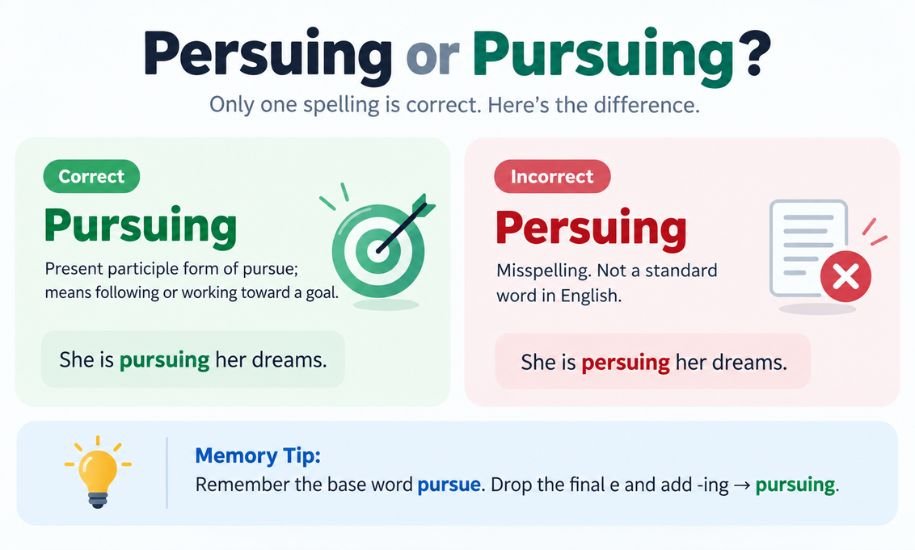
Pursuing is the correct spelling. Persuing is a misspelling and should not be used in standard English. The correct base verb is pursue, so its -ing form is pursuing.
Persuing or Pursuing: The Correct Form
The correct spelling is pursuing.
Persuing is not an alternative spelling and is not the British or American version of the word. It is simply a spelling error.
| Form | Correct? | Explanation |
|---|---|---|
| pursue | ✅ Yes | Base form of the verb |
| persue | ❌ No | Misspelling of pursue |
| pursuing | ✅ Yes | -ing form of pursue |
| persuing | ❌ No | Misspelling of pursuing |
| pursued | ✅ Yes | Past tense and past participle |
| pursues | ✅ Yes | Third-person singular form |
So, if you are writing a sentence such as “She is pursuing her goals,” pursuing is the form you need.
What Does “Pursue” Mean?
Pursue is a verb with several related meanings. It can mean to follow or chase someone or something, but it is also frequently used when talking about goals, ambitions, careers, interests, or plans.
For example:
- The police continued to pursue the vehicle.
- Maria decided to pursue a career in medicine.
- He wants to pursue his interest in photography.
- The company plans to pursue new opportunities.
In many everyday contexts, pursue means to work toward achieving or obtaining something.
Examples of “Pursue” in a Sentence
She decided to pursue her dream of becoming a pilot.
He is determined to pursue a career in engineering.
The organization will pursue several new projects next year.
They chose not to pursue the matter any further.
The verb can therefore describe either physical pursuit or the effort to achieve a particular goal.
What Does “Pursuing” Mean?
Pursuing is the present participle and gerund form of pursue.
It is used when the action is happening or when pursue functions as a noun-like activity.
For example:
- She is pursuing a master’s degree.
- He is pursuing a new career.
- They are pursuing several possible solutions.
- Pursuing your interests can lead to new opportunities.
The spelling is formed from pursue by changing the final -e before adding -ing:
pursue → pursuing
This is why the spelling is not persuing.
Why Is “Persuing” Incorrect?
Persuing results from changing the spelling of the base word incorrectly.
The correct verb contains purs-:
p-u-r-s-u-e
When it becomes an -ing form:
p-u-r-s-u-i-n-g
Therefore:
pursue → pursuing
not:
persue → persuing
The incorrect form can seem natural because the pronunciation does not make every letter obvious. Someone who has heard the word but has not seen it written may reasonably spell it incorrectly.
However, persuing is not an accepted standard spelling.
Persue or Pursue: Which One Is Correct?
When choosing between persue and pursue, always use pursue.
Correct
She hopes to pursue a career in journalism.
Incorrect
She hopes to persue a career in journalism.
The same rule applies to related forms:
- pursue — correct
- pursues — correct
- pursued — correct
- pursuing — correct
- persue — incorrect
- persues — incorrect
- persued — incorrect
- persuing — incorrect
Learning the base spelling pursue makes the other forms much easier to recognize.
Pursue or Persue: How Should You Use It?
The reversed comparison—pursue or persue—has the same answer: pursue is correct.
Use pursue when you mean to:
- chase or follow something;
- try to achieve a goal;
- seek an opportunity;
- continue a course of action;
- develop an interest or career.
Consider these examples:
The athlete is pursuing a place on the national team.
She decided to pursue further education.
The detectives pursued several leads.
He wants to pursue his passion for music.
None of these sentences should use persue or persuing.
Pursuing or Persuing in a Sentence
A simple way to check your writing is to replace the -ing form with the base verb.
For example:
She is pursuing a degree in law.
Remove -ing and you get:
She wants to pursue a degree in law.
Because pursue is the correct verb, pursuing is the correct -ing form.
Compare that with the incorrect version:
❌ She is persuing a degree in law.
There is no standard English verb persue that could produce persuing. That makes the spelling easy to rule out.
Common Examples of the Correct Spelling
Here are several natural examples using pursuing:
- She is pursuing a career in environmental science.
- He spent years pursuing his professional goals.
- The company is pursuing a different strategy.
- They are pursuing new opportunities overseas.
- She continued pursuing her interest in classical music.
- The researchers are pursuing several possible explanations.
Notice that the word remains pursuing regardless of the subject or context.
Common Mistakes to Avoid
1. Writing “persuing”
❌ He is persuing his education.
✅ He is pursuing his education.
The first version contains the common spelling error.
2. Writing “persue”
❌ She wants to persue a new career.
✅ She wants to pursue a new career.
Remember that the base verb contains urs, not ers.
3. Assuming it is a regional spelling
Persuing is not an American-versus-British spelling difference. Standard English uses pursuing in both varieties.
For example, both American and British English use:
She is pursuing a degree.
The difference is therefore not regional.
4. Changing the spelling of the wrong base word
If you remember persue as the base verb, it is easy to create persuing. The better approach is to memorize the correct base form first:
pursue → pursuing
An Easy Way to Remember “Pursuing”
A useful memory trick is to remember the word in two steps:
PURSU(E) → PURSUING
Keep the PURSU- sequence in your mind.
You can also connect the word to familiar forms:
- pursue
- pursues
- pursued
- pursuing
They all begin with purs-.
If you see pers-, check the spelling carefully. In this word family, the standard forms begin with purs-.
Is “Persuing” Ever Correct?
In standard modern English, persuing should not be used as the spelling of the verb meaning “following,” “seeking,” or “working toward.”
If you are writing an essay, email, article, application, report, or other formal text, use pursuing.
Likewise, use pursue rather than persue when you need the base form.
Related Forms of “Pursue”
Understanding the complete word family can help prevent future mistakes.
| Grammatical form | Example |
|---|---|
| pursue | I want to pursue my goal. |
| pursues | She pursues every opportunity. |
| pursued | He pursued a different career. |
| pursuing | They are pursuing new options. |
The spelling persue/persuing does not belong in this standard verb family.
Frequently Asked Questions
Is “persuing” a word?
Persuing is not the standard spelling of the verb pursue. When you mean “following,” “seeking,” or “working toward,” the correct -ing form is pursuing.
Is it “persue” or “pursue”?
Pursue is correct. Persue is a misspelling. For example, write “She wants to pursue a career in teaching,” not “She wants to persue a career in teaching.”
Is “pursuing” the correct spelling?
Yes. Pursuing is the correct present participle and gerund form of pursue. For example: “He is pursuing a degree in business.”
Is “persuing” British English?
No. Persuing is not simply the British spelling of pursuing. Standard British and American English both use pursuing.
Why is “pursuing” spelled with “su”?
The word comes from the verb pursue, which is spelled p-u-r-s-u-e. When the -ing ending is added, the final e is dropped: pursue → pursuing.
How can I remember the correct spelling?
Remember the base word pursue first. Then think of the spelling pattern pursue → pursuing. The beginning remains purs-, which helps distinguish it from the incorrect persuing.
Final Verdict: Persuing or Pursuing?
Pursuing is the correct spelling, while persuing is a misspelling. The same distinction applies to pursue and persue: use pursue in standard English. Remembering the correct word family—pursue, pursues, pursued, pursuing—makes the spelling much easier to get right. Grammarifyr helps make these small but important English distinctions clearer, so you can choose the right word with confidence.
You may also Read : Tased or Tazed? Correct Spelling Explained