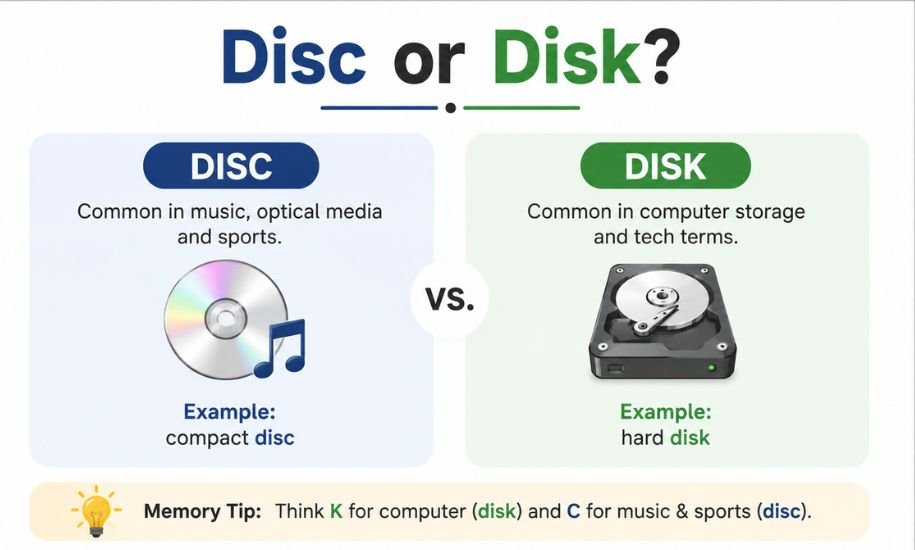
Disc or Disk? How to Use Each Spelling Correctly
“Disc” and “disk” are both correct English words, which is why choosing between them can feel surprisingly difficult. They generally describe something round and flat, but established usage determines which spelling sounds right in a particular expression. For example, we normally write hard disk for computer storage but compact disc for a CD. In American English, “disk” is especially common in computing and when referring to spinal structures, while “disc” is strongly established in terms such as “disc golf” and “compact disc.”
Both disc and disk are correct spellings. “Disk” is commonly preferred for computer storage, such as hard disk and floppy disk, while “disc” is standard in expressions such as compact disc and disc golf. For some other meanings, including spinal anatomy, either spelling can occur, although one may be preferred in a particular variety of English.
Disc vs. Disk: The Key Difference
The two words are variants, not two completely different words. Both can refer to a thin, flat, roughly circular object. Dictionaries list them as alternative spellings, but particular fields have developed their own preferences.
| Context | Preferred/common spelling | Example |
|---|---|---|
| Computer storage | disk | hard disk |
| Magnetic storage | disk | magnetic disk |
| Floppy storage | disk | floppy disk |
| CDs and music | disc | compact disc |
| Disc golf | disc | golf disc |
| Spinal anatomy | disk or disc | herniated disk/disc |
| General circular object | disk or disc | a flat disk/disc |
| Astronomy | Often disk | solar disk |
The important point is that there is no universal rule saying one spelling is correct and the other is wrong. Established terminology matters more than simply counting letters.
When Should You Use “Disk”?
Disk is particularly common in American English and in technical terms related to computer storage.
Common expressions include:
- hard disk
- hard disk drive
- disk drive
- disk space
- disk storage
- floppy disk
- magnetic disk
- disk partition
For example:
My computer’s hard disk is nearly full.
The technician replaced the damaged disk drive.
I need more disk space for these files.
This convention became firmly established as computer technology developed. Merriam-Webster specifically identifies computer-related terms such as floppy disk as an area where “disk” is preferred.
What about optical storage?
This is where things become less predictable. Optical disc and compact disc are widely established, even though they are also forms of computer or digital storage.
So you would normally write:
The files are stored on an optical disc.
rather than automatically changing every storage-related term to “disk.”
When Should You Use “Disc”?
Disc is especially common in music, optical media, and flying-disc sports.
Some familiar expressions are:
- compact disc
- optical disc
- disc golf
- disc jockey
- music disc
- brake disc
For example:
I found an old compact disc in the attic.
She plays disc golf on weekends.
The car needs a new brake disc.
The spelling disc has a long-established association with physical music media. Merriam-Webster notes that the recording industry favored “disc,” including in terms such as “disc jockey,” while computer storage developed a strong preference for “disk.”
What About “Herniated Disk” or “Herniated Disc”?
Both herniated disk and herniated disc are used. The difference is largely one of spelling preference and regional or professional usage, not a difference in the medical condition.
In American English, herniated disk is very common:
The doctor diagnosed a herniated disk.
You may also encounter herniated disc, particularly in British English and other varieties of English:
The scan showed a herniated disc.
Dictionary.com lists slipped disk and herniated disk among the contexts where “disk” is usually used, while Merriam-Webster’s medical entry recognizes “disc” and “disk” as variants for anatomical structures, including the intervertebral structure.
So if you’re wondering about disc or disk spine, neither spelling represents a different part of the spine. They are variant forms.
Spinal examples
Both of these can be found in English:
- herniated disk
- herniated disc
- spinal disk
- spinal disc
- intervertebral disk
- intervertebral disc
- slipped disk
- slipped disc
For a US-focused publication, herniated disk is a natural choice. If you’re writing for a British audience, herniated disc may fit the local convention better.
Is It “Disc” or “Disk” in American English?
American English does not use “disk” exclusively.
It strongly favors disk in computer terminology:
hard disk
floppy disk
disk drive
disk space
But American English also has firmly established expressions with disc:
compact disc
disc golf
disc jockey
That means the simple rule “disk is American, disc is British” is misleading. Both spellings are used in American English; the preferred form often depends on the particular expression.
Is “Disc” or “Disk” British English?
British English traditionally uses disc more broadly, including for many general and anatomical meanings.
For example, a British writer may naturally use:
a spinal disc
a herniated disc
the disc of the Sun
However, disk is not an impossible spelling in British English. It is also used in specialized terminology, particularly computing. Dictionary.com, for example, identifies “disk” as a US/Canadian spelling variant of “disc” in its general entry while separately recognizing the computing term in British usage.
The best approach is therefore to follow the established spelling for the term and remain consistent with your chosen variety of English.
How Do You Spell It in Common Expressions?
If you’re unsure which form to choose, the expression itself is often the best guide.
Use “disk”
Hard disk
The laptop has a 1 TB hard disk.
Floppy disk
I found an old floppy disk in a drawer.
Disk space
The application requires 10 GB of disk space.
Disk drive
The computer cannot detect the disk drive.
Use “disc”
Compact disc
The album was released on compact disc.
Disc golf
They played disc golf at the park.
Disc jockey
The disc jockey played music throughout the evening.
Optical disc
The archive was transferred to an optical disc.
These are conventions rather than absolute spelling laws. Dictionaries explicitly recognize overlap between the two forms.
Why Are the Words So Easily Confused?
The confusion is understandable because the words have the same pronunciation and essentially the same core meaning. They also share the same historical origin.
The distinction became more noticeable as specialized vocabulary developed. Computing settled heavily on disk, while music and optical media retained disc in many established terms. Other fields developed their own preferences.
This is why trying to remember one universal rule can actually make things harder. It is usually more useful to remember familiar combinations such as hard disk, floppy disk, compact disc, and disc golf.
Common Mistakes to Avoid
1. Assuming “disc” is wrong
It isn’t. “Disc” is a standard English spelling and is preferred in many established expressions.
2. Assuming “disk” is wrong
It isn’t either. “Disk” is the normal spelling in many computer-related terms.
3. Treating American and British usage as a perfect split
The distinction is more complicated than “disk = American” and “disc = British.” Established terminology can override broad regional tendencies.
4. Writing “hard disc” when you mean standard computer terminology
Although “hard disc” may be understandable and can be encountered, hard disk is the standard choice in modern American computer terminology.
5. Assuming “herniated disk” and “herniated disc” describe different conditions
They don’t. They are spelling variants referring to the same anatomical structure and condition.
An Easy Way to Remember
A practical memory trick is:
K = computer
Think of:
- hard disk
- floppy disk
- disk drive
- disk space
For C, remember familiar music and sports terms:
- compact disc
- disc jockey
- disc golf
This is not a universal grammar rule, but it works well for many everyday expressions.
Disc or Disk: Examples in Sentences
Here are some natural examples that show the difference:
Computer storage
The old hard disk contains several years of photographs.
Music
I still have the compact disc that I bought years ago.
Sports
He threw the disc toward the basket.
Spinal anatomy
The MRI showed a herniated disk.
British-style medical usage
The specialist explained that the damaged disc was pressing on a nerve.
Astronomy
The telescope captured a detailed image of the solar disk.
Notice that the choice changes according to context rather than following a single spelling rule.
Frequently Asked Questions
Is “disc” or “disk” correct?
Both are correct. They are variant spellings of the same basic word. The preferred form depends on context: disk is especially common in computer terminology, while disc is established in expressions such as compact disc and disc golf.
Is it “hard disk” or “hard disc”?
Hard disk is the standard form in modern American computer terminology. “Hard disc” can be understood and may occur in some varieties or contexts, but “hard disk” is the safer choice for general US English.
Is it “compact disc” or “compact disk”?
Compact disc is the established term for a CD. “Compact disk” can occur as a variant, but compact disc is the conventional spelling associated with the format.
Is it “herniated disk” or “herniated disc”?
Both forms are correct. Herniated disk is particularly common in American English, while herniated disc is also widely used, especially in British English and other varieties.
Is “disc” just the British spelling of “disk”?
Not exactly. British English does use disc more broadly, but American English also uses “disc” in established expressions such as compact disc and disc golf. Similarly, “disk” is used in British computing terminology.
What is the plural of “disc” and “disk”?
The usual plurals are discs and disks, respectively. Both forms are recognized in dictionaries.
The Bottom Line
There is no single winner between disc and disk. Both are legitimate spellings, but certain expressions strongly favor one form. Use disk for familiar computer terms such as hard disk and disk drive, and disc for established expressions such as compact disc and disc golf. For spinal terminology, either form can be correct, with regional preferences influencing the choice. When you’re unsure, Grammarifyr guiding principle is simple: know the established expression, then use the spelling that fits it.
You may also Read : Transferred or Transfered: Correct Spelling Explained