Icicle or Icycle: Spelling, Meaning and Examples
English spelling can sometimes be confusing when a word does not look exactly the way it sounds. Icicle and icycle are a good example. The second form may seem plausible because of the way the word is pronounced, but standard English uses only one spelling for the familiar pointed piece of ice that hangs from a roof, branch, or other surface.
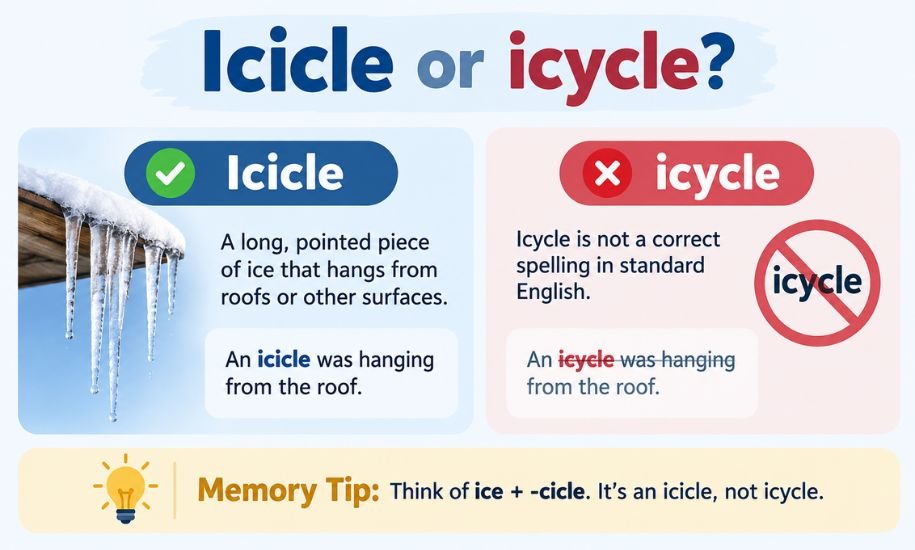
The answer is straightforward: icicle is the correct standard spelling. “Icycle” is normally a misspelling and should be avoided in formal, academic, professional, and everyday writing. Dictionaries such as Cambridge, Oxford, and Collins all list icicle as the standard noun.
Icicle is the correct spelling. It means a pointed or tapering piece of ice formed when dripping or falling water freezes. Icycle is generally a misspelling, not an alternative spelling of the word.
Icicle or Icycle: What’s the Difference?
The main difference is simply standard spelling versus a spelling error.
| Feature | Icicle | Icycle |
|---|---|---|
| Standard English word? | Yes | No, for this meaning |
| Meaning | A hanging, pointed piece of ice | — |
| Part of speech | Noun | — |
| Plural | Icicles | — |
| Pronunciation | /ˈaɪ.sɪ.kəl/ | Not a standard separate word |
| Example | An icicle hung from the roof. | Incorrect: An icycle hung from the roof. |
Cambridge defines icicle as a long pointed stick of ice formed when drops of water freeze. Oxford describes it as a pointed piece of ice formed when water freezes as it falls from something such as a roof.
So if you are describing frozen water hanging from a building or another surface, write icicle, not icycle.
What Does “Icicle” Mean?
An icicle is a pointed piece of ice that hangs down from a surface. It commonly forms when water drips or runs over an edge and freezes in cold conditions.
You might see icicles hanging from:
- Roofs
- Gutters
- Tree branches
- Bridges
- Cliffs
- Fences
- Wires
- Other exposed surfaces
For example:
A long icicle formed beneath the roof overnight.
The children watched the icicles melt in the afternoon sun.
The word is a countable noun, so you can talk about one icicle, two icicles, or several icicles. Collins and Dictionary.com both give icicles as the plural form.
Icicle in a Sentence
Here are some natural examples:
- An icicle was hanging from the edge of the roof.
- The freezing temperatures caused several icicles to form.
- A large icicle fell from the gutter.
- The sunlight made the icicles begin to melt.
- We had to stay away from the roof because of the falling icicles.
These examples demonstrate the ordinary meaning and grammatical use of the word.
Is “Icycle” a Real Word?
For the meaning discussed in this article, icycle is not the standard English spelling.
Modern English dictionaries identify icicle, rather than icycle, as the noun for a hanging piece of ice. Oxford, Cambridge, and Collins all provide entries for icicle.
Therefore, writing icycle in a sentence such as:
An icycle formed on the roof.
should be corrected to:
An icicle formed on the roof.
It is best not to invent a separate definition for icycle. In ordinary English writing, it is simply a spelling error when the intended word is icicle.
Why Do People Confuse the Two Spellings?
The confusion is understandable because icicle is not pronounced exactly as someone might expect from looking at its letters.
Cambridge gives the pronunciation as /ˈaɪ.sɪ.kəl/ in both its UK and US pronunciation entries.
When spoken naturally, the middle sounds can be easy to overlook. Someone who has heard the word but has not seen it written may therefore attempt to spell it according to the sound.
There is also a visual reason for the mistake. The ending of icicle can remind people of familiar words such as cycle, while the beginning is associated with ice. That can make icycle look more plausible than it actually is.
The solution is simply to remember the established spelling:
i-c-i-c-l-e
Not:
i-c-y-c-l-e
How to Pronounce “Icicle”
The standard pronunciation is approximately:
/ˈaɪ.sɪ.kəl/
Cambridge lists this pronunciation for both British and American English.
The word has three syllables, and the first syllable carries the main stress.
icicle
/ˈaɪ.sɪ.kəl/Add to flashcards
Give feedback
Because the pronunciation can make the spelling less obvious, learning the written form alongside the spoken form is useful.
What Is the Plural of Icicle?
The plural form is icicles.
The spelling changes simply by adding -s:
icicle → icicles
Examples:
One icicle was hanging from the gutter.
Several icicles were hanging from the gutter.
Do not write icycles when you mean more than one icicle. That form incorrectly changes the spelling of the singular word.
Also pay attention to the apostrophe:
- icicles = more than one icicle
- icicle’s = belonging to one icicle
- icicles’ = belonging to multiple icicles
For example:
The icicle’s tip broke off.
Here, the apostrophe indicates possession.
Correct and Incorrect Examples
Seeing the two forms side by side makes the distinction easy to remember.
Correct
A sharp icicle hung from the roof.
Incorrect
A sharp icycle hung from the roof.
Correct
Several icicles formed along the gutter.
Incorrect
Several icycles formed along the gutter.
Correct
The icicle’s surface began to melt.
Incorrect
The icycle’s surface began to melt.
The important point is that the spelling icicle remains unchanged whether you are using the singular, plural, or possessive form.
Icicle vs. Ice Cycle
Another possible source of confusion is the phrase ice cycle.
An icicle is a physical formation of ice. An ice cycle, if used as two separate words, would mean a cycle or recurring process involving ice and is not another spelling of icicle.
For example:
The melting and refreezing of water can be part of an ice cycle.
That is different from:
A large icicle formed beneath the roof.
The words may sound somewhat related in casual speech, but they have different structures and meanings.
What Are Some Synonyms for “Icicle”?
There is not always a perfect one-word synonym for icicle, because the word specifically identifies a hanging formation of ice.
Depending on the context, you might use descriptive phrases such as:
- Hanging piece of ice
- Spike of ice
- Pointed piece of ice
- Tapering piece of ice
- Hanging ice formation
However, icicle is usually the most natural and precise word.
Cambridge, Oxford, and Collins all describe the object in terms of a pointed or hanging piece of ice.
Other Meanings of “Icicle”
Although the weather-related meaning is the most familiar, dictionaries record additional uses of icicle.
For example, Dictionary.com lists a decorative strip of paper, plastic, or foil that resembles an icicle and is used on Christmas trees. It also records a figurative use for a cold or unemotional person.
Examples include:
Silver icicles decorated the Christmas tree.
And, in a figurative context:
His manner was described as cold as an icicle.
These uses still use the spelling icicle, never icycle.
Easy Way to Remember the Spelling
A simple strategy is to memorize the word as a complete spelling rather than trying to reconstruct it from its pronunciation:
ICICLE
Break it visually into:
ICI + CLE
You can also associate the first part with ice, because an icicle is made of ice. Most importantly, remember that the middle contains ic, not yc.
A useful visual rule is:
Ice becomes an icicle, not an icycle.
This is not a general spelling rule for English words; it is simply a practical memory aid for this particular word.
Common Mistakes to Avoid
1. Writing “icycle”
❌ An icycle hung from the roof.
✅ An icicle hung from the roof.
2. Using “icycles” as the plural
❌ The roof was covered with icycles.
✅ The roof was covered with icicles.
3. Confusing “icicle” with “ice cycle”
The two expressions should not be treated as alternative spellings. Icicle is the established noun for a hanging piece of ice.
4. Forgetting the article “an”
Because icicle begins with a vowel sound, the natural indefinite article is an:
✅ an icicle
not:
❌ a icicle
5. Changing the spelling because of pronunciation
English spelling does not always correspond perfectly to pronunciation. In this case, remembering the dictionary spelling is more reliable than trying to spell the word exactly as it sounds.
A Note on the Word’s Origin
The spelling has a long history and is not simply a modern combination of ice and another word.
Oxford traces icicle through Middle English and connects it with dialectal ickle, ultimately from Old English gicel.
Etymonline similarly traces the word to Middle English forms and Old English gicel, with related Germanic forms associated with ice.
This history helps explain why the modern spelling may not seem completely predictable from the word’s pronunciation.
Frequently Asked Questions
Is “icicle” or “icycle” correct?
Icicle is correct when you mean a pointed piece of ice hanging from a surface. Icycle is generally a misspelling and should not be used as the standard spelling of this noun.
How do you spell the plural of icicle?
The plural is icicles. Simply add -s to the singular form: icicle → icicles. For example, “Several icicles formed along the roof.”
How do you pronounce icicle?
The standard pronunciation is approximately /ˈaɪ.sɪ.kəl/. The first syllable is stressed. Cambridge gives this pronunciation for both UK and US English.
Is “icycle” an alternative British spelling?
No. Icicle is the standard spelling in both British and American English. Oxford and Cambridge both use icicle in their British and American dictionary resources.
What does icicle mean?
An icicle is a pointed or tapering piece of ice formed when dripping or falling water freezes, commonly along roofs, gutters, branches, and similar surfaces.
Should I write “an icicle” or “a icicle”?
Write an icicle because the word begins with a vowel sound. For example: “An icicle was hanging from the gutter.”
Final Verdict: Icicle or Icycle?
Icicle is the correct standard spelling for a hanging or pointed formation of ice. Icycle is normally a misspelling, often caused by the way the word sounds when spoken. The plural is icicles, and the standard pronunciation is approximately /ˈaɪ.sɪ.kəl/. When in doubt, remember the spelling I-C-I-C-L-E. For clear, accurate word guidance, Grammarifyr helps you know the difference and use the right words.
You may also Read : Molding or Moulding: US and UK Spelling Explained
One Comment