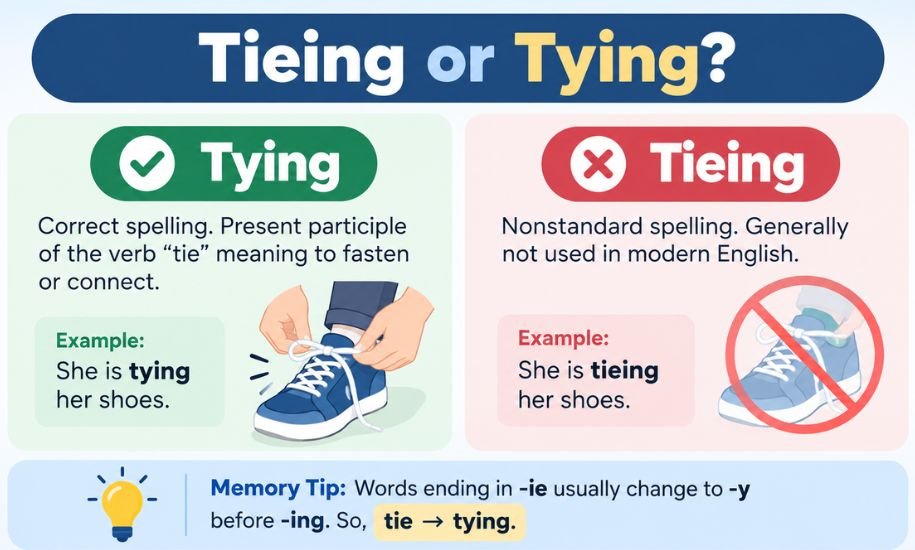
Tieing or Tying: The Correct Spelling Explained
If you have ever wondered whether the correct spelling is “tieing” or “tying,” you are not alone. The confusion usually comes from looking at the base verb tie and assuming that adding -ing simply produces tieing. English spelling rules do not work that way in this case. The standard spelling is tying, with the final -ie changed to -y before -ing is added.
Tying is the standard spelling. When the verb tie takes the -ing ending, ie changes to y, giving us tying. “Tieing” is generally considered a nonstandard spelling in modern English.
Tying or Tieing: Which Is Correct?
The correct form for standard modern English is tying.
The verb tie means to fasten, secure, connect, or bring something together with a knot, string, rope, ribbon, or another method. Its present participle and gerund form is tying, not tieing.
| Form | Standard English? | Example |
|---|---|---|
| tie | Yes | I need to tie my shoes. |
| tied | Yes | She tied the package carefully. |
| tying | Yes | He is tying his shoes. |
| tieing | Generally nonstandard | Avoid this spelling in standard writing. |
So, if you are writing an email, essay, article, school assignment, or professional document, choose tying.
Why Is It “Tying” Instead of “Tieing”?
The reason is a common English spelling pattern involving verbs that end in -ie.
When -ing is added to a verb ending in -ie, the ie normally changes to y. This prevents an awkward combination of letters and produces the established spelling pattern used in standard English.
The pattern looks like this:
- tie → tying
- lie → lying
- die → dying
- vie → vying
Notice that the final ie does not remain unchanged.
For example:
She is tying her shoelaces.
Not:
She is tieing her shoelaces.
The same pattern applies regardless of what is being tied.
What Does “Tying” Mean?
Tying is the present participle and gerund form of tie.
As a verb, it can describe the action of fastening or securing something.
Examples include:
- Marcus is tying his shoes.
- She is tying a ribbon around the gift.
- They are tying the boxes with string.
- He spent several minutes tying the rope securely.
The word can also appear in expressions where tie has a broader meaning, such as connecting ideas or linking one thing to another.
For example:
The report is tying the recent changes to the company’s new strategy.
Here, tying means connecting or associating two things.
Is “Tieing” a Real Word?
This is where some confusion can arise.
In ordinary modern English, tieing is not the spelling you should use for the -ing form of tie. Contemporary dictionaries and standard usage guides give tying as the normal form.
Some dictionary and usage discussions may record historical, rare, or variant appearances of tieing. That does not make it the preferred spelling for everyday modern writing.
For practical purposes, remember:
tie + ing → tying
If you are unsure which form to use, tying is the safe standard choice.
Tying a Game: What Does It Mean?
The word tying is not limited to physical objects. It can also be used in sports and games.
Tying a game means bringing the score level with the opposing team or player.
For example:
The home team scored in the final minute, tying the game at 2–2.
Here, tying means making the score equal.
Another example:
A late goal gave the visitors a chance to tie the game.
When describing this action with the present participle, tying is the correct spelling.
Incorrect:
The team is tieing the game.
Correct:
The team is tying the game.
This distinction is especially useful because the phrase “tying a game” can sometimes make the spelling question more confusing.
Tying Hair: The Correct Spelling
Another common expression is tying hair.
If someone uses a hairband, elastic, ribbon, or similar item to secure their hair, the appropriate verb form is tying.
Examples:
She is tying her hair before exercising.
I was tying my hair when the phone rang.
He helped his daughter with tying her hair.
The spelling does not change because the object is hair. The same tie → tying rule applies.
So:
Correct: tying hair
Not standard: tieing hair
Tying the Knot
You may also encounter the familiar expression “tying the knot.”
The phrase is commonly used to mean getting married.
For example:
They are tying the knot next summer.
After several years together, the couple decided to tie the knot.
Again, tying is the correct form.
The expression provides a useful everyday example of how the spelling works. Even though the base word is tie, its -ing form is tying.
Tying Into Something
The phrase “tying into” can have several meanings depending on context. It may describe connecting one thing to another, linking ideas, or making something fit into an existing system or plan.
For example:
The final paragraph is tying into the main argument of the article.
This new lesson is tying into what students learned last week.
In these examples, tying is again the correct spelling.
A useful distinction is that tying is the verb form, while tie is the base form:
This idea ties into the main argument.
This idea is tying into the main argument.
Both forms can be correct depending on the grammatical structure of the sentence.
Common Mistakes With “Tying”
1. Adding -ing without changing “ie”
The most obvious mistake is treating tie like a verb such as walk:
tie + ing = tieing
English does not use that pattern here.
The standard form is:
tie → tying
2. Confusing “tying” with “tied”
These are different verb forms.
She is tying her shoes.
She tied her shoes yesterday.
Tying describes an ongoing action or functions as a gerund, while tied is the past tense and past participle.
3. Using “tieing” in formal writing
Even if a reader understands tieing, it is best avoided in standard formal English.
Use:
The athlete is tying his shoes.
rather than:
The athlete is tieing his shoes.
4. Forgetting the same rule with related verbs
The spelling pattern is not unique to tie.
Compare:
lie → lying
die → dying
vie → vying
Seeing these together can make the rule easier to remember.
An Easy Way to Remember the Spelling
A simple memory trick is:
Words ending in -ie usually change to -y before -ing.
Think of:
IE → Y + ING
So:
TIE → TY + ING → TYING
You can reinforce the pattern with two familiar examples:
- lie → lying
- die → dying
If you remember “ie becomes y before -ing,” you will usually know why tying is spelled without the extra e.
Tying in Example Sentences
Here are some natural examples showing different uses of the word:
- I am tying my shoelaces before the race.
- She was tying a blue ribbon around the present.
- The player scored a goal, tying the game.
- He is tying his hair back before starting work.
- They are tying the boxes together with rope.
- The new section is tying into the ideas discussed earlier.
- The couple will be tying the knot this weekend.
- She learned how to tie a secure knot before tying the rope.
These examples show that the word can describe physical fastening, equalizing a score, connecting ideas, and common expressions.
Tying vs. Tied vs. Tie
It is also useful to understand the three forms rather than memorizing tying in isolation.
| Form | Function | Example |
|---|---|---|
| tie | Base/present form | I need to tie my shoes. |
| tied | Past tense/past participle | She tied the ribbon yesterday. |
| tying | Present participle/gerund | He is tying the ribbon now. |
This makes the spelling easier to understand in context.
For example:
I tie my shoes every morning.
I tied my shoes before leaving.
I am tying my shoes now.
The spelling changes because the grammatical form changes.
Is “Tieing” Correct in British English?
The standard British English spelling is also tying.
This is not a case like colour/color, where both forms represent established regional spellings. British English does not normally use tieing as an alternative spelling of the present participle of tie.
So whether your audience is in the UK, the US, Canada, Australia, or another English-speaking region, tying is the standard choice in ordinary modern English.
Frequently Asked Questions
Is “tying” the correct spelling?
Yes. Tying is the standard spelling of the present participle and gerund of tie. The final -ie changes to y before the -ing ending is added.
Why is “tieing” spelled incorrectly?
The spelling tieing results from treating the word as though you simply add -ing to tie. English spelling changes ie to y in this pattern, producing tying.
Is “tieing” ever used?
Rare or historical examples of tieing may be encountered in some sources, but it is not the standard spelling recommended for ordinary modern English. Tying is the form to use in formal and general writing.
Is “tying a game” correct?
Yes. Tying a game means bringing the score level. For example, “The team scored in the final seconds, tying the game.”
How do you spell “tying the knot”?
The correct expression is “tying the knot.” It is commonly used to refer to getting married.
How can I remember “tying”?
Remember the spelling pattern -ie → -y + ing. Thus, tie becomes tying, just as lie becomes lying and die becomes dying.
Final Verdict: Tieing or Tying?
Tying is the standard spelling you should use. The word comes from tie, but its -ing form changes the ending from -ie to -y, giving us tying. Whether you are writing about tying shoes, tying hair, tying a game, tying a knot, or tying two ideas together, this is the form to choose.
For more clear explanations of confusing spellings, grammar forms, and word choices, Grammarifyr helps you know the difference and use the right words.
You may also Read : MYF Meaning in Text: What Does MYF Mean?
One Comment