Molding or Moulding: US and UK Spelling Explained
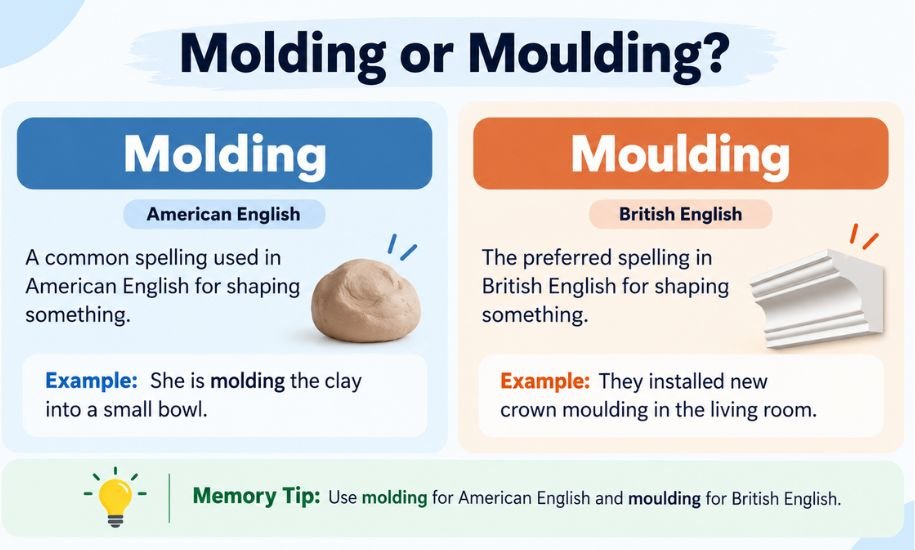
If you have come across both molding and moulding, you may wonder whether one is a spelling mistake. The answer is no: both are correct. The difference is mainly regional. Molding is the standard spelling in American English, while moulding is the standard spelling in British English. Both can describe the process of shaping a material, something shaped in a mould, or decorative architectural trim.
Both molding and moulding are correct. Molding is preferred in American English, while moulding is preferred in British English. They have the same basic meanings, so choose the spelling that matches the variety of English you are using.
Molding or Moulding: The Main Difference
The distinction is straightforward:
| Feature | Molding | Moulding |
|---|---|---|
| Standard variety | American English | British English |
| Correct spelling? | Yes | Yes |
| Basic meaning | Shaping or something shaped | Shaping or something shaped |
| Common example | crown molding | crown moulding |
| Related verb | mold | mould |
| Related past form | molded | moulded |
| Common manufacturing term | injection molding | injection moulding |
Cambridge identifies molding as the US spelling of moulding, while its British English entry gives moulding as the UK form.
So, if you are writing for readers in the United States, molding will generally be the natural choice. If you are following British English conventions, use moulding.
What Does “Moulding” Mean?
Moulding is the British English spelling. It can function as a noun and can describe something made into a particular shape or a decorative feature used in buildings and furniture.
For example, architectural moulding may be a shaped strip of wood, plastic, plaster, or stone placed around a wall, ceiling, door, window, or piece of furniture. Cambridge and Oxford both give this decorative sense.
Examples:
- The house has beautiful wooden moulding around the doors.
- The decorator replaced the damaged ceiling moulding.
- The artist is moulding the clay into a bowl.
- The factory uses injection moulding to make plastic components.
The British spelling also appears in compound expressions such as crown moulding, injection moulding, and plastic moulding.
What Does “Molding” Mean?
Molding has essentially the same meanings, but it is the standard American spelling.
As a noun, it can refer to decorative architectural material or the process of shaping something. As a verb, it is the present participle of mold.
For example:
- The house has decorative molding around the windows.
- We replaced the old crown molding.
- She is molding the clay by hand.
- The company specializes in plastic injection molding.
Collins defines molding as including the act or process of molding, something molded, and decorative contours or strips used in architecture.
Therefore, molding is not an incorrect version of moulding. It is the normal American spelling.
Molding or Moulding Clay
When talking about clay, both spellings are possible because the underlying verb follows the same regional pattern.
American English
The artist is molding the clay into a small figure.
British English
The artist is moulding the clay into a small figure.
The difference comes from mold/mould, the related verb meaning to shape a soft material into a particular form. Collins gives mould as the British form and mold as the US form.
The same pattern applies to other materials:
- molding plastic / moulding plastic
- molding wax / moulding wax
- molding ceramic material / moulding ceramic material
- molding dough / moulding dough
The choice depends on the variety of English, not on the material being shaped.
Molding or Moulding a Person
The word can also be used figuratively when talking about influencing or shaping a person’s character, behaviour, abilities, or development.
For example:
American English:
Her teachers played an important role in molding her character.
British English:
Her teachers played an important role in moulding her character.
This use comes from the literal idea of shaping something into a particular form. The meaning is figurative rather than physical.
Other examples include:
- Parents can help mould a child’s character.
- Good mentors can help mold young professionals.
- The experience helped mould his approach to leadership.
- Early education can play a role in molding a person’s habits.
The spelling changes, but the meaning does not.
Crown Molding or Crown Moulding?
This is one of the most familiar examples of the regional difference.
In American English:
The living room has beautiful crown molding.
In British English:
The living room has beautiful crown moulding.
Here, the word refers to decorative trim positioned around the upper part of a wall, usually near the ceiling. Dictionaries such as Cambridge and Oxford describe moulding/molding as decorative material used around walls, doors, windows, and furniture.
So crown molding and crown moulding describe the same type of architectural feature.
Neither spelling is inherently more correct. Your choice should follow your audience and the spelling system used throughout the rest of your writing.
Molding or Moulding in Food and Cooking
The same spelling distinction applies when the word describes shaping food.
For example, an American recipe might say:
Mold the mixture into small balls before serving.
A British recipe might say:
Mould the mixture into small balls before serving.
The present participle follows the same pattern:
- molding food — American English
- moulding food — British English
The distinction is particularly useful when reading recipes from different countries. The spelling may change, but the instruction remains the same: shape the food into a particular form.
Injection Molding or Injection Moulding?
Manufacturing provides another common example.
Injection molding is the standard American spelling, while injection moulding is the British spelling. The term refers to a manufacturing process in which material is shaped using a mould or mold.
For example:
US English:
The company manufactures plastic parts using injection molding.
UK English:
The company manufactures plastic parts using injection moulding.
Cambridge specifically lists injection moulding among the related meanings and expressions associated with the British form.
The same regional distinction appears with plastic molding/plastic moulding and other manufacturing terms.
Why Are Molding and Moulding Both Used?
The difference comes from the broader spelling distinction between mold and mould.
American English normally uses:
- mold
- molding
- molded
- moldable
British English normally uses:
- mould
- moulding
- moulded
- mouldable
Dictionaries consistently identify molding as the US spelling and moulding as the UK spelling.
This is similar to other American and British spelling differences, although the exact spelling pattern varies from word to word.
The important point is that moulding is not a misspelling of molding, and molding is not a misspelling of moulding.
Correct Usage Examples
Here are some examples showing how the two forms work in different contexts.
American English
- The carpenter installed new crown molding.
- She is molding the clay into a vase.
- The factory specializes in plastic molding.
- His experiences were molding his personality.
- The recipe says to mold the mixture into a ball.
British English
- The carpenter installed new crown moulding.
- She is moulding the clay into a vase.
- The factory specializes in plastic moulding.
- His experiences were moulding his personality.
- The recipe says to mould the mixture into a ball.
Notice that the meaning remains essentially unchanged.
Common Mistakes to Avoid
1. Treating “molding” as a spelling error
This is incorrect. Molding is the standard American form.
2. Treating “moulding” as a spelling error
This is also incorrect. Moulding is the standard British form.
3. Mixing regional spellings unnecessarily
If you are writing in British English, it is better to maintain mould, moulding, moulded consistently. If you are writing in American English, use mold, molding, molded.
4. Assuming the meaning changes
The difference is primarily spelling, not meaning. A British reader and an American reader can generally understand both forms.
5. Changing the spelling within the same piece
For example, using crown moulding in one paragraph and crown molding in another can make your writing look inconsistent if you are following one regional variety.
An Easy Way to Remember the Difference
A simple memory rule is:
British English → moulding
American English → molding
Think of the related base words:
UK: mould → moulding
US: mold → molding
Once you remember the difference between mould and mold, the spelling of the longer form becomes much easier.
Which Spelling Should You Use?
Choose based on your intended audience.
If you are writing for a US audience, use:
- molding
- mold
- molded
- moldable
If you are writing for a UK audience, use:
- moulding
- mould
- moulded
- mouldable
For a website aimed at an international audience, either spelling can be understood, but consistency is important. If the rest of your content follows British English, moulding will fit naturally. If your content follows American English, molding is the appropriate choice.
Frequently Asked Questions
Is “molding” correct English?
Yes. Molding is the standard American English spelling. It can refer to the process of shaping something, something that has been shaped, or decorative architectural material.
Is “moulding” correct English?
Yes. Moulding is the standard British English spelling. It has the same basic meanings as the American molding.
Is moulding British or American?
Moulding is the British spelling, while molding is the American spelling. Cambridge explicitly identifies moulding as the UK spelling of molding.
Should I write “crown molding” or “crown moulding”?
Use crown molding in American English and crown moulding in British English. Both refer to decorative trim used near the upper part of a wall or ceiling.
Is “molding” different from “moulding” in meaning?
Generally, no. The two forms have the same basic meanings. The main distinction is regional spelling rather than vocabulary or meaning.
How do I remember which one to use?
Remember the base-word pair: mold → molding for American English and mould → moulding for British English. Keeping the same spelling throughout your writing will also help maintain consistency.
The Bottom Line
Molding and moulding are both correct. The main difference is regional: molding is the standard American spelling, while moulding is the standard British spelling. The same pattern applies to related words such as mold/mould, molded/moulded, and expressions such as crown molding/crown moulding and injection molding/injection moulding. For more clear explanations of confusing English choices, Grammarifyr helps readers Know the Difference. Use the Right Words.
You may also Read : Tieing or Tying: The Correct Spelling Explained

One Comment