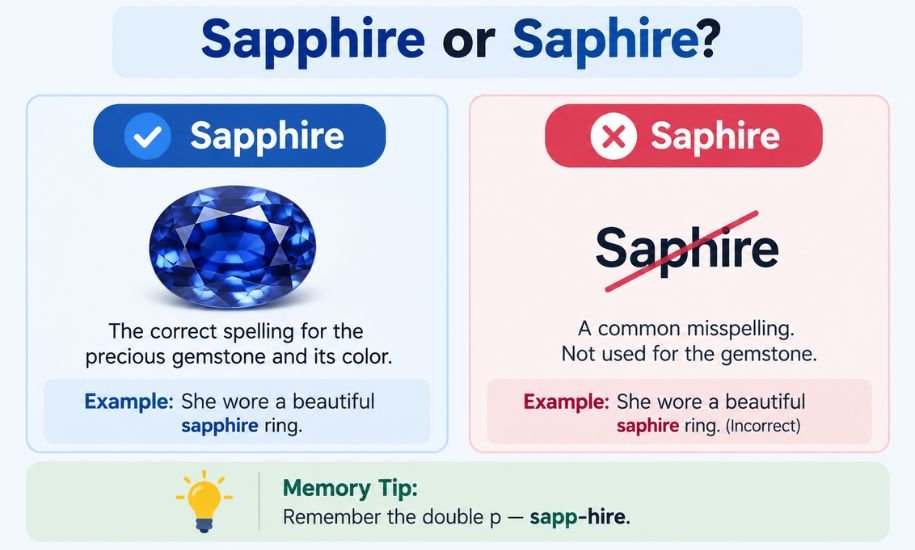
Sapphire or Saphire: Meaning and Correct Spelling
Have you ever wondered whether the correct spelling is sapphire or saphire? These two forms look almost identical, making it easy to mix them up when writing about gemstones, jewelry, or colors. However, only one is the standard English spelling. Sapphire is the correct form, while saphire is generally a misspelling. A sapphire is a precious gemstone best known for its beautiful blue color, although it also occurs in several other shades. Understanding the correct spelling, meaning, pronunciation, and usage can help you avoid this common writing mistake.
Quick Answer
Sapphire is the correct spelling, while saphire is a misspelling when referring to the gemstone or its color. Sapphire is a precious variety of corundum, commonly known for its blue appearance. Although Saphire may be used as a personal name or brand name, it is not an accepted alternative spelling of the gemstone.
Sapphire or Saphire: Which Is Correct?
The correct spelling is sapphire, with two p’s and the letters h, i, r, and e following them. The spelling saphire is incorrect in standard English when referring to the gemstone, jewelry, or the color associated with it.
The confusion mainly comes from the way the word is pronounced. The letters ph produce an f sound, which can make the spelling less obvious to someone who has only heard the word spoken.
| Feature | Sapphire | Saphire |
|---|---|---|
| Correct spelling | Yes | No, for the gemstone |
| Meaning | A precious gemstone | No standard gemstone meaning |
| Part of speech | Noun; also used adjectivally | Not a standard English word for the stone |
| Color reference | Sapphire blue | Incorrect in standard usage |
| Jewelry descriptions | Correct | Incorrect |
| Personal name | Can be used | May be used as a proper name |
For formal writing, educational content, product descriptions, and everyday communication, use sapphire whenever you mean the gemstone.
What Does Sapphire Mean?
A sapphire is a precious gemstone that belongs to the corundum mineral family. It is composed primarily of aluminum oxide and is valued for its hardness, durability, and attractive appearance.
Although blue is the color most commonly associated with sapphires, these gemstones can also be pink, yellow, green, orange, purple, and even colorless. Sapphires are used in various types of jewelry, including engagement rings, necklaces, earrings, and bracelets.
Sapphire is also used as an adjective to describe a particular shade of blue. For example:
- She wore a beautiful sapphire necklace to the wedding.
- The jeweler displayed a sparkling blue sapphire.
- His watch features a durable sapphire crystal.
- The artist painted the evening sky in a deep sapphire blue.
In these examples, the word refers either to the gemstone itself or to a color inspired by it.
Is Saphire a Real Word?
Saphire is not a standard English spelling of the gemstone. It is generally considered a spelling error rather than a separate word with its own established meaning.
However, the spelling can appear as a personal name, surname, business name, or brand. Proper names do not always follow standard dictionary spelling, so Saphire may be correct when it is the official spelling of a particular name.
For example:
- Incorrect: She purchased a saphire engagement ring.
- Correct: She purchased a sapphire engagement ring.
- Name: Saphire is the name printed on the event invitation.
The important distinction is the context. Use sapphire for the gemstone and its associated color, but preserve Saphire when referring to someone or something officially named that way.
Why Do People Confuse These Spellings?
The main reason people confuse sapphire and saphire is their similar appearance and pronunciation. Both forms contain nearly the same letters, but the correct spelling includes a double p.
There are a few reasons this mistake can occur:
- Pronunciation: The ph combination produces an f sound, which does not make the spelling immediately obvious.
- Unfamiliar spelling: People who rarely write about gemstones may not remember the exact arrangement of letters.
- Typing errors: When writing quickly, it is easy to omit one of the p’s or rearrange letters.
- Visual similarity: Both forms look plausible at a glance, even though only one is standard for the gemstone.
Remember that the standard spelling is sapphire, regardless of whether you are writing about a gemstone, a ring, or a shade of blue.
Sapphire Stone: Color, Hardness, and Characteristics

Sapphire is one of the best-known precious gemstones. It is especially recognized for its blue varieties, but its appeal extends to many other colors.
Some important characteristics of sapphire include:
- Mineral: Corundum
- Chemical composition: Aluminum oxide (Al₂O₃)
- Hardness: 9 on the Mohs scale
- Common color: Blue
- Other colors: Pink, yellow, green, orange, purple, and colorless
- Traditional birthstone: September
Its hardness makes sapphire suitable for jewelry that is worn frequently. Although it is highly resistant to scratching, it can still chip or fracture under certain conditions.
Sapphires are also available as natural and laboratory-grown gemstones. Both can have the same basic chemical composition, but their origin and growth processes are different.
What Are the Different Sapphire Colors?

Blue sapphire is the most familiar variety, but sapphires naturally occur in several shades. Their colors are influenced by trace elements and the conditions under which the crystals formed.
| Type | Description |
|---|---|
| Blue sapphire | Ranges from light blue to deep, rich blue |
| Pink sapphire | Displays shades from pale pink to vivid pink |
| Yellow sapphire | Has a color range from soft yellow to golden yellow |
| Green sapphire | Appears in light to dark green shades |
| White sapphire | A colorless variety of corundum |
| Purple sapphire | Displays violet and purple tones |
| Padparadscha sapphire | A distinctive pinkish-orange to orangy-pink variety |
The term sapphire blue is also used to describe a rich, vivid blue shade in clothing, interior design, artwork, and other contexts.
Where Is Sapphire Found?
Sapphires are found in different parts of the world, including Asia, Africa, Australia, and North America. Some locations are especially recognized for the quality, color, or historical importance of their gemstones.
Major sapphire-producing regions include:
- Sri Lanka: Known for blue and fancy-colored sapphires.
- Madagascar: An important source of sapphires in a variety of colors.
- Myanmar: Historically associated with fine-quality sapphires.
- Kashmir: Famous for its highly prized velvety blue sapphires.
- Australia: Known for producing blue and other varieties, including darker stones.
- Thailand: An important source and trading center for colored gemstones.
- United States: Montana is known for its natural sapphire deposits.
The origin of a sapphire can influence its market value, especially when it comes from a historically significant location. However, the quality of the individual gemstone remains an important consideration.
Sapphire Ring and Jewelry Uses

Sapphire is widely used in fine jewelry because of its durability, beauty, and range of colors. Blue sapphire rings are particularly popular for engagement rings, anniversary gifts, and other special occasions.
Common jewelry pieces featuring sapphires include:
- Engagement and wedding rings
- Necklaces and pendants
- Earrings and studs
- Bracelets
- Brooches
A sapphire ring may feature a single gemstone or combine sapphires with diamonds and other precious stones. The choice of metal, gemstone cut, color, and setting all contribute to the overall appearance.
Sapphire has also been associated with loyalty, wisdom, sincerity, and faithfulness in various cultural traditions. These associations are symbolic and are not scientifically proven properties of the stone.
Sapphire Price: What Affects Its Value?
The price of a sapphire depends on several characteristics, so there is no single price that applies to every gemstone. Two sapphires with the same carat weight can have very different values because of their quality and appearance.
The main factors that influence sapphire prices are:
- Color: Rich, attractive, well-saturated colors can increase a stone’s value.
- Clarity: Gemstones with fewer visible inclusions may command higher prices.
- Cut: A well-proportioned cut can improve the stone’s brilliance and color distribution.
- Carat weight: Larger, high-quality sapphires are often rarer.
- Origin: Some origins, including Kashmir, may attract a premium.
- Treatments: Untreated sapphires may command higher prices than comparable treated stones, depending on quality.
When purchasing a sapphire, it is useful to obtain an independent gemological report that identifies the stone and discloses any detectable treatments. This can help buyers understand what they are paying for.
What Is Sapphire Crystal?
Sapphire crystal is a durable, transparent material commonly made from synthetic sapphire. Although natural sapphire is a gemstone, laboratory-grown sapphire is often manufactured for practical applications.
Due to its hardness and optical properties, sapphire crystal is used in:
- Watch covers and watch faces
- Optical windows
- Scientific instruments
- Specialized electronic components
- Industrial equipment
Sapphire crystal is highly resistant to everyday scratches, although it is not completely scratch-proof and can still be damaged by a sufficiently hard impact.
How to Pronounce Sapphire
Sapphire is commonly pronounced SAF-eye-er in American English, with some variation across English accents.
The letters ph make an f sound, as they do in words such as phone and phrase. The spelling is the same in American and British English.
For example:
- The sapphire ring was carefully polished.
- She received a beautiful sapphire for her birthday.
- The watch has a sapphire crystal cover.
Remember that the pronunciation does not change the spelling. The correct written form always contains two p’s.
Common Mistakes to Avoid
Here are some mistakes to watch for when writing about sapphires:
- Using one p: Writing saphire instead of sapphire when referring to the gemstone.
- Treating it as a regional spelling: Saphire is not an accepted British or American alternative.
- Using the wrong spelling in color descriptions: Write sapphire blue, not saphire blue.
- Confusing a name with the gemstone: A person named Saphire may use that spelling, but the gemstone remains sapphire.
- Assuming all sapphires are blue: Sapphires come in a wide range of colors.
Paying attention to these details helps keep your writing accurate, especially in educational articles, jewelry descriptions, and product content.
Frequently Asked Questions
Is sapphire or saphire the correct spelling?
Sapphire is the correct spelling when referring to the precious gemstone or its associated color. Saphire is generally a misspelling and should be avoided in standard English writing unless it is an official personal or brand name.
Are sapphire and saphire the same thing?
When saphire is intended to refer to the gemstone, it is simply a misspelling of sapphire. There is no recognized difference between two gemstones with these spellings.
Is sapphire a real gemstone?
Yes, sapphire is a genuine precious gemstone belonging to the corundum mineral family. It is valued for its hardness, durability, and attractive colors, particularly blue. It is used extensively in jewelry and certain industrial and optical applications.
Can Saphire be a girl’s name?
Yes, Saphire can be used as a personal name. The spelling of personal names can vary, so it may be appropriate when referring to someone whose official name is Saphire. This does not make it an alternative standard spelling of the gemstone.
Is sapphire always blue?
No. Although blue is the most widely recognized sapphire color, the gemstone also occurs naturally in pink, yellow, green, orange, purple, and colorless varieties. Sapphires that are not blue are often described as fancy sapphires.
Is sapphire spelled differently in British and American English?
No. Sapphire is the standard spelling in both British and American English. Unlike words such as colour and color, it does not have different standard regional spellings.
Final Verdict: Sapphire or Saphire?
Sapphire is the correct spelling for the gemstone, its color, and jewelry made with it. Saphire is generally a spelling mistake, although it can be a valid personal or brand name. Remember the double p in sapphire to avoid this error in everyday and formal writing. Understanding these small but important spelling differences is part of the approach Grammarifyr follows: Know the Difference. Use the Right Words.
You may also Read : Oversite or Oversight: Meaning and Key Differences


One Comment