Tear or Tare: Meaning, Difference, and Correct Usage
The words tear and tare sound alike when tear means to rip something, but they have completely different meanings and uses. Both are correct English words, so choosing the right one depends on the context. Tear refers to ripping, a damaged area, or a drop from the eye, while tare is mainly used when discussing the weight of an empty container or adjusting a weighing scale. Understanding their definitions, pronunciation, and examples can help you avoid spelling mistakes and use each word correctly in everyday writing.
Quick Answer
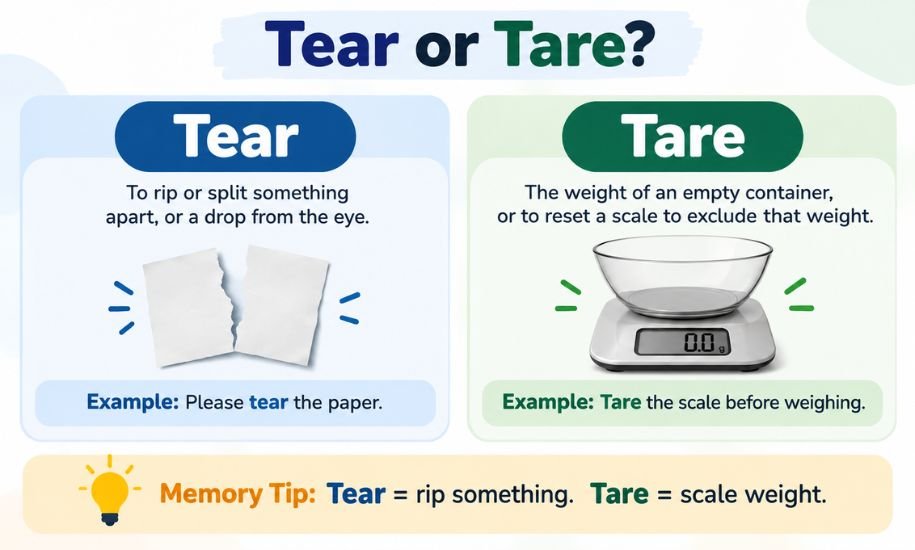
Both tear and tare are correct words, but they have different meanings. Tear means to rip something apart or refers to a drop of liquid from the eye. Tare refers to the weight of an empty container or the act of setting a scale to exclude that weight. Use tear when talking about ripping paper or fabric, and tare when weighing something.
Tear or Tare: What Is the Difference?
The main difference between these words is their meaning and context. Although tear (meaning rip) and tare are pronounced alike in most English accents, they are not interchangeable.
| Feature | Tear | Tare |
|---|---|---|
| Correct spelling | Yes | Yes |
| Main meaning | To rip or split something | Weight of an empty container |
| Other meanings | A hole or a drop from the eye | To reset a scale; a type of plant |
| Part of speech | Noun and verb | Noun and verb |
| Pronunciation | Tair (rip), teer (eye drop) | Tair |
| Past tense | Tore | Tared |
| Past participle | Torn | Tared |
| Common context | Paper, clothing, emotions | Weighing, packaging, shipping |
| Example | Tear the paper carefully. | Tare the scale before weighing. |
For example, if you accidentally damage your shirt, you might say, “I noticed a tear in my shirt.” However, if you are measuring flour in a bowl, you would tare the scale to remove the bowl’s weight from the reading.
Both words are valid, but the context determines which spelling is appropriate.
What Does Tear Mean?
Tear has several meanings in English and can function as both a noun and a verb. Its pronunciation changes depending on the meaning.
Tear as a Verb
As a verb, tear means to pull, rip, or split something apart, either intentionally or accidentally. It is commonly used when describing damage to paper, fabric, packaging, and other materials.
Examples:
- Please tear the paper into four equal pieces.
- He accidentally tore his trousers while climbing the fence.
- Be careful not to tear the envelope when opening it.
- The strong wind tore the flag from its pole.
The past tense of tear is tore, while its past participle is torn.
Forms of the verb tear
| Form | Example |
|---|---|
| Present | I tear the paper. |
| Past | I tore the paper. |
| Past participle | I have torn the paper. |
| Present participle | I am tearing the paper. |
Tear as a Noun
As a noun, tear can refer to a rip, hole, or split in a material. It can also mean a drop of liquid produced by the eye.
Examples:
- There is a small tear in my favourite jacket.
- She repaired the tear in the curtain.
- A tear rolled down his cheek as he watched the film.
- Her eyes filled with tears when she heard the news.
These two noun meanings have different pronunciations. A tear in clothing rhymes with air, while a tear from the eye rhymes with ear.
What Does Tare Mean?
Tare is a correctly spelled English word primarily associated with weighing and measurement. It refers to the weight of an empty container or packaging, which is excluded when calculating the net weight of its contents.
For example, when you place an empty bowl on a kitchen scale, the scale measures the bowl’s weight. Pressing the tare button resets the reading to zero, allowing you to measure only the ingredients added afterward.
Tare as a Noun
As a noun, tare refers to the weight of a container or packaging without its contents. It is particularly useful in shipping, food production, retail, and transportation.
Examples:
- The tare weight of the container is 500 grams.
- The shipping label displays the gross, net, and tare weights.
- The warehouse employee recorded the tare weight before loading the goods.
Tare as a Verb
As a verb, tare means to adjust a weighing scale so that the weight of an empty container is excluded from the measurement.
Examples:
- Tare the kitchen scale before adding the sugar.
- She tared the weighing machine before measuring the ingredients.
- The laboratory technician tared the container before weighing the sample.
The past tense and past participle of tare are both tared.
The word can also refer to certain vetch plants, particularly in agricultural or botanical contexts, although this meaning is less common in everyday conversation.
Tear or Tare: Pronunciation
One reason these words are easily confused is that they share a pronunciation in their most common comparison.
- Tear (to rip): Pronounced like air, care, or fair.
- Tare (weight): Also pronounced like air, care, or fair.
- Tear (from the eye): Pronounced like ear, fear, or near.
This means you generally cannot distinguish tear (rip) from tare by hearing the word alone. You need to understand the sentence to determine the correct spelling.
For example:
- “Please tear the paper.” Here, tear means to rip.
- “Please tare the scale.” Here, tare means to reset the weighing scale.
How to Use Tear and Tare in Sentences
The easiest way to understand the difference is to look at how each word functions in everyday situations.
| Sentence | Correct word | Explanation |
|---|---|---|
| I accidentally ripped my shirt. | Tear | Refers to damaging fabric. |
| There is a small hole in the paper. | Tear | A rip or split in a material. |
| A drop rolled down her cheek. | Tear | Liquid produced by the eye. |
| Reset the scale before weighing the flour. | Tare | Excludes the container’s weight. |
| The empty box weighs 300 grams. | Tare | Refers to the container’s weight. |
| The mechanic tore the old packaging. | Tear | Past tense of the verb tear. |
| The technician tared the machine. | Tare | Past tense of the verb tare. |
Correct and Incorrect Examples
Understanding the context helps prevent common spelling errors.
– Correct: Please tear the paper into smaller pieces. Incorrect: Please tare the paper into smaller pieces.
– Correct: The tare weight of the empty box is two kilograms. Incorrect: The tear weight of the empty box is two kilograms.
– Correct: He noticed a tear in his coat. Incorrect: He noticed a tare in his coat.
– Correct: Tare the scale before placing the ingredients on it. Incorrect: Tear the scale before placing the ingredients on it.
In each example, the intended meaning determines the correct spelling.
Why Are Tear and Tare Confused?
Tear and tare are often confused because they have similar spelling and, in two of their main uses, identical pronunciation. Both contain four letters, begin with the letter t, and end with a similar sound.
When someone hears a sentence such as “The container has a tare of 200 grams,” they may be unfamiliar with the word and mistakenly associate it with tear. Similarly, someone writing about ripping paper may choose tare because it sounds identical.
Another source of confusion is that tear has two different meanings and pronunciations. A tear in a piece of clothing and a tear in someone’s eye are spelled the same way but pronounced differently.
The best way to avoid these mistakes is to consider what the sentence describes rather than relying on pronunciation alone.
Easy Ways to Remember the Difference
A simple memory trick can help you choose the correct word.
- Tear = Tear something apart: Think of ripping paper, tearing clothes, or creating a hole in fabric.
- Tare = Tare a scale: Associate the word with weighing ingredients, packages, or containers.
You can also remember these two short examples:
- Tear the paper when you want to rip it.
- Tare the scale when you want to measure something without including the container’s weight.
If the sentence is about damage, ripping, or crying, tear is usually the correct choice. If it is about weighing or excluding container weight, use tare.
Common Mistakes to Avoid
Here are some mistakes to watch for when using these words:
- Writing “tare” when you mean to rip: Use tear for pulling paper, fabric, or another material apart.
- Writing “tear weight” instead of “tare weight”: The correct technical expression is tare weight.
- Confusing the two pronunciations of tear: The word referring to ripping rhymes with air, while the word referring to an eye drop rhymes with ear.
- Using the wrong past tense: The past tense of tear is tore, not teared, when referring to ripping. The past tense of tare is tared.
These distinctions are useful in both everyday writing and more technical contexts, particularly when describing damage or measurements.
Frequently Asked Questions
1. Is it tear or tare as in rip?
Tear is the correct word when you mean to rip or pull something apart. For example, “Be careful not to tear the paper.” Tare is associated mainly with weighing and measuring, not ripping.
2. Are tear and tare pronounced the same?
Tear, meaning to rip, and tare, meaning container weight, are generally pronounced the same way. Both rhyme with air. However, tear, meaning a drop from the eye, rhymes with ear and has a different pronunciation.
3. How do you spell tare?
The correct spelling is tare, with the letters T-A-R-E. It is commonly used in weighing to describe the weight of an empty container or to refer to adjusting a scale to exclude that weight.
4. Is tear a noun or a verb?
Tear can be both a noun and a verb. As a verb, it means to rip or split something apart. As a noun, it can refer to a rip in material or a drop of liquid from the eye. Its grammatical role depends on how it is used in a sentence.
5. Can you use tare for paper?
No, not when you mean to rip or split paper. The correct expression is “tear the paper.” The verb tare is used in weighing, such as when resetting a scale before measuring ingredients.
6. What is the difference between tare weight and net weight?
Tare weight is the weight of the empty container or packaging, while net weight is the weight of the contents alone. Gross weight includes both the contents and the container. Therefore, net weight is calculated by subtracting tare weight from gross weight.
The Bottom Line
Tear and tare are both correct English words, but they serve different purposes. Use tear when referring to ripping, a damaged area, or a drop from the eye. Use tare when discussing the weight of an empty container or adjusting a scale for accurate measurement. Understanding this distinction makes it easier to avoid spelling errors and communicate clearly. With practical examples and straightforward explanations, Grammarifyr helps readers know the difference and use the right words.
You may also Read : Sapphire or Saphire: Meaning and Correct Spelling