Vender or Vendor: Meaning, Difference and Examples
The words vender and vendor look almost identical, making it easy to confuse them when writing. Both forms have been used in English to describe someone who sells goods or services, but they are not equally common in modern writing. The distinction is also interesting because vender is a correctly spelled Spanish verb meaning “to sell.” Understanding these differences can help you choose the appropriate word in business documents, everyday conversations, and formal writing.
Quick Answer
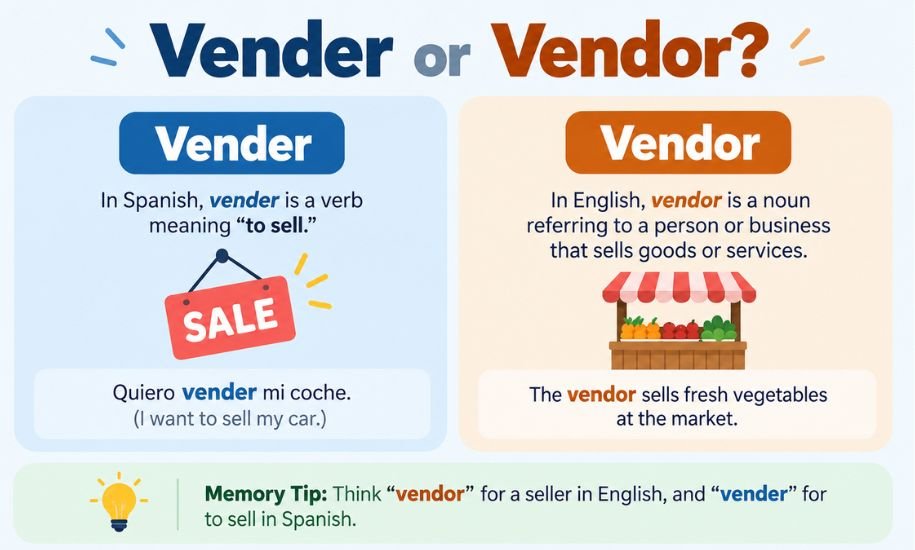
Vendor is the standard and widely accepted spelling in modern English for a person or business that sells goods or services. Vender is a rare English variant with the same general meaning, but it is best avoided in contemporary writing. In Spanish, however, vender is the standard verb meaning “to sell.”
Vender or Vendor: Which Is Correct?
Vendor is the conventional spelling used in modern English, particularly in business, retail, technology, and everyday communication. It refers to an individual, company, or organisation that sells products or provides services.
Vender is also recorded as an English spelling variant, although it is much less common. It may appear in older texts or certain dictionary entries, but most contemporary writers use vendor for clarity and consistency.
| Feature | Vendor | Vender |
|---|---|---|
| English spelling | Standard | Rare variant |
| Meaning in English | A person or business that sells | Same general meaning |
| Modern usage | Common | Uncommon |
| Formal writing | Recommended | Generally avoided |
| British English | Standard | Rare |
| American English | Standard | Uncommon variant |
| Spanish | Not the standard verb | Means “to sell” |
For example:
- Correct and recommended: The vendor delivered the furniture on Monday.
- Rare English variant: The vender delivered the furniture on Monday.
Although the second sentence can be understood, vendor is the more familiar and appropriate choice for modern English writing.
What Does Vendor Mean?
A vendor is a person, business, or organisation that sells goods or services to customers, retailers, or other businesses. The word is a noun and is widely used in commercial and professional settings.
A vendor may sell physical products, provide digital services, supply materials, or offer specialist solutions to other organisations.
Examples of vendor in sentences:
- The market vendor sells fresh vegetables and seasonal fruits.
- Our company selected a new vendor to provide office equipment.
- The online vendor offers free shipping on selected products.
- The software vendor released an updated version of its application.
The term can also be used in real estate and legal transactions to describe the person or organisation selling a property.
For instance, a property vendor is the seller of a house, apartment, commercial building, or piece of land.
Is Vender a Real Word?
Yes, vender is a documented English spelling variant of vendor. It has been used historically with the meaning of a person who sells something. However, it is considerably less common in present-day English.
Some dictionaries record it as an alternative spelling, while many contemporary writing resources recommend vendor as the standard form.
It is important not to confuse the uncommon English variant with a spelling mistake in every context. Although vender may be valid in certain dictionary contexts, using it in modern business writing or general articles can appear unusual to readers.
Examples:
- The vendor supplied the required materials.
- The vender supplied the required materials.
Both sentences express the same basic meaning when vender is being used as an English variant. However, the first sentence follows standard contemporary usage.
What Does Vender Mean in Spanish?
In Spanish, vender is a common and correctly spelled verb meaning “to sell.” Unlike its rare English noun usage, it is a standard verb in Spanish.
It describes the action of exchanging a product, service, or item for money.
Examples in Spanish:
- Quiero vender mi coche. — I want to sell my car.
- Ella quiere vender su casa. — She wants to sell her house.
- Vamos a vender frutas. — We are going to sell fruit.
- Mi amigo vende ropa. — My friend sells clothes.
In Spanish, vender is an infinitive verb. Its conjugated forms include vendo (I sell), vendes (you sell), and vende (he, she, or you formal sells).
This distinction is useful for bilingual writers and English learners. In English, vendor generally identifies the seller, while Spanish vender describes the act of selling.
Vendor in British and American English
The spelling vendor is standard in both British and American English. Unlike words such as colour and color, it does not have a common regional spelling difference.
In the UK, the word is frequently used in business, retail, property transactions, and procurement. In the United States, it is similarly used in commercial agreements, technology, retail, and everyday language.
Examples in British and American English:
- The vendor agreed to the terms of the contract.
- We need a reliable vendor for our new project.
- The street vendor sells snacks near the station.
The spelling remains vendor in each example, regardless of the intended English-speaking audience. Therefore, writers can confidently use this form in British, American, Australian, and international English.
Why Are These Words Confused?
The confusion between vender and vendor mainly comes from their similar spelling, pronunciation, and meaning.
Both words contain the same initial letters and have historically been used to describe someone who sells something. The difference is only one vowel, making it easy to mistype or misremember the conventional spelling.
Another source of confusion is the Spanish verb vender. People familiar with Spanish may naturally use this spelling when writing in English, even though vendor is the conventional English noun.
Because the two English forms have overlapping meanings, the distinction is primarily one of spelling preference and modern usage rather than a significant difference in definition.
Correct Usage Examples
Seeing the word in different contexts makes it easier to understand how vendor is used in everyday and professional English.
Business and commerce
- The company signed a new agreement with its equipment vendor.
- Each vendor must submit an invoice before receiving payment.
- We contacted several vendors to compare their prices.
Retail and markets
- A street vendor was selling handmade jewellery.
- The food vendor prepared fresh sandwiches for customers.
- The festival attracted vendors from nearby towns.
Technology and services
- The software vendor provides technical support to its customers.
- Our business is looking for a cloud service vendor.
- The vendor updated its platform to improve security.
Property transactions
- The vendor accepted the buyer’s offer for the house.
- The property vendor agreed to complete the sale next month.
In formal writing, use vendor consistently unless you are quoting a historical text or discussing the alternative spelling itself.
Easy Way to Remember the Correct Spelling
A simple way to remember vendor is to associate it with a business or seller.
Think of a vendor selling products at a market or supplying services to a company. The spelling with an o is the conventional English noun.
You can also remember the related words:
- Vendor: A person or business that sells.
- Vendee: A person who buys in a transaction.
- Vend: To sell.
When writing in English, choose vendor whenever you mean a seller. When writing in Spanish, use vender when you mean “to sell.”
Common Mistakes to Avoid
There are a few mistakes worth watching for when using these words.
- Using vender in professional documents: Although it is a recorded English variant, vendor is more conventional and easier for modern readers to recognise.
- Assuming vender has no English usage: It is documented as a rare alternative, so describing it as a completely invented word would be inaccurate.
- Confusing a vendor with a buyer: A vendor sells goods or services, whereas a buyer purchases them.
- Mixing English and Spanish meanings: Spanish vender is a verb, while English vendor is a noun.
- Changing spelling inconsistently: Choose vendor and use it consistently throughout an article, report, or business document.
Frequently Asked Questions
Is vender or vendor the correct spelling?
Vendor is the standard spelling in modern English. Vender is a rare alternative that has also been recorded in English, but it is generally not recommended for contemporary writing.
Is vender a word in the Oxford Dictionary?
Vender has been recorded as an English spelling variant in some dictionaries and language references. For precise dictionary definitions and regional labels, consult the current edition of the relevant dictionary, as entries can differ.
Is vendor British or American English?
Vendor is used in both British and American English. It is also conventional in Australian, Canadian, and international English, so there is no need to change the spelling for different audiences.
What is the meaning of vender in English?
In English, vender is a rare spelling variant of vendor, referring to a person or business that sells goods or services. It is much less common than the standard spelling.
What is the difference between vender and vendor in Spanish?
Vender is a Spanish verb meaning “to sell.” Vendor is an English noun meaning a seller. Spanish speakers use vendedor for a male seller and vendedora for a female seller.
What is the plural of vendor?
The plural of vendor is vendors. For example, “Several vendors attended the weekend market.” The plural is formed by adding -s to the singular noun.
The Bottom Line
Vendor is the conventional spelling to use when referring to a person or business that sells goods or services in modern English. Although vender is a documented, uncommon English variant, it is generally better to use vendor in everyday, academic, and professional writing. Remember that vender is also the standard Spanish verb meaning “to sell.” Grammarifyr helps you understand these distinctions so you can know the difference and use the right words.
You may also Read : Repore or Rapport: Meaning, Spelling and Examples

One Comment