Knaw or Gnaw: Meaning, Spelling and Examples
When writing about biting, chewing, or slowly wearing something away with the teeth, you may wonder whether to use knaw or gnaw. The two spellings look and sound similar, which can make it difficult to know which one is correct. The confusion is understandable because the word gnaw begins with a silent letter that is not pronounced in modern English. However, there is a clear distinction between the two forms, particularly in standard writing.
Quick Answer
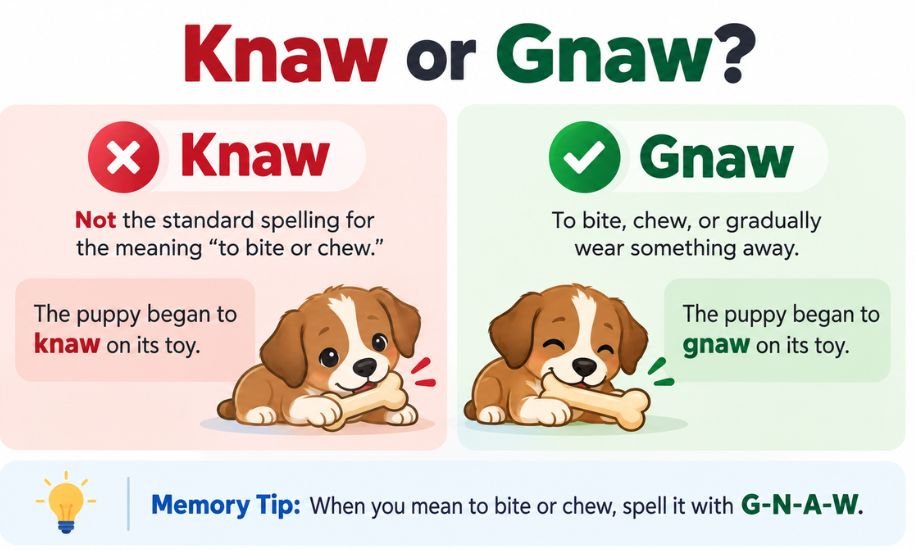
Gnaw is the correct standard spelling when you mean to bite, chew, or gradually wear something away. Knaw is not the standard modern spelling for this meaning, although it has appeared as an archaic spelling and in some nonstandard or dialectal usage. For everyday writing, always use gnaw.
Knaw or Gnaw: Which Is Correct?
Gnaw is the correct spelling in contemporary standard English when describing the action of repeatedly biting or chewing something. It can also describe something that gradually causes worry, guilt, or emotional distress.
Knaw is generally considered a misspelling when used with this meaning. Although the spelling has historical and dialectal uses, it should not replace gnaw in modern formal or everyday writing.
| Feature | Knaw | Gnaw |
|---|---|---|
| Standard spelling for chewing | No | Yes |
| Meaning | Nonstandard in this context | To bite, chew, or wear away |
| Part of speech | Nonstandard form in this context | Verb and occasionally noun |
| Pronunciation | May vary in nonstandard use | /nɔː/ (British), /nɑː/ (American) |
| Formal writing | Avoid for this meaning | Correct |
| Example | Knaw the bone (incorrect) | Gnaw the bone (correct) |
For example:
- Correct: The puppy loves to gnaw on its favourite toy.
- Incorrect: The puppy loves to knaw on its favourite toy.
The correct spelling remains gnaw regardless of whether the sentence refers to animals chewing, people biting their nails, or worries that persist in someone’s mind.
What Does Gnaw Mean?
Gnaw is a verb that means to bite, chew, or repeatedly scrape something with the teeth. It often describes animals chewing food, bones, wood, or other objects. It can also be used figuratively to describe persistent feelings such as worry, regret, or guilt.
The word has several related meanings:
- To chew persistently: To bite something repeatedly, often using the front teeth.
- To wear away: To gradually damage or remove material through repeated biting.
- To cause emotional distress: To create continuing worry, anxiety, guilt, or doubt.
Examples of Gnaw in Sentences
- The rabbit began to gnaw on a wooden branch.
- The dog likes to gnaw on a bone after dinner.
- Rats can gnaw through wires and wooden structures.
- A feeling of regret continued to gnaw at his conscience.
- Uncertainty about the decision began to gnaw at her.
In these examples, the word describes both a physical action and an emotional experience. Its exact meaning depends on the context of the sentence.
Is Knaw a Real Word?
Knaw is not the accepted modern spelling of the verb meaning to bite or chew. However, it is not entirely without historical or linguistic use.
The spelling has been recorded as an archaic variant of gnaw. It has also appeared as a nonstandard or dialectal form of know in some varieties of English.
For this reason, it is more accurate to describe knaw as a nonstandard spelling for the intended meaning rather than a word that has never existed.
Consider these examples:
- Nonstandard: The mouse began to knaw the wooden box.
- Standard: The mouse began to gnaw the wooden box.
If you encounter knaw in an old text, a dialectal conversation, a username, or a creative piece, its intended meaning may depend on the context. In standard contemporary writing, however, gnaw is the appropriate spelling for chewing.
Why Are Knaw and Gnaw Confused?
The main reason these spellings are confused is the silent G in gnaw. Although the word begins with the letters G and N, the G is not pronounced in modern English.
Because gnaw sounds like a word beginning with the letter N, some writers may mistakenly assume that it should be spelled differently. Others may associate the silent G with the letter K because both can appear in words where the initial consonant is not pronounced.
English has several other words with a silent initial G, including:
- Gnat: A small flying insect.
- Gnome: A mythical or fictional small human-like creature.
- Gnash: To grind or strike the teeth together.
- Gnarled: Twisted, rough, or knobbly in appearance.
These examples demonstrate that the spelling of English words does not always correspond directly to their pronunciation. The same pattern applies to gnaw, whose traditional spelling has been retained despite the silent initial letter.
Gnaw Pronunciation: How Do You Say It?
The word gnaw is pronounced without sounding the initial G. Its pronunciation varies slightly between British and American English.
| English variety | IPA | Approximate sound |
|---|---|---|
| British English | /nɔː/ | Naw |
| American English | /nɑː/ | Nah |
In both varieties, the first letter is silent, and the word is pronounced as a single syllable.
The silent G is also the reason why some people mistakenly write knaw. However, pronunciation is not a reliable way to determine the spelling of every English word. Remembering the correct written form is more useful than trying to spell it phonetically.
Correct and Incorrect Examples
Seeing the two forms in context can make the spelling difference easier to remember. The following examples show how gnaw is used in everyday sentences.
| Incorrect usage | Correct usage |
|---|---|
| The puppy began to knaw its toy. | The puppy began to gnaw its toy. |
| The rat knawed through the cardboard. | The rat gnawed through the cardboard. |
| The rabbit is knawing on a carrot. | The rabbit is gnawing on a carrot. |
| Worry continued to knaw at her. | Worry continued to gnaw at her. |
| The dog likes to knaw on bones. | The dog likes to gnaw on bones. |
The word also changes its form depending on the tense of the sentence.
| Verb form | Example |
|---|---|
| Base form: Gnaw | Rabbits gnaw on food. |
| Third-person singular: Gnaws | The mouse gnaws on the wood. |
| Past tense: Gnawed | The dog gnawed the old shoe. |
| Past participle: Gnawed | The bone has been gnawed clean. |
| Present participle: Gnawing | The puppy is gnawing on a toy. |
Notice that all these forms retain the initial G. Spellings such as knawed and knawing should be avoided when referring to the standard verb.
Synonyms of Gnaw
Several words can replace gnaw, but the best choice depends on the action or feeling you want to describe.
| Synonym | Meaning | Example |
|---|---|---|
| Chew | To bite and grind with the teeth | The dog chewed its toy. |
| Nibble | To take small bites | The rabbit nibbled a leaf. |
| Bite | To grip or cut with the teeth | The puppy bit the stick. |
| Munch | To chew food steadily | He munched on a carrot. |
| Chomp | To bite down forcefully | The horse chomped on hay. |
| Erode | To wear away gradually | Water eroded the stone. |
| Torment | To cause ongoing mental distress | Guilt tormented him. |
| Worry | To cause anxiety | The problem worried her. |
Although these words share some similarities with gnaw, they are not interchangeable in every situation. For instance, nibble suggests taking small bites, whereas gnaw often conveys repeated or persistent chewing.
When used figuratively, gnaw can describe an uncomfortable feeling that continues to affect someone over time. In that context, trouble, worry, or torment may be suitable alternatives, depending on the sentence.
Easy Way to Remember the Correct Spelling
A simple way to remember gnaw is to associate it with other words that begin with a silent G, such as gnat and gnash.
Remember this rule:
When you mean to bite, chew, or wear something away with the teeth, spell the word with G-N-A-W.
You can also remember the sentence:
The dog uses its teeth to gnaw on a bone.
The word gnaw is always spelled with a G in its standard modern forms, including gnaws, gnawed, and gnawing.
Frequently Asked Questions
Is knaw or gnaw the correct spelling?
Gnaw is the correct standard spelling when referring to biting or chewing. Knaw is a nonstandard spelling for this meaning, although it has historical and dialectal uses. In schoolwork, professional writing, and everyday communication, use gnaw.
What is the meaning of knaw?
Knaw is not the standard modern spelling of the verb meaning to chew. It has been recorded as an archaic spelling of gnaw and as a nonstandard or dialectal form of know. Its intended meaning depends on the context in which it appears.
What does gnaw mean in text messages?
In text messages, gnaw generally has the same meaning as in standard English: to chew or bite persistently. It can also be used figuratively to describe worry, guilt, or a troubling thought that will not go away. It is not a separate standard texting abbreviation.
Is the G silent in gnaw?
Yes, the G in gnaw is silent in modern English. The word is pronounced as one syllable, beginning with an N sound. This silent letter is also found in words such as gnat, gnome, and gnash.
What is the past tense of gnaw?
The standard past tense of gnaw is gnawed. For example, you can say, “The dog gnawed on its bone.” The past participle is also gnawed, as in, “The bone has been gnawed clean.”
What are some synonyms for gnaw?
Depending on the context, synonyms for gnaw include chew, nibble, bite, munch, and chomp. When describing emotional distress, alternatives include worry, torment, and trouble. The appropriate synonym depends on whether the word describes a physical action or a figurative feeling.
Final Verdict: Knaw or Gnaw?
Gnaw is the correct spelling for the act of biting, chewing, or gradually wearing something away. Although knaw has historical and nonstandard uses, it is not accepted as the standard modern spelling of this verb.
Remember the silent G, and use gnaw, gnawed, or gnawing when writing about chewing or persistent worry. For more clear explanations of confusing English words and spelling differences, Grammarifyr helps you know the difference and use the right words.
You may also Read : Potatos or Potatoes: Spelling, Rules and Examples