Repore or Rapport: Meaning, Spelling and Examples
When writing about a positive relationship with someone, you might wonder whether the correct spelling is repore or rapport. The confusion is understandable because the word does not sound exactly as it is written. You may have heard someone say they have a good connection with a colleague, friend, or teacher and wondered how to spell it. Although both forms may look plausible, only one is accepted in standard English for this meaning. Understanding its spelling, pronunciation, and usage will help you communicate more clearly in everyday conversations and formal writing.
Quick Answer
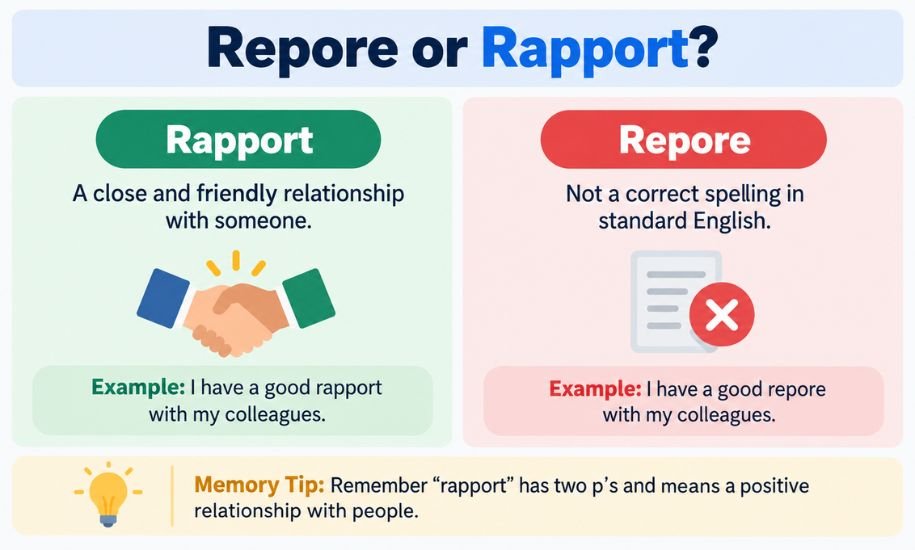
Rapport is the correct spelling, while repore is a misspelling when referring to a friendly, trusting relationship between people. Rapport is a noun that describes mutual understanding, trust, and comfortable communication. For example, “I have a good rapport with my colleagues” is the correct sentence.
Repore or Rapport: Which Is Correct?
Rapport is the correct spelling in standard English. It refers to a positive connection between people who communicate comfortably, understand one another, or share mutual trust.
Repore is a common spelling mistake that occurs because people often write the word as they hear it. It is not an accepted alternative spelling of rapport in standard English.
| Feature | Repore | Rapport |
|---|---|---|
| Correct spelling | No | Yes |
| Meaning | No standard meaning for this context | A positive interpersonal connection |
| Part of speech | Not standard for this meaning | Noun |
| Pronunciation | Phonetic misspelling | ruh-PORE |
| Formal writing | Incorrect | Correct |
| Example | Build a repore | Build rapport |
For example:
- Correct: She has a good rapport with her students.
- Incorrect: She has a good repore with her students.
If you are writing an email, an academic assignment, a professional report, or a casual message, use rapport to describe a positive relationship.
What Does Rapport Mean?
Rapport is a noun that describes a friendly, harmonious, and understanding relationship between two or more people. When people have rapport, they generally feel comfortable communicating with each other and may find it easier to share thoughts, exchange ideas, and work together.
Rapport does not necessarily mean that people are close friends or agree on every subject. Two people can have rapport simply because they respect each other, communicate openly, and understand one another’s perspectives.
For example:
- The teacher developed a strong rapport with her students. This means the teacher established a comfortable and trusting relationship with the class.
- I have a good rapport with my manager. This means the speaker communicates well and has a positive working relationship with their manager.
- The doctor quickly established rapport with the patient. This suggests the patient felt comfortable communicating with the doctor.
- Their natural rapport made the conversation enjoyable. This means they interacted comfortably and understood each other well.
The word is particularly useful when describing relationships that involve trust, cooperation, mutual respect, and effective communication.
Is Repore a Real Word?
Repore is not a standard English spelling of the word used to describe a positive relationship. It is generally considered a misspelling of rapport, rather than a separate word with an established meaning in this context.
The mistake usually happens when someone learns the word by hearing it instead of seeing it written down. Since the final t in rapport is silent in its usual English pronunciation, the spelling may seem unfamiliar.
For example:
- Incorrect: We have built a strong repore over the years.
- Correct: We have built a strong rapport over the years.
Similarly:
- Incorrect: He has excellent repore with his customers.
- Correct: He has excellent rapport with his customers.
If you intend to describe a positive relationship, always choose rapport.
How to Pronounce Rapport
The word rapport is commonly pronounced ruh-PORE, although the vowel sound can vary slightly between English accents. The stress usually falls on the second syllable, and the final t is silent.
Its pronunciation can make the spelling confusing, especially for people encountering the word for the first time.
A useful way to learn it is to remember that the spoken word does not reveal every letter in its written form. Although you do not hear the final t, you must include it when spelling the word.
Examples of Rapport in Sentences
Seeing the word in different contexts can make it easier to understand how to use it naturally. Here are some examples of correct usage.
| Sentence | Context |
|---|---|
| I have a good rapport with them. | Personal relationships |
| She built rapport with her new colleagues. | Workplace |
| The teacher has an excellent rapport with her class. | Education |
| A counsellor needs to establish rapport with clients. | Counselling |
| The manager maintains a positive rapport with employees. | Leadership |
| Their rapport was clear during the interview. | Communication |
| Good listening skills can help develop rapport. | Interpersonal skills |
| The coach shares a strong rapport with the players. | Sports |
| It took time to develop rapport with the new team. | Teamwork |
| The interviewer established rapport with the guest. | Interviews |
These sentences show that rapport can describe relationships in personal, educational, and professional situations.
Correct vs Incorrect Examples
The following examples demonstrate how to correct common spelling errors.
– Incorrect: I want to build a good repore with my clients. Correct: I want to build a good rapport with my clients.
– Incorrect: The teacher has a friendly repore with the children. Correct: The teacher has a friendly rapport with the children.
– Incorrect: They developed a strong repore during their first meeting. Correct: They developed a strong rapport during their first meeting.
– Incorrect: Good repore is important for teamwork. Correct: Good rapport is important for teamwork.
In each example, replacing repore with rapport makes the sentence correct without changing its intended meaning.
What Does Rapport Mean in Psychology?
In psychology, rapport refers to a positive interpersonal connection that encourages trust, mutual understanding, and comfortable communication. It is particularly relevant in counselling, psychotherapy, interviews, and other situations in which people need to communicate openly.
For example, a therapist may work to establish rapport with a client so the client feels comfortable discussing personal experiences. Similarly, a researcher conducting an interview may build rapport to help participants feel at ease when sharing their perspectives.
Rapport can involve several elements:
- Trust: Feeling confident that the other person will treat you respectfully.
- Empathy: Showing an understanding of another person’s feelings or experiences.
- Active listening: Paying attention and responding thoughtfully.
- Mutual respect: Recognising and valuing the other person’s perspective.
- Comfortable communication: Being able to express thoughts without unnecessary discomfort.
Rapport can support meaningful conversations, but it does not guarantee agreement, trust in every situation, or a particular psychological outcome.
Good Rapport With Someone: Meaning and Usage
Having good rapport with someone means sharing a positive connection that makes communication easier and more natural. It can develop between friends, family members, colleagues, teachers, students, and people meeting for the first time.
For instance, when someone says, “I have a good rapport with my colleagues,” they mean they communicate comfortably and maintain positive working relationships.
The expression is commonly used with verbs such as build, develop, establish, and maintain.
- Build rapport: Gradually create a positive relationship.
- Develop rapport: Strengthen a connection over time.
- Establish rapport: Create an initial sense of understanding and trust.
- Maintain rapport: Preserve a positive relationship through continued interaction.
These expressions are all grammatically correct, although the best choice depends on whether the relationship is beginning, growing, or continuing.
Synonyms for Rapport
Several words have meanings similar to rapport, but they are not interchangeable in every sentence.
| Synonym | Meaning |
|---|---|
| Connection | A sense of being linked to someone |
| Understanding | Awareness of another person’s perspective |
| Harmony | A peaceful or cooperative relationship |
| Bond | A close emotional or interpersonal connection |
| Relationship | A connection between people |
| Trust | Confidence in another person |
| Compatibility | The ability to interact or work well together |
| Affinity | A natural liking or attraction |
| Empathy | Understanding another person’s feelings |
For example, connection is a broad alternative, while trust refers specifically to confidence in someone. Rapport often combines elements of understanding, comfort, and positive interaction.
Why Do People Confuse These Spellings?
The confusion mainly comes from the difference between the written form and the spoken form of rapport.
There are a few reasons someone might write repore instead:
- Phonetic spelling: People may attempt to spell the word according to how it sounds.
- Silent final letter: The final t is not usually pronounced in English, making the spelling less obvious.
- French origin: The word retains a French-derived spelling that may be unfamiliar to some English learners.
- Limited exposure: Someone who has heard the word in conversations but rarely read it may not know its standard spelling.
Recognising these reasons can help you avoid the mistake in future writing.
Easy Way to Remember the Correct Spelling
An easy way to remember rapport is to focus on its two P’s and its final T.
SPELLING TIP
R-A-P-P-O-R-T
Remember the double P and the silent final T.
Think of the final T as a letter you write but do not pronounce. This can help you recall the correct spelling whenever you use the word.
You can also practise by writing a simple sentence, such as “I have a good rapport with my team.” Repeated exposure to the correct form can make it easier to remember.
Common Mistakes to Avoid
When using this word, keep the following points in mind:
- Writing repore instead of rapport: Always use the standard spelling when describing a positive relationship.
- Leaving out a P: The correct word contains two P’s, not one.
- Leaving out the final T: Even though it is silent, the final T is essential to the spelling.
- Confusing rapport with friendship: Rapport describes a positive connection, but the people involved do not have to be close friends.
- Using a synonym without considering context: Words such as trust, bond, and connection have related meanings but may not communicate exactly the same idea.
Being aware of these mistakes will help you use the word accurately in both casual and formal writing.
Frequently Asked Questions
1. Is it repore or rapport?
Rapport is the correct standard English spelling when referring to a positive relationship between people. Repore is a misspelling and should not be used in formal or standard writing to express this meaning.
2. What does “I have a good rapport with them” mean?
It means you have a positive relationship with those people. You communicate comfortably, understand each other, and generally interact with mutual respect and trust.
3. Is repore an accepted alternative spelling of rapport?
No. Repore is not an accepted standard alternative spelling of rapport. Although it may appear in informal writing as a phonetic misspelling, the correct spelling remains rapport in both British and American English.
4. How do you pronounce rapport?
Rapport is commonly pronounced ruh-PORE, with the stress on the second syllable. The final t is silent in its usual English pronunciation, which is one reason the spelling can be difficult to remember.
5. What is a synonym for rapport?
Depending on the context, synonyms include connection, understanding, harmony, bond, and affinity. The most suitable alternative depends on whether you want to emphasise trust, emotional closeness, or comfortable communication.
6. Is rapport a noun or a verb?
Rapport is a noun. It describes a positive relationship or connection between people. You can use it with verbs such as build, develop, establish, or maintain, as in “They developed a strong rapport.”
Final Verdict: Repore or Rapport?
Rapport is the correct spelling when describing a friendly, trusting, and understanding relationship. Repore is a misspelling that often results from the way the word is pronounced. Remember the double P and the silent final T to avoid this error in your writing. At Grammarifyr, our goal is to help you understand these differences so you can know the difference and use the right words with confidence.
You may also Read : Knaw or Gnaw: Meaning, Spelling and Examples
One Comment