Leaped or Leapt: Meaning, Difference, and Examples
When writing about a jump, sudden movement, or quick reaction, should you use leaped or leapt? Both spellings are correct, but their usage can vary between American and British English. Since they are different past-tense forms of the verb leap, it is easy to wonder whether one is more appropriate than the other. Understanding their meanings, pronunciation, grammatical forms, and regional preferences can help you choose the right word for your writing.
Quick Answer
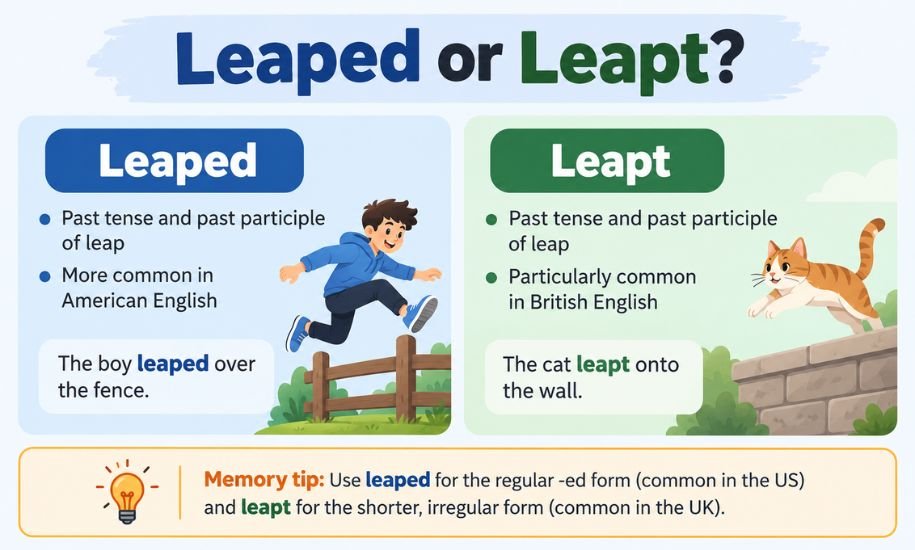
Both leaped and leapt are correct past-tense and past-participle forms of the verb leap, meaning to jump or move suddenly. Leaped is generally more common in American English, while leapt is particularly common in British English. Both are acceptable in formal and informal writing.
Leaped or Leapt: What’s the Difference?
The main difference between these two words is their spelling and regional preference, not their meaning. Both describe an action that has already happened, such as jumping over an obstacle, moving suddenly, or reacting with excitement.
| Feature | Leaped | Leapt |
|---|---|---|
| Correct spelling | Yes | Yes |
| Meaning | Jumped or sprang | Jumped or sprang |
| Part of speech | Verb | Verb |
| Past tense | Yes | Yes |
| Past participle | Yes | Yes |
| American English | Generally more common | Also used |
| British English | Also used | Particularly common |
| Formal writing | Acceptable | Acceptable |
| Pronunciation | /liːpt/ | /lept/ |
For example:
- The athlete leaped over the final hurdle.
- The athlete leapt over the final hurdle.
Both sentences are grammatically correct and communicate exactly the same action. You can choose either form based on your preferred writing style or audience.
What Does Leaped Mean?
Leaped is the past-tense and past-participle form of leap. It describes jumping, springing, or moving suddenly from one position to another. It can also refer to sudden emotional reactions, rapid increases, or significant progress.
The word follows the regular English pattern of adding -ed to a verb to form its past tense.
Examples of leaped in sentences:
- The rabbit leaped across the garden and disappeared into the bushes.
- She leaped from her seat when she heard the unexpected announcement.
- The player leaped high into the air to catch the ball.
- The company’s revenue leaped significantly after the new product launch.
In the first three examples, leaped describes physical movement or a sudden reaction. In the final example, it refers to a rapid increase.
The form leaped is particularly common in American English, but it is also correct in British and other varieties of English.
What Does Leapt Mean?
Leapt is another accepted past-tense and past-participle form of leap. It has the same definition as leaped and can be used in both literal and figurative contexts.
Unlike leaped, which follows the regular -ed pattern, leapt is an irregular form of the verb. It is especially common in British English and is frequently found in literature, storytelling, and everyday communication.
Examples of leapt in sentences:
- The deer leapt over the fallen tree.
- His heart leapt with happiness when he received the good news.
- The child leapt into his father’s arms.
- The temperature leapt unexpectedly during the afternoon.
In these examples, the word describes jumping, an emotional response, or a sudden change.
Although leapt is often associated with British English, it is also used in American English. It is not an exclusively British spelling.
Leaped vs Leapt in American and British English
Both forms are standard in English, but their frequency differs across regional varieties.
American English
In American English, leaped is generally the more frequently used form. It follows the familiar regular past-tense pattern, making it a natural choice in everyday writing, journalism, and professional communication.
Examples:
- The dog leaped over the garden fence.
- She leaped at the opportunity to join the project.
- The company’s stock leaped after the announcement.
However, American writers can also use leapt without making a grammatical error.
British English
In British English, leapt is particularly common and is often preferred in everyday writing and literature. Nevertheless, leaped is also an accepted spelling.
Examples:
- The fox leapt across the narrow path.
- He leapt to his feet when the music started.
- The athlete leapt over the barrier.
Both spellings are understood in the United Kingdom, and neither should be considered universally incorrect.
What about Canadian English?
Canadian English uses influences from both British and American spelling conventions. Both leaped and leapt are acceptable, and the choice can depend on the writer, publication, or context. If you are writing for a particular Canadian publication, follow its preferred style guide.
How to Pronounce Leaped and Leapt
Although both words have the same meaning, their standard pronunciations differ in the vowel sound.
| Word | IPA pronunciation | Simple guide |
|---|---|---|
| Leaped | /liːpt/ | Leept |
| Leapt | /lept/ | Lept |
| Leap | /liːp/ | Leep |
Leaped has a long ee vowel sound, similar to the vowel in sleep or keep. Leapt has a shorter e sound, similar to the vowel in kept or slept.
The final consonant sounds are the same in both words. Paying attention to the vowel is the easiest way to distinguish their standard pronunciations.
How to Use Leaped and Leapt in Sentences
Both forms can be used in a variety of situations, including physical actions, emotional reactions, and figurative expressions.
Physical movement
- The kangaroo leaped across the open field.
- The gymnast leapt from the platform into the pool.
- The boy leaped over a puddle on his way to school.
Emotions and reactions
- Her heart leapt when she saw her family waiting at the airport.
- He leaped with excitement after hearing the results.
- The audience leapt to their feet at the end of the performance.
Sudden changes and progress
- The number of customers leaped during the holiday season.
- The team’s performance leapt forward after months of training.
- Housing prices leapt following the announcement.
These examples show that both spellings work in the same grammatical structures. The choice does not change the meaning of the sentence.
Related Forms of the Verb Leap
Understanding the different forms of leap makes it easier to use leaped and leapt correctly.
| Verb form | Word | Example |
|---|---|---|
| Base form | Leap | I leap over small obstacles. |
| Third-person singular | Leaps | She leaps across the stream. |
| Past tense | Leaped / Leapt | He leaped over the wall. |
| Past participle | Leaped / Leapt | They have leapt into action. |
| Present participle | Leaping | The cat is leaping onto the table. |
Both past-tense forms can also be used with helping verbs such as has, have, and had.
For example:
- She has leaped over several hurdles.
- She has leapt over several hurdles.
- They had leaped into action before the situation worsened.
- They had leapt into action before the situation worsened.
All these sentences are grammatically correct.
Common Mistakes to Avoid
Although leaped and leapt are both correct, a few mistakes can occur when using these verb forms.
- Using lept: The spelling lept is not the standard past-tense form of leap. Use leaped or leapt instead.
- Assuming leapt is incorrect in American English: Both forms are accepted in American English, even though leaped is generally more common.
- Assuming leaped is incorrect in British English: British English accepts both spellings, despite the preference for leapt in many contexts.
- Mixing verb tenses: Use the appropriate form according to the sentence. For example, “She leaped yesterday” is correct, while “She has leaped yesterday” is generally inappropriate in standard English because the specific past-time expression calls for the simple past.
Choosing the appropriate tense and maintaining consistency are more important than choosing one accepted spelling over the other.
Easy Way to Remember the Difference
A simple way to remember these forms is to think of leaped as the regular past-tense form and leapt as the established irregular alternative.
- Leaped: Follows the familiar -ed ending, like jumped and walked.
- Leapt: Has a shorter spelling and follows an irregular pattern, like kept and slept.
If you are writing primarily for an American audience, leaped is a natural default. For a British audience, leapt is also a natural choice. When writing for an international audience, either form is suitable, as long as you use it consistently.
Frequently Asked Questions
Is leaped or leapt grammatically correct?
Both are grammatically correct. They are accepted past-tense and past-participle forms of leap. You can use either to describe a completed jump, sudden movement, or figurative change without altering the sentence’s meaning.
Is leapt British or American English?
Leapt is particularly common in British English, but it is also accepted in American English. Similarly, leaped is widely used in American English and is also correct in British English.
Is leaped more common than leapt?
Leaped is generally more common in American English, while leapt is more common in British English. However, usage varies between writers, publications, and contexts, so neither form is restricted to a particular region.
Can I use leapt in formal writing?
Yes. Leapt is suitable for formal writing, including academic, professional, and journalistic contexts. It is a standard verb form, not slang or an informal alternative. Follow the relevant publication’s style guide if one is provided.
Is lept ever a correct spelling?
Lept is not the standard spelling of the past tense or past participle of leap. In standard English, use leaped or leapt instead.
What is the past participle of leap?
Both leaped and leapt can function as the past participle of leap. For example, “The horse has leaped over the fence” and “The horse has leapt over the fence” are both correct.
Final Verdict: Leaped or Leapt?
Both leaped and leapt are correct spellings of the past tense and past participle of leap. The main distinction is regional preference, with leaped generally more common in American English and leapt particularly common in British English. Choose the form that suits your audience and maintain consistency throughout your writing. At Grammarifyr, understanding these small differences helps you know the difference and use the right words with confidence.
You may also Read : Carmel or Caramel: Meaning and Pronunciation