Carmel or Caramel: Meaning and Pronunciation
The words Carmel and caramel look and sound almost identical, which can make it difficult to know which one to use. The difference becomes clearer when you consider their meanings. One is the name of places, people, and institutions, while the other refers to a sweet made by heating sugar. Pronunciation adds to the confusion, particularly in American English, where caramel can be spoken with either two or three syllables. Understanding when to use each spelling will help you avoid mistakes in recipes, everyday writing, and formal communication.
Quick Answer
Both caramel and Carmel are correct, but they have different uses. Caramel is the sweet made from heated sugar and can also describe its flavor or color. Carmel, with one “a” after the “C,” is usually a proper noun, such as a place name or a person’s name.
Carmel or Caramel: What’s the Difference?
The main difference is meaning, not simply spelling. Caramel is a common noun associated with food, desserts, sauces, and flavors. Carmel is generally a proper noun used in names, such as Carmel-by-the-Sea in California or Mount Carmel.
| Feature | Caramel | Carmel |
|---|---|---|
| Correct spelling? | Yes | Yes |
| Main meaning | A sweet made by heating sugar | A proper name |
| Word type | Noun; also used as an adjective | Proper noun |
| Common use | Candy, sauce, flavor, color | Places, people, institutions |
| Example | She added caramel to her coffee. | They visited Carmel, California. |
If you are writing about a dessert, candy, topping, or flavor, use caramel. If you are referring to a person or place named Carmel, use Carmel.
What Does “Caramel” Mean?
Caramel is a noun that refers to a sweet substance produced by heating sugar until it melts and develops a golden-brown color and characteristic flavor. Depending on how it is prepared, caramel can be soft, chewy, hard, or pourable.
It is commonly used in desserts, confectionery, drinks, and baking. The word can also describe a flavor or a light golden-brown color.
Examples:
- She poured warm caramel over the vanilla ice cream.
- I ordered a caramel latte with extra milk.
- The recipe calls for caramel sauce and chopped nuts.
- The sofa was upholstered in a beautiful caramel-colored fabric.
In cooking, caramel can be made by heating sugar on its own or by combining it with ingredients such as cream or butter, depending on the recipe. It is used in sweets such as caramel candies, puddings, cakes, and sauces.
When caramel describes a color, it usually refers to a warm shade of golden, tan, or light brown.
What Does “Carmel” Mean?
Carmel is most often a proper noun. Unlike caramel, it does not refer to a type of food or a sweet flavor in standard English.
It appears in the names of geographical locations, religious sites, people, schools, and other institutions. For example, Carmel-by-the-Sea is a coastal city in California, and Mount Carmel is a biblical place name.
Examples:
- My family is planning a trip to Carmel, California.
- Mount Carmel is mentioned in the Bible.
- Carmel joined the school’s debate team.
- The Carmel community organized a local event.
Because Carmel is a proper noun, it should generally begin with a capital letter when used as a name. It should not be substituted for caramel when describing food.
Carmel vs. Caramel Pronunciation
Pronunciation is one of the main reasons these words are confused. In some accents, caramel sounds very similar to Carmel, even though their spellings and meanings differ.
The word caramel has two common pronunciations in English:
| Pronunciation | Syllables | Approximate sound |
|---|---|---|
| CARE-uh-mel | 3 | kar-uh-mel |
| KAR-mel | 2 | kar-mel |
Both pronunciations are used in American English. The three-syllable version is also common in British English, although pronunciation varies between speakers and regions.
Carmel is generally pronounced with two syllables or sounds, often like “KAR-mel.” This can make it sound identical or very close to the two-syllable pronunciation of caramel.
Caramel Pronunciation in American English
In American English, you may hear caramel pronounced as either “CARE-uh-mel” or “KAR-mel.” The two-syllable pronunciation is especially familiar in some regions, while other speakers clearly pronounce all three syllables.
Neither common pronunciation changes the spelling. If you are talking about the sweet, the correct written form remains caramel, even when you pronounce it like Carmel.
There is no single pronunciation map that perfectly divides these forms by state or region. Speech patterns overlap, and individual speakers may use different pronunciations.
Carmel or Caramel in Recipes and Sauces
When following a recipe, the correct spelling is almost always caramel if the instructions refer to a sweet ingredient, topping, or cooking process.
For example:
- Caramel sauce: A sweet, pourable sauce made with caramelized sugar and often cream or butter.
- Caramel candy: A chewy or firm confection made with sugar and other ingredients.
- Caramel filling: A sweet mixture used inside cakes, chocolates, or pastries.
- Caramel topping: A sauce or syrup drizzled over desserts and drinks.
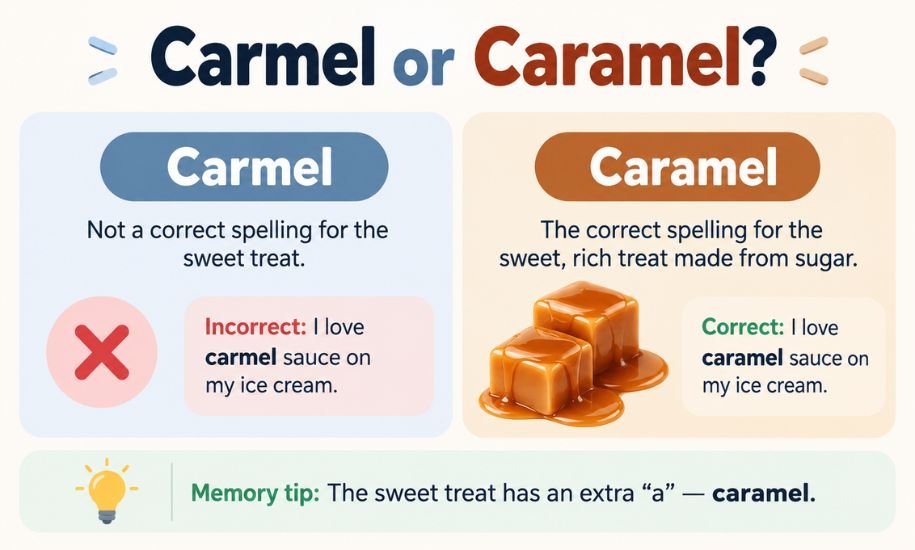
Correct: Add two tablespoons of caramel sauce to the mixture.
Incorrect: Add two tablespoons of Carmel sauce to the mixture.
The second spelling would be appropriate only if Carmel were part of a specific product, brand, or proper name.
Why Are These Words Confused?
There are a few straightforward reasons that Carmel and caramel are often mixed up.
- Similar pronunciation: The two-syllable pronunciation of caramel sounds like Carmel to many speakers.
- Similar spelling: Both words begin and end with nearly the same letters, making them easy to mix up when writing.
- Regional differences: English speakers pronounce caramel differently, which can influence how they spell it based on sound.
- Familiar names: People who know a place or person called Carmel may be more accustomed to that spelling.
The key is to focus on the meaning of the word rather than relying on how it sounds.
Common Mistakes to Avoid
A few simple checks can help you choose the right form.
| Mistake | Correct usage |
|---|---|
| Writing “Carmel sauce” for a regular dessert sauce | Caramel sauce |
| Spelling the sweet “Carmel” because it is pronounced with two syllables | Caramel |
| Using lowercase “carmel” for a specific place named Carmel | Carmel |
| Assuming “Carmel” is always a misspelling | Both words are correct in different contexts |
Remember that capitalization matters, too. Use Carmel when it is a proper name, but use caramel as a common noun or adjective.
Easy Way to Remember the Difference
A simple memory trick is to associate the extra “a” in caramel with “a sweet.”
- Caramel has an extra “a” and refers to the sweet food, sauce, or flavor.
- Carmel is commonly used as a name for places, people, and institutions.
If you are describing something you can eat, pour over a dessert, or add to coffee, you almost certainly need caramel. If you are naming a location or person, check whether the proper name is Carmel.
Frequently Asked Questions
Is Carmel or caramel the correct spelling?
Both are correct, but they have different meanings. Caramel refers to a sweet made by heating sugar, as well as its flavor or color. Carmel is usually a proper noun, such as a place or person’s name.
Is Carmel a real word or a misspelling?
Carmel is a real word when used as a proper noun. It is the name of places, people, and institutions. However, it is not the standard spelling for the sweet food, which is caramel.
Is caramel pronounced like Carmel?
Sometimes. In American English, caramel can be pronounced with two syllables, making it sound similar to Carmel. It can also be pronounced with three syllables. The pronunciation does not change the spelling when referring to the sweet.
Is caramel pronounced differently in American and British English?
Pronunciation varies in both varieties. American English commonly uses both two- and three-syllable pronunciations, while the three-syllable version is common in British English. Individual accents and speaking habits can differ.
Should I write Carmel or caramel sauce?
Use caramel sauce when referring to the sweet topping or ingredient. Use Carmel only if it is part of a specific proper name, such as a brand or named product.
How can I remember the difference between Carmel and caramel?
Connect caramel with sweets and desserts. The spelling with the extra “a” is the one used for the food, flavor, and color. Carmel is generally a name, so use it when referring to a person, place, or institution.
Final Verdict: Carmel or Caramel?
Both spellings are correct, but they are not interchangeable. Use caramel for candy, sauces, desserts, flavors, and colors. Use Carmel for proper names, such as locations or people. Even if the two words sound alike in your accent, their meanings determine which spelling belongs in your sentence. For more straightforward explanations of confusing English words, Grammarifyr helps you understand the difference and choose the right form.
You may also Read : Leach or Leech: Meaning, Examples, and Usage