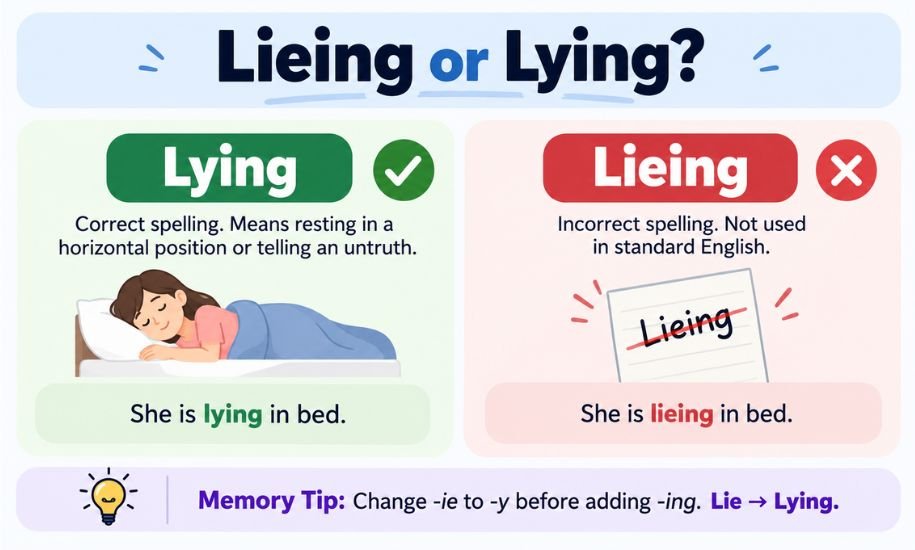
Lieing or Lying: Meaning, Rules, and Examples
When writing in English, it is easy to confuse words that sound similar but follow different spelling rules. “Lieing” or “lying” is a common example, especially when describing someone resting in bed or telling an untruth. Although both spellings may look reasonable at first, only one is accepted in standard English. Understanding the correct spelling, its meaning, and how it works in different sentences can help you avoid mistakes in everyday writing, emails, and academic work.
Quick Answer
Lying is the correct spelling, while lieing is a misspelling in standard English. Lying is the present participle of lie and can mean resting in a horizontal position or deliberately saying something untrue. For example, “She is lying in bed” and “He is lying about his age” are both correct.
Lieing or Lying: What Is the Difference?
The correct spelling is lying, not lieing. Although adding -ing to a verb often involves simply attaching the suffix to its base form, some verbs follow a spelling change.
When a verb ends in -ie, the -ie is generally changed to -y before adding -ing. This is why lie becomes lying rather than lieing.
| Word | Correct? | Explanation |
|---|---|---|
| Lying | Yes | Standard present participle of lie |
| Lieing | No | Nonstandard misspelling |
| Lie | Yes | Base form of the verb |
| Lied | Yes | Past tense of lie (to tell an untruth) |
| Lay | Yes | Past tense of lie (to recline) |
For example:
- Correct: The baby is lying on the blanket.
- Incorrect: The baby is lieing on the blanket.
- Correct: He is lying to his friends.
- Incorrect: He is lieing to his friends.
The spelling rule applies regardless of which meaning of lie you intend.
What Does Lying Mean?
The word lying has two main meanings in English. It can describe a person or object resting in a horizontal position, or it can refer to deliberately giving false information.
Lying as Resting or Reclining
When lying describes a physical position, it means resting, reclining, or being positioned horizontally. It is commonly used when talking about people, animals, or objects.
Examples include:
- My brother is lying on the sofa and watching television.
- She was lying in bed when the phone rang.
- The dog is lying on the floor near the door.
- He enjoys lying on the grass and looking at the clouds.
In these sentences, lying describes someone’s position rather than an action involving dishonesty.
Lying as Telling an Untruth
The second meaning refers to deliberately saying something false with the intention of misleading someone. It is the present participle of lie when the verb means to tell an untruth.
Examples include:
- He is lying about where he spent the weekend.
- She admitted to lying to her parents.
- The witness was lying about what happened.
- They have been lying to their customers.
In this context, lying is associated with dishonesty or deception. The meaning is determined by the sentence rather than the spelling.
Why Is “Lieing” Incorrect?
The confusion comes from the way English verbs form their present participles. Many verbs simply take -ing at the end, such as walk becoming walking and read becoming reading. However, verbs ending in -ie generally change their final letters before the suffix is added.
The -ie changes to -y, followed by -ing.
| Base verb | Correct form |
|---|---|
| Lie | Lying |
| Die | Dying |
| Tie | Tying |
| Vie | Vying |
For instance, dieing is incorrect in standard English when referring to the process of dying, just as tieing is generally incorrect when referring to tying something.
Therefore, the correct form is always lying in standard modern English, whether you are describing someone resting or someone being dishonest.
Lying Down, Lying in Bed, and Lying on the Floor
The word lying is frequently used with expressions that describe a physical position. In these phrases, it functions as the -ing form of the verb lie, meaning to recline or rest.
Lying down describes the act of moving into or remaining in a horizontal position.
Examples:
- I am lying down because I feel tired.
- She was lying down on the couch after lunch.
- The child is lying down on the carpet.
Lying in bed usually describes someone resting or remaining in bed.
Examples:
- My father is lying in bed and reading a newspaper.
- She spent the morning lying in bed.
- I was lying in bed when it started raining.
Lying on the floor describes someone or something resting on the floor.
Examples:
- The puppy is lying on the floor.
- He found his keys lying on the kitchen floor.
- The children were lying on the floor, playing with their toys.
In all these examples, lying is the correct spelling. Using lieing would be a spelling mistake.
Lying vs. Laying: Understanding the Difference
Although lying and laying look and sound similar, they have different grammatical uses. This distinction is important because the two words are often confused.
Lying is the -ing form of lie. When lie means to recline, it does not normally require a direct object.
Example: She is lying on the bed.
Laying is the -ing form of lay, which means to put or place something somewhere. It usually takes a direct object.
Example: She is laying the blanket on the bed.
| Lying | Laying |
|---|---|
| Present participle of lie | Present participle of lay |
| Means to recline or rest | Means to put or place something |
| Does not normally take a direct object | Usually takes a direct object |
| He is lying on the sofa. | He is laying a book on the sofa. |
Remember that lying can also mean telling an untruth, while laying does not have that meaning.
Lie, Lying, Lay, and Lied: Verb Forms Explained
The verb lie has different forms depending on its meaning and tense. Knowing these forms can prevent confusion in both speaking and writing.
| Verb form | To recline | To tell an untruth |
|---|---|---|
| Base form | Lie | Lie |
| Present participle | Lying | Lying |
| Simple past | Lay | Lied |
| Past participle | Lain | Lied |
Examples:
- Present: I lie on the couch after work.
- Present continuous: I am lying on the couch.
- Simple past (recline): I lay on the couch yesterday.
- Past participle (recline): I have lain here for an hour.
- Simple past (untruth): He lied to his teacher.
- Present continuous (untruth): He is lying to his teacher.
The important point is that the present participle is lying in both meanings, but the simple past forms differ.
Correct and Incorrect Examples of Lying
Seeing the spelling in context makes it easier to remember and apply correctly.
| Incorrect | Correct |
|---|---|
| She is lieing in bed. | She is lying in bed. |
| He was lieing to his parents. | He was lying to his parents. |
| The cat is lieing on the floor. | The cat is lying on the floor. |
| They are lieing about the results. | They are lying about the results. |
| I enjoy lieing in the sun. | I enjoy lying in the sun. |
Here are some additional examples of the correct usage:
- The book was lying on the desk when I entered the room.
- She realized that her friend had been lying to her.
- The children are lying on the grass and enjoying the sunshine.
- He denied lying about his previous experience.
Notice how the word remains unchanged even when the context changes.
Easy Ways to Remember the Correct Spelling
A simple way to remember the spelling is to learn the -ie to -y rule.
When a verb ends in -ie, replace those two letters with -y before adding -ing.
For example:
- Lie + ing = Lying
- Die + ing = Dying
- Tie + ing = Tying
You can also remember the word by comparing it with dying. Since dying is correct rather than dieing in the ordinary verb form, lying follows the same pattern.
If you are unsure while writing, remember that lying is used for both reclining and telling an untruth.
Frequently Asked Questions
Is lieing ever correct?
Lieing is not the standard spelling of the present participle of lie. In modern standard English, lying is used instead. You should use lying in academic assignments, professional communication, articles, and everyday writing.
Is it lying down or lieing down?
Lying down is correct. It describes a person or animal resting in a horizontal position. For example, “The dog is lying down beside the sofa” uses the correct spelling and grammatical form.
What is the meaning of lying?
Lying has two primary meanings. It can describe being in a horizontal resting position, such as lying in bed, or deliberately saying something untrue to deceive someone. The surrounding words help identify which meaning is intended.
Is lying in bed grammatically correct?
Yes, lying in bed is grammatically correct. It uses the present participle of lie to describe someone’s position or activity. For example, “She is lying in bed and listening to music” is a correct sentence.
How do you use lying in a sentence?
You can use lying to describe a physical position or dishonesty. For example, “The cat is lying on the floor” describes a position, while “He is lying about his mistake” refers to telling an untruth.
What is the past tense of lying?
It depends on the meaning. When lie means to recline, its past tense is lay, and its past participle is lain. When lie means to tell an untruth, its past tense and past participle are both lied.
Final Verdict: Lieing or Lying?
Lying is the correct spelling in standard English, while lieing is a misspelling. The word can describe someone resting in a horizontal position or deliberately telling an untruth, depending on the context. Remember the -ie to -y spelling rule to avoid this mistake. At Grammarifyr, our goal is to help you know the difference and use the right words with confidence.
You may also Read : Leaped or Leapt: Meaning, Difference, and Examples