Leach or Leech: Meaning, Examples, and Usage
“Leach” and “leech” sound exactly the same, but they have different meanings and uses. One usually describes the process of removing substances from a material, while the other refers to a worm-like animal that may feed on blood. The words can be confusing because they share the same pronunciation and differ by just one letter. Knowing when to use each spelling can help you avoid mistakes in writing, especially when discussing soil, water, animals, or someone who takes advantage of others.
Quick Answer
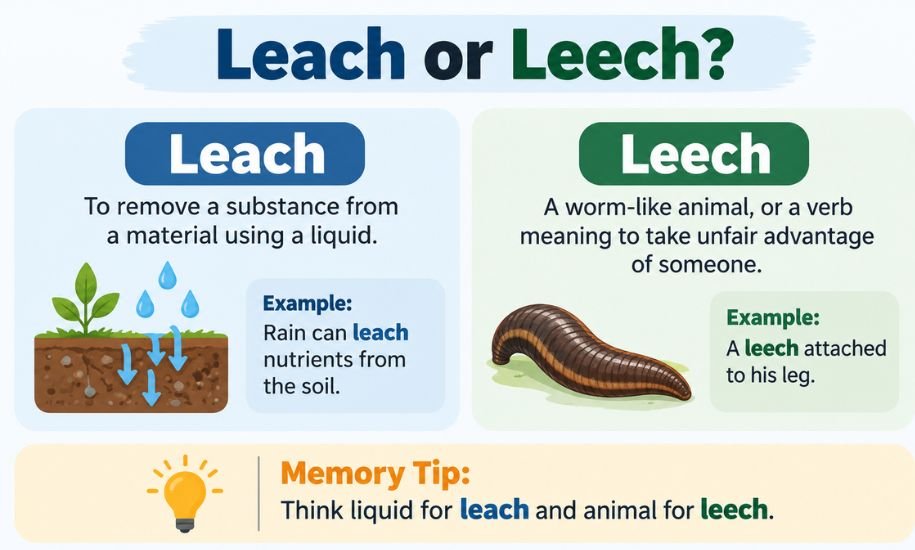
Both leach and leech are correct English words, but they have different meanings. Leach is mainly a verb meaning to remove a substance from a material through the action of a liquid. Leech is usually a noun for a worm-like animal, but it can also be a verb meaning to depend on or exploit someone unfairly.
Leach or Leech: What’s the Difference?
The main difference is that leach describes a process of extraction or removal, while leech most commonly refers to an animal. Although both words are pronounced /liːtʃ/, their meanings and grammatical uses are distinct.
| Feature | Leach | Leech |
|---|---|---|
| Main meaning | To remove a substance using a liquid | A worm-like animal |
| Part of speech | Mainly a verb | Noun and verb |
| Common usage | Soil, minerals, chemicals, and water | Animals, blood-feeding, and exploitation |
| Example | Rain can leach minerals from soil. | A leech attached to his leg. |
| Related form | Leachate | Leeches |
Neither word is a misspelling of the other. The right choice depends on what you want to describe.
What Does “Leach” Mean?
Leach is primarily a verb meaning to remove soluble substances from a solid material by allowing a liquid to pass through or act on it. The process is called leaching and is commonly discussed in agriculture, environmental science, chemistry, and mining.
For example, rainwater can leach nutrients from soil, while water passing through waste materials may carry unwanted chemicals into the surrounding environment.
Examples of “leach” in sentences:
- Heavy rainfall can leach essential nutrients from the garden soil.
- Some chemicals may leach into groundwater from poorly managed waste.
- The process is designed to leach valuable minerals from the ore.
- Overwatering can cause nutrients to leach away from plant roots.
The word also appears in related forms:
| Form | Example |
|---|---|
| Leach | Water can leach minerals from rocks. |
| Leaches | Rainwater leaches salts from the soil. |
| Leached | Some nutrients have leached out of the ground. |
| Leaching | Leaching can affect soil quality. |
A related noun is leachate, which refers to liquid that has passed through a material and picked up dissolved or suspended substances.
What Does “Leech” Mean?
A leech is a segmented, worm-like invertebrate belonging to the subclass Hirudinea. Some species feed on blood by attaching to animals or humans, while others are predators that feed on small invertebrates.
Leeches live in various environments, including freshwater habitats and damp areas. Not every leech feeds on blood, so it is inaccurate to assume that all leeches are bloodsuckers.
Examples of “leech” as a noun:
- A leech attached itself to his leg while he was walking through the marsh.
- The biologist studied a leech found in a freshwater pond.
- Some leeches feed on small aquatic animals rather than blood.
The word can also be used figuratively to describe a person who takes advantage of someone else’s money, time, or resources.
For example:
- He felt his cousin was a leech because he constantly borrowed money and never repaid it.
- She was tired of people who leeched off her generosity.
As a verb, leech is often used in the phrase leech off, meaning to depend on someone else in an exploitative or unfair way. It is generally informal and can sound critical.
Leach or Leech for an Animal, Dog, or Collar?
When referring to the animal, the correct word is leech. A leech is a living creature, while leach describes the removal of substances by a liquid.
However, if you are talking about something used to walk or control a dog, the word you probably need is leash, not leach or leech.
- Leech: A worm-like animal that may feed on blood.
- Leach: To remove substances through the action of a liquid.
- Leash: A strap or cord used to lead or restrain a dog.
Examples:
- Correct: The leech was found near the riverbank.
- Correct: Rain can leach nutrients from the soil.
- Correct: She attached the dog’s leash to its collar.
A collar is worn around a dog’s neck, while a leash is attached to the collar or harness to guide the dog. Neither leach nor leech is the correct term for this equipment.
Does a Leech Leach?
A leech does not leach simply by being a leech. The two words describe different things: leech names the animal, whereas leach refers to a process involving the removal of substances by liquid.
A leech may feed on blood, but that process is not normally described as leaching. The verb leach is more appropriate when a liquid carries dissolved substances out of a material, such as when rainwater removes minerals from soil.
Examples:
- Correct: A leech attached to the animal and fed on its blood.
- Correct: Rainwater leached minerals from the soil.
- Incorrect: The leach attached to the animal and fed on its blood.
Should You Use “Leach Off” or “Leech Off”?
When describing someone who takes advantage of another person’s resources, the usual expression is leech off, not leach off.
“Leech off” is an informal phrasal verb that means to depend on someone else in a way that is considered unfair, selfish, or exploitative.
Examples:
- He continues to leech off his parents instead of finding a job.
- She does not want her friends to leech off her generosity.
- They accused him of leeching off the family’s savings.
By contrast, leach is normally used with words such as out, away, from, or into when describing substances being removed or carried by liquid.
Examples:
- Water can leach minerals out of the rock.
- Chemicals may leach into nearby groundwater.
- Heavy rain can leach nutrients away from the soil.
Use leech off for exploitative dependence and leach for the movement or removal of substances.
Is “Leach” or “Leech” the Word for a Fruit?
Neither leach nor leech is the standard name for a fruit. If you mean the small tropical fruit with a rough, reddish shell and sweet, translucent flesh, the correct spelling is lychee.
Lychee is a tropical fruit native to parts of Asia. It is commonly eaten fresh and also used in desserts and drinks.
Examples:
- We bought fresh lychees from the market.
- Lychee has a sweet, floral flavour.
- She added lychee to the fruit salad.
Although lychee looks and sounds somewhat similar to leach and leech, it is a separate word with a different meaning.
Leach vs. Leech: Etymology
The words have different historical backgrounds, despite having the same modern pronunciation.
Leach is associated with the Old English verb leccan, meaning “to wet” or “moisten.” Its modern scientific use developed around the process of liquids passing through materials and carrying substances away.
Leech comes from the Old English lǣce, a word associated with a physician or healer, as well as the animal. Leeches were historically used in medicine for bloodletting, which helps explain the historical connection between the animal and healing.
Their shared pronunciation does not mean that the two words have the same origin or meaning.
Common Mistakes to Avoid
Here are a few mistakes that can occur when using these words:
- Using “leach” for the animal: Write “A leech attached to his foot,” not “A leach attached to his foot.”
- Using “leach off” for exploitation: The usual phrase is “leech off someone.”
- Confusing “leash” with “leech”: A dog is walked on a leash, not a leech.
- Using “leech” for chemical removal: Write “The water can leach chemicals from the material.”
- Spelling “lychee” as “leach” or “leech”: Use lychee when referring to the fruit.
Easy Way to Remember the Difference
A simple way to remember the distinction is to associate leach with liquid. Both begin with “l,” but thinking of the liquid helps you recall that leaching involves a liquid carrying substances away.
For leech, remember the animal. If you are talking about a worm-like creature or someone who unfairly takes advantage of another person, leech is the word you need.
You can also remember the three related words:
- Leach: Liquid removes substances.
- Leech: Animal or exploitative person.
- Leash: Strap used to lead a dog.
Frequently Asked Questions
Is “leach” or “leech” the correct spelling?
Both are correct spellings, but they have different meanings. Leach usually means to remove substances through the action of a liquid. Leech refers to a worm-like animal and can also mean to exploit someone’s resources when used as a verb.
Is a leech an animal?
Yes. A leech is a segmented invertebrate in the subclass Hirudinea. Some species feed on blood, while others are predators. Leeches are found in a range of environments, including freshwater habitats.
Can “leech” be used as a verb?
Yes. Leech can be used as a verb, especially in the expression leech off. It means to depend on someone else’s resources in a way that is considered unfair or exploitative. For example, “He leeches off his friends.”
What does “leach” mean in soil?
In soil, leach describes the removal of soluble substances, such as nutrients or salts, when water moves through the ground. Depending on the conditions, leaching can reduce nutrients available to plants or carry contaminants into groundwater.
Is “leach off” grammatically correct?
Leach off can occur in contexts involving substances being removed, but it is not the usual expression for exploiting another person. In that context, use leech off, as in “She does not want him to leech off her.”
Is “lychee” the same as “leech”?
No. A lychee is a tropical fruit, while a leech is a worm-like invertebrate. The words are similar in spelling and sound but refer to entirely different things.
Final Verdict: Leach or Leech?
Use leach when describing a liquid removing substances from a material, such as rainwater leaching nutrients from soil. Use leech when referring to the animal or to someone who unfairly depends on another person’s resources. If you mean the strap used to walk a dog, choose leash; if you mean the tropical fruit, use lychee. Understanding these distinctions makes it easier to choose the right word, a goal that Grammarifyr supports through clear explanations of commonly confused English terms.
You may also Read : Heros or Heroes: Meaning, Spelling and Examples