Heros or Heroes: Meaning, Spelling and Examples
When writing about brave people, inspiring individuals or fictional characters, you may wonder whether the correct spelling is heros or heroes. Although both forms appear in different contexts, only one is the standard plural of the word hero. The confusion often comes from English pluralisation rules, as many nouns form their plurals simply by adding -s. However, some words ending in -o follow a different pattern. Understanding this small spelling difference will help you write more accurately in everyday conversations, academic assignments and professional communication.
Quick Answer
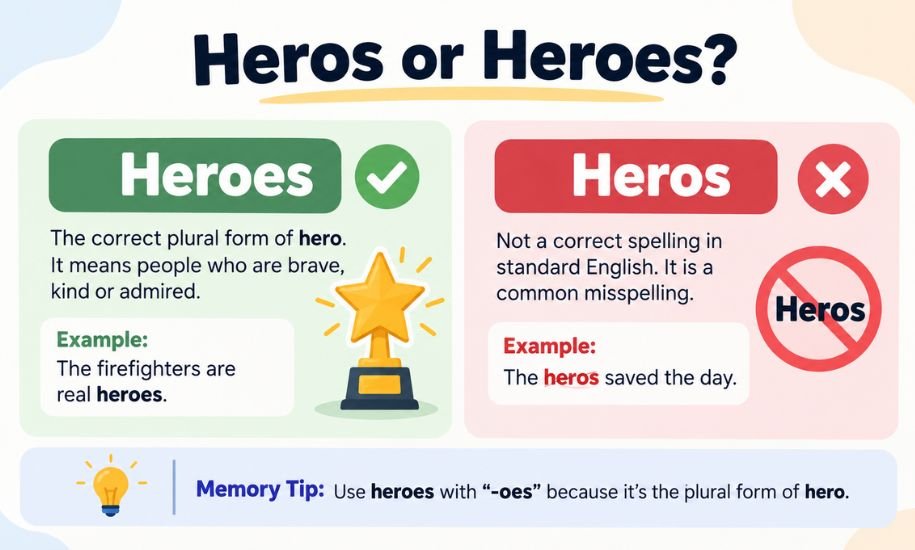
Heroes is the correct standard plural of hero in both British and American English. Use heroes when referring to brave people, admired individuals or fictional characters. Heros is generally considered a misspelling in these contexts, although it can be used in certain specialised cases, such as a regional spelling for a type of sandwich.
Heros or Heroes: Which Is Correct?
Heroes is the correct spelling when you are talking about more than one hero. It is the standard plural form used in British English, American English and other major varieties of English.
The word hero refers to someone admired for courage, exceptional achievements, selflessness or significant contributions. When referring to multiple people or characters with these qualities, the word changes to heroes.
For example:
- The firefighters were celebrated as heroes after rescuing the family.
- The heroes of the story worked together to protect their village.
- Many children consider their parents to be their heroes.
- The soldiers returned home as national heroes.
In each sentence, heroes is the grammatically correct plural. Writing heros instead would be a spelling error in standard English.
| Feature | Heros | Heroes |
|---|---|---|
| Standard plural of hero | No | Yes |
| Correct in formal writing | No | Yes |
| British English | Nonstandard | Correct |
| American English | Nonstandard for people | Correct |
| Refers to multiple brave people | Incorrect | Correct |
| Example | The heros arrived. | The heroes arrived. |
The important point is that heroes should be your default choice whenever you are writing about more than one heroic person or character.
What Does “Hero” Mean?
A hero is a noun used to describe someone who is admired for their courage, kindness, achievements or willingness to help others. A hero may perform an extraordinary act of bravery, make a meaningful contribution to society or inspire people through their actions.
The word also describes the central character in a story, novel, film or television programme, particularly when that character plays a leading role in the narrative.
Here are some common uses of the word:
- A courageous person: Someone who risks their safety to protect or rescue others.
- An inspiring individual: Someone admired for their achievements, values or positive influence.
- A fictional protagonist: The main character in a story, film, comic book or television series.
- A role model: Someone whose actions inspire others to behave positively.
For example:
- The lifeguard became a hero after saving two swimmers.
- My grandfather has always been my hero.
- The hero of the novel faces several difficult challenges.
- The community honoured the teacher as a local hero.
When referring to more than one person, the noun takes the plural form heroes.
Why Does Hero Become Heroes?
English pluralisation rules are not always consistent. While many nouns form their plurals by adding -s, certain words ending in -o take -es instead.
The word hero belongs to the latter group. Its final letter does not simply take an -s to create the standard plural. Instead, an -es is added, producing heroes.
Consider these examples:
| Singular | Plural |
|---|---|
| Hero | Heroes |
| Potato | Potatoes |
| Tomato | Tomatoes |
| Echo | Echoes |
| Torpedo | Torpedoes |
| Photo | Photos |
| Piano | Pianos |
| Radio | Radios |
As the table shows, not every noun ending in -o follows the same pattern. Some take -es, while others simply add -s.
Therefore, it is better to learn the standard plural of each word rather than assume that all nouns ending in -o follow one universal rule.
A helpful way to remember the spelling is to associate hero with potato and tomato. All three form their standard plurals by adding -es.
Heros or Heroes in UK and US English
There is no spelling difference between British and American English when hero refers to a courageous person, an admired individual or a fictional character.
Both varieties use heroes as the standard plural.
British English
- The emergency workers were praised as heroes.
- The heroes of the story were celebrated at school.
American English
- The firefighters were recognised as local heroes.
- The film features several fictional heroes.
Although British and American English differ in spellings such as colour and color or centre and center, hero does not have different standard plural forms in these varieties.
If you are writing for a UK audience, use heroes. The same applies to US readers, educational materials, news articles and formal documents.
Is “Heros” Ever a Correct Word?
Although heros is incorrect as the standard plural of hero when referring to people, it can appear in specialised contexts.
One example is the American sandwich known as a hero. This is a long bread roll filled with ingredients such as meat, cheese, vegetables and sauces. Depending on the region and dictionary, heros may be used as a plural spelling for this food.
For example:
- We ordered two meatball heros from the local deli.
- The restaurant serves Italian chicken heros for lunch.
The spelling heroes is also used for this sandwich meaning, so heros is not the only acceptable option.
Additionally, Heros may appear in proper names, brand names or titles. In these cases, the spelling is determined by the particular name rather than the ordinary pluralisation rule.
However, when referring to brave people, fictional protagonists or admired individuals, always use heroes in standard English.
Heros or Heroes: Examples in Sentences
The easiest way to understand the distinction is to see how the correct spelling works in everyday writing.
Correct examples
- The doctors and nurses were recognised as heroes for their dedication.
- The heroes of the film joined forces to save the city.
- My parents are my greatest heroes because they have always supported me.
- The children read stories about legendary heroes from ancient mythology.
- The rescue team became heroes after helping people during the flood.
- Every hero in the book has a unique story.Incorrect examples
- The firefighters were praised as heros.
- The story follows three brave heros.
- Our school honoured the heros of the community.In these examples, replace heros with heroes to make the sentences correct in standard English.
These examples also demonstrate that heroes can be used as the subject, object or complement of a sentence.
Heroes, Hero’s and Heroes’: Understanding the Difference
Another common source of confusion is the difference between heroes, hero’s and heroes’. Although these forms look similar, they have different grammatical functions.
| Form | Meaning | Example |
|---|---|---|
| Hero | Singular noun | The hero saved the child. |
| Heroes | Plural noun | The heroes saved the child. |
| Hero’s | Singular possessive | The hero’s costume was damaged. |
| Heroes’ | Plural possessive | The heroes’ costumes were damaged. |
Heroes simply refers to more than one hero. Hero’s indicates that something belongs to one hero, while heroes’ indicates possession by multiple heroes.
For example, in the sentence “The heroes’ bravery inspired the entire town,” the apostrophe comes after the s because the bravery is associated with multiple heroes.
Remember that the plural form does not need an apostrophe unless you are expressing possession or a contraction in another grammatical construction.
Common Mistakes to Avoid
When using the plural of hero, a few mistakes are worth watching for.
- Writing heros instead of heroes: Use heroes for the standard plural of hero.
- Writing superheros instead of superheroes: The same plural spelling applies to compound words formed with hero.
- Adding an unnecessary apostrophe: Heroes is plural, while hero’s is usually possessive or a contraction.
- Assuming all words ending in -o take -es: Words such as photo and piano take -s in their standard plurals.
- Treating it as a UK-US spelling difference: Both British and American English use heroes for multiple heroic people.
Avoiding these errors will make your writing clearer and help you use plural nouns and possessives correctly.
What About the Heroes TV Show and Its Cast?
Heroes is also the title of an American science-fiction television series that premiered in 2006. The show follows ordinary people who discover they have extraordinary abilities and explores how their lives become connected.
The original cast includes Milo Ventimiglia as Peter Petrelli, Hayden Panettiere as Claire Bennet, Zachary Quinto as Sylar, Masi Oka as Hiro Nakamura, Jack Coleman as Noah Bennet and Ali Larter as Niki Sanders.
The title is officially spelt Heroes, with an -es ending. This is a proper title rather than an example of a different pluralisation rule. When discussing the programme, retain its official spelling.
Easy Way to Remember the Correct Spelling
A simple way to remember the correct plural is to connect hero with other familiar nouns that take -es.
Think of this pattern:
- Hero → Heroes
- Potato → Potatoes
- Tomato → Tomatoes
You can also remember the phrase: “Heroes have an extra e.”
Whenever you are referring to more than one courageous person, fictional protagonist or admired individual, use heroes. If you are unsure, remember that the standard plural does not simply add an s to hero.
Frequently Asked Questions
Is “heros” or “heroes” correct in English?
Heroes is the correct standard plural of hero in English. Use it when referring to multiple brave people, inspiring individuals or fictional characters. Heros is generally a misspelling in these contexts, although it can occur in specialised food-related usage and proper names.
Is “heroes” correct in British English?
Yes. Heroes is the accepted plural in British English, just as it is in American English. There is no regional spelling difference for this word when referring to multiple people or fictional characters.
What is the plural of hero in the Oxford Dictionary?
The standard plural form of hero is heroes. This is the form used in standard English dictionaries and is appropriate for formal writing, school assignments, articles and everyday communication.
Is “heros” a real word?
Heros can appear as a specialised plural for a type of American sandwich, and it may also occur in proper names and titles. However, it is not the standard plural of hero when referring to people.
Is it “superheros” or “superheroes”?
Superheroes is the correct standard plural of superhero. The word follows the same pluralisation pattern as hero, adding -es rather than only -s.
Do heroes need an apostrophe?
No apostrophe is needed when heroes is simply the plural of hero. Use hero’s to indicate possession by one hero and heroes’ to indicate possession by more than one hero.
Final Verdict: Heros or Heroes?
The correct standard spelling is heroes, whether you are writing in British or American English. It is the plural of hero and is used for courageous people, admired individuals and fictional characters. Although heros may appear in specialised contexts, it is not appropriate as the ordinary plural. Understanding this simple spelling rule will help you write with confidence, and Grammarifyr is here to help you know the difference and use the right words.
You may also Read : Vender or Vendor: Meaning, Difference and Examples
One Comment