Challenge or Challange: Correct Spelling and Meaning
When writing in English, it is easy to mix up words that sound similar but have different spellings. Challenge or challange is one such example. Although both forms may look reasonable at first glance, only one is accepted in standard English. The confusion often comes from the way the word is pronounced and the spelling patterns of similar words. Knowing the correct form will help you write more clearly in emails, school assignments, professional documents, and everyday conversations.
Quick Answer
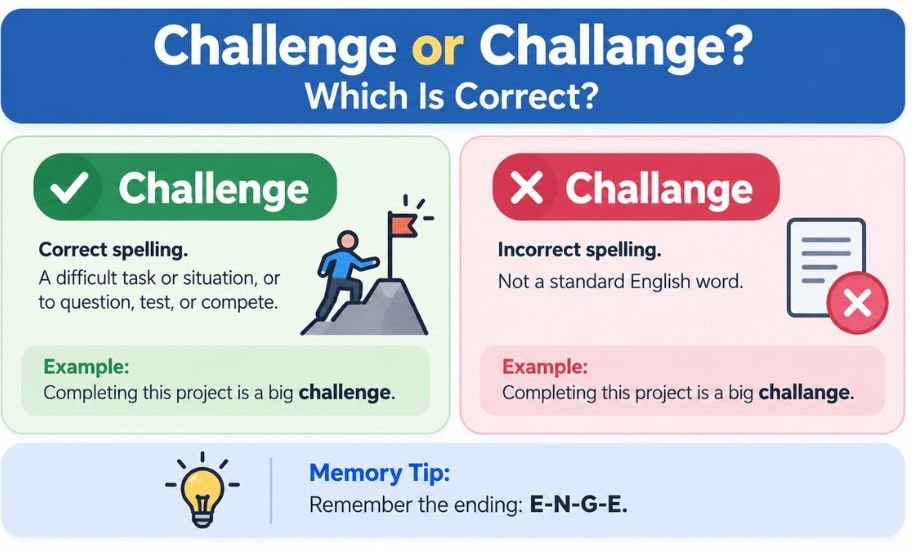
Challenge is the correct spelling, while challange is a misspelling. The word challenge can be used as a noun to describe a difficult task or situation, or as a verb meaning to question, test, or invite someone to compete. It is spelled the same way in both British and American English.
Challenge or Challange: Which Is Correct?
The correct spelling is challenge, with an e after the g in the final syllable. Challange is not a standard English spelling and should be avoided in formal and informal writing.
| Word | Correct? | Explanation |
|---|---|---|
| Challenge | Correct | Standard English spelling |
| Challange | Incorrect | Common spelling mistake |
For example:
- Correct: Completing the project was a difficult challenge.
- Incorrect: Completing the project was a difficult challange.
The spelling does not change between American and British English. You should always use challenge, regardless of your intended audience.
What Does Challenge Mean?
Challenge is a word that functions as both a noun and a verb. Its meaning depends on how it is used in a sentence.
Challenge as a Noun
As a noun, challenge refers to a difficult task, demanding situation, test of ability, or invitation to compete. It can describe something that requires effort, determination, or skill.
Examples:
- Learning a new language can be a rewarding challenge.
- The team faced a major challenge during the competition.
- She accepted the challenge of leading the project.
- Finding a solution to the problem was our biggest challenge.
The plural form is challenges, which refers to more than one difficult task, situation, or test.
Challenge as a Verb
As a verb, challenge means to question something, dispute a decision, test someone’s abilities, or invite someone to compete.
Examples:
- The student challenged the teacher’s explanation.
- Our coach challenged us to improve our performance.
- She decided to challenge the official decision.
- He challenged his friend to a game of chess.
In each sentence, the word describes an action rather than a difficult task itself.
Is Challange a Real Word?
Challange is a misspelling of challenge, not an accepted alternative in standard English. It does not have a separate dictionary meaning that should be used in place of the correct word.
The mistake may occur when writers rely on how the word sounds instead of remembering its spelling. However, in schoolwork, professional communication, articles, and other forms of standard writing, challenge is the appropriate form.
Why Do People Confuse These Spellings?
There are a few understandable reasons why someone might write the incorrect form.
- Pronunciation: The unstressed final syllable can make the vowel difficult to identify when spelling the word by sound.
- Similar words: Words such as change, strange, and arrange use the -ange ending, which may cause confusion.
- Typing mistakes: Writing quickly or being unfamiliar with the word can result in accidentally replacing the e with an a.
- Spelling uncertainty: Writers may remember the pronunciation but not the exact letter sequence.
Despite these similarities, the standard spelling remains challenge.
Correct Spelling Examples in Sentences
Seeing the correct form in different contexts can make it easier to remember and use.
Everyday situations
- Getting up early every morning is a challenge for me.
- She enjoys taking on new challenges in life.
- Cooking a complicated recipe was a fun challenge.
Education and work
- The final examination challenged the students’ knowledge.
- Managing multiple projects can be challenging.
- The company faced several challenges during its expansion.
Competition and disagreements
- The athlete accepted the challenge from her rival.
- He challenged the referee’s decision.
- The two teams challenged each other for the championship.
In each example, the spelling remains consistent, regardless of whether the word is used as a noun, verb, or part of a related form.
Different Forms of Challenge
The word has several related grammatical forms. Understanding them can help you avoid additional spelling mistakes.
| Word | Part of speech | Example |
|---|---|---|
| Challenge | Noun / Verb | I accept the challenge. |
| Challenges | Plural noun / Verb | She faces many challenges. |
| Challenged | Past tense / Past participle | They challenged the result. |
| Challenging | Adjective / Present participle | It was a challenging task. |
| Challenger | Noun | The challenger entered the competition. |
Notice that challenging uses an i before n, not an a. Similarly, the past tense is challenged, not challanged.
Easy Ways to Remember the Correct Spelling
A simple way to remember the spelling is to break the word into two parts:
CHALL + ENGE
Remember the final letters: E-N-G-E
Challenge = C-H-A-L-L-E-N-G-E
You can also remember the e by connecting the word with challenging. Both forms retain the same spelling pattern.
When in doubt, use a spellchecker or consult a dictionary, particularly when preparing formal writing.
Common Mistakes to Avoid
Some errors occur when writers change the spelling of the word in its related forms.
- Challange: Use challenge instead.
- Challanges: Use challenges for the plural form.
- Challanged: Use challenged for the past tense.
- Challanging: Use challenging as the adjective or present participle.
Remember that the correct spelling is maintained across the different forms, even when the ending changes.
Frequently Asked Questions
1. Is it challenge or challange?
Challenge is the correct spelling in standard English. Challange is a misspelling and should not be used in formal writing, educational assignments, or professional communication.
2. What is the meaning of challenge?
As a noun, challenge means a difficult task, demanding situation, or test of ability. As a verb, it means to question, dispute, test someone’s abilities, or invite someone to compete.
3. Is challange ever correct in British or American English?
No. Challenge is the standard spelling in both British and American English. There is no regional spelling difference between these varieties for this word.
4. What is the plural of challenge?
The plural of challenge is challenges. For example, “The students faced several challenges during the course.” The spelling challanges is incorrect.
5. How do you spell challenging?
The correct spelling is challenging, formed by adding -ing to challenge while dropping the final e. For example, “Learning a new skill can be challenging.”
6. What is the difference between challenge and challenging?
Challenge can be a noun or a verb, while challenging is commonly used as an adjective or a present participle. For example, “The challenge was difficult” uses a noun, while “The task was challenging” uses an adjective.
The Bottom Line
The correct spelling is challenge, not challange. It can describe a difficult task or an action such as questioning or testing something, and its spelling stays consistent in both British and American English. Remembering the -enge ending will help you avoid this mistake in your everyday writing. Grammarifyr helps you understand these spelling differences so you can know the difference and use the right words with confidence.
You may also Read : Lier or Liar: Difference, Meaning and Usage
One Comment