Breath or Breathe: Meaning, Pronunciation and Usage
The words breath and breathe look almost identical, and both are connected to the process of taking air into and out of your lungs. However, they have different meanings and grammatical functions, so they cannot always be used interchangeably. The difference becomes easier to understand when you know which word is a noun and which is a verb. Whether you are writing an email, completing a grammar exercise, or improving your everyday English, learning when to use each form will help you avoid a common spelling mistake.
Quick Answer
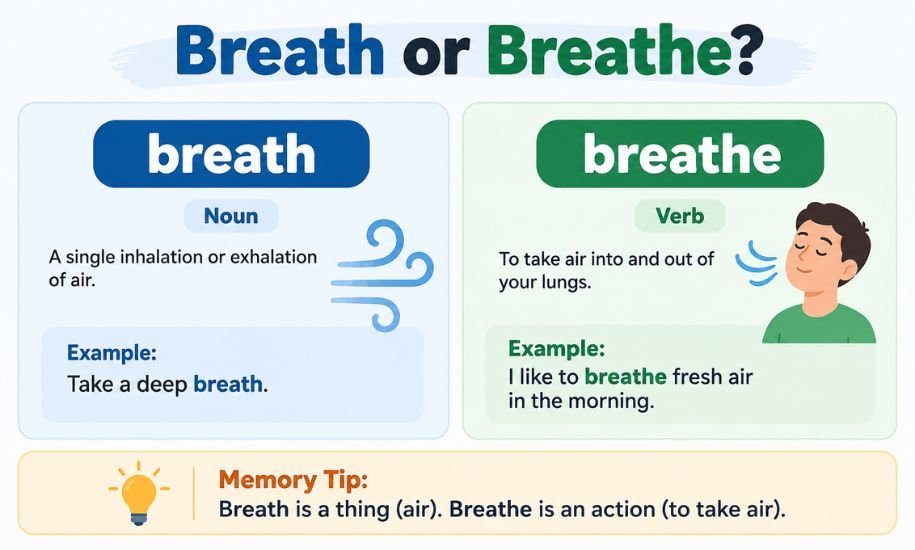
Both breath and breathe are correct English words, but they have different grammatical roles. Breath is a noun that refers to the air you inhale or exhale, while breathe is a verb that describes the action of taking air in and releasing it. You take a breath, but you breathe.
Breath or Breathe: What’s the Difference?
The main difference is that breath names something, whereas breathe describes an action. Although they are closely related in meaning, choosing the right word depends on how it functions in a sentence.
| Feature | Breath | Breathe |
|---|---|---|
| Part of speech | Noun | Verb |
| Meaning | Air taken in or released from the lungs | To inhale and exhale air |
| Pronunciation | /brɛθ/ | /briːð/ |
| Final sound | Unvoiced “th” | Voiced “th” |
| Typical use | Take a breath | Breathe deeply |
| Example | She took a deep breath. | She breathed deeply. |
| Related forms | Breaths | Breathes, breathed, breathing |
For example:
- Breath: Daniel took a slow breath before answering the question.
- Breathe: Daniel tried to breathe slowly to calm himself.
In the first sentence, breath refers to an act or amount of air taken into the lungs. In the second, breathe describes what Daniel is doing.
Both words are standard in British and American English. The difference is grammatical, not regional.
What Does Breath Mean?
Breath is a noun that refers to the air you take into and release from your lungs. It can describe a single act of breathing, the air itself, or the ability to breathe.
The word is used in everyday conversations, descriptive writing, and figurative expressions.
Examples of breath in sentences:
- She took a deep breath before walking onto the stage.
- His breath was visible in the freezing morning air.
- I was out of breath after running up the stairs.
- The doctor asked the patient to hold their breath for a moment.
In these examples, breath identifies the air or a particular instance of breathing rather than describing an action.
Common Expressions With Breath
Breath is also used in several familiar English expressions.
- Take a deep breath: To inhale deeply, often to relax or prepare for something.
- Hold your breath: To temporarily stop breathing.
- Out of breath: To be breathing heavily, often after physical activity.
- Catch your breath: To recover normal breathing after exertion.
- A breath of fresh air: Something refreshing, different, or welcome.
- Under your breath: To say something quietly so that others may not hear it.
- Waste your breath: To speak when your words are unlikely to change anything.
For example, “The new teacher was a breath of fresh air” means the teacher brought a welcome change to the environment.
What Does Breathe Mean?
Breathe is a verb that means to take air into the lungs and release it. It describes the physical process of respiration and can also be used figuratively to express life, movement, or vitality.
Unlike breath, which names the air or an instance of breathing, breathe tells the reader what someone or something does.
Examples of breathe in sentences:
- Try to breathe slowly when you feel nervous.
- The athlete struggled to breathe after the intense workout.
- She breathed deeply before beginning her speech.
- Most land animals breathe air to obtain oxygen.
The verb can also describe allowing air to circulate. For example, “These shoes allow your feet to breathe” means that the shoes allow better airflow.
Forms of the Verb Breathe
The verb changes depending on the tense and grammatical structure of the sentence.
| Verb form | Example |
|---|---|
| Base form | I breathe fresh air every morning. |
| Third-person singular | He breathes slowly. |
| Past tense | She breathed deeply. |
| Past participle | They have breathed a sigh of relief. |
| Present participle | The baby is breathing normally. |
| Infinitive | I need to breathe. |
Remember that breathed is the past tense and past participle of breathe. It is not interchangeable with the noun breath.
Breath or Breathe Pronunciation
Although the spellings differ by only one letter, the pronunciation of the two words is noticeably different.
Breath
/brɛθ/
Rhymes with “death”
The vowel is short, like the “e” in bed. The final “th” is unvoiced, as in think.
NOUN
Breathe
/briːð/
Rhymes with “seethe”
The vowel is long, like the “ee” in see. The final “th” is voiced, as in this.
VERB
One helpful way to practise is to say both words aloud and notice the difference in the vowel sound and the final consonant. When pronouncing breathe, your vocal cords vibrate during the final “th” sound, whereas they do not vibrate when you pronounce breath.
The distinction is the same in British and American English, although individual accents may affect the precise vowel quality.
Take a Deep Breath or Breathe?
Both expressions are grammatically correct, but they are used in different sentence structures.
Take a deep breath uses breath as a noun. The verb take is followed by the noun referring to the act or amount of air.
Breathe deeply uses breathe as a verb, with deeply describing how the action is performed.
Examples:
- Correct: Take a deep breath before your interview.
- Correct: Breathe deeply and relax your shoulders.
- Correct: She took a breath and continued speaking.
- Correct: He breathed slowly to regain his composure.
The incorrect form “Take a deep breathe” uses a verb where a noun is required.
Similarly, “Try to take a breathe” is incorrect because take a should be followed by the noun breath.
Out of Breath or Breathe?
The correct expression is out of breath, not out of breathe.
In this phrase, breath is a noun that refers to the air or breathing capacity someone has. The expression usually describes a person who is breathing heavily after physical effort.
Examples:
- I was out of breath after climbing the hill.
- She arrived at the classroom completely out of breath.
- The children were out of breath after playing football.
By contrast, breathe is used when describing the action itself.
- Correct: I need a moment to breathe.
- Correct: He found it difficult to breathe after running.
A simple way to remember the difference is that you are out of breath, but you may need to breathe.
Breath of Fresh Air: Meaning and Usage
A breath of fresh air is a common English idiom that describes someone or something that feels refreshing, positive, or different from what came before.
The phrase uses breath because it is a noun in the expression.
Examples:
- The new manager was a breath of fresh air for the team.
- Her creative approach brought a breath of fresh air to the project.
- The quiet countryside felt like a breath of fresh air after a busy week.
The expression is usually figurative, although it can also refer to actual fresh air.
Using breathe in this idiom would be incorrect. The established phrase is always a breath of fresh air.
Common Mistakes to Avoid
Because the two words look similar, it is easy to mix them up, particularly when writing quickly. Understanding the grammatical role of each word can help prevent these errors.
| Incorrect sentence | Correct sentence |
|---|---|
| Take a deep breathe. | Take a deep breath. |
| I can’t breath properly. | I can’t breathe properly. |
| She needs to breath. | She needs to breathe. |
| He was out of breathe. | He was out of breath. |
| Try to take a breathe. | Try to take a breath. |
A useful grammatical clue is to look at the words around the blank.
- After a, the, your or his, the noun breath is often needed when referring to an instance of breathing.
- After to, can, could, should or must, the base verb breathe is often needed.
For example, “You should breathe slowly” is correct because should is followed by a base-form verb. However, “You should take a breath” is also correct because the verb take is followed by the noun breath.
Easy Ways to Remember the Difference
A simple memory trick can make the distinction easier to recall.
Breath has no final e, just like death. Both are nouns. You can take a breath, just as you can experience a death.
Breathe has an extra e, just like the verb forms that describe an action. It is the word you use when someone is performing the action of inhaling and exhaling.
You can also remember this short sentence:
Take a breath. Breathe deeply.
Breath = noun · Breathe = verb
This sentence shows both words in their correct grammatical positions and is useful to remember when writing.
Frequently Asked Questions
Is breath or breathe correct?
Both are correct English words. Breath is a noun referring to air taken into or released from the lungs, while breathe is a verb describing the action of inhaling and exhaling. The correct choice depends on the sentence.
Is it take a breath or take a breathe?
The correct expression is take a breath. The word take is followed by a noun in this expression, and breath is the noun form. For example, “Take a breath before you answer.”
Is it hard to breath or hard to breathe?
The correct phrase is hard to breathe. The word to is followed by the base form of a verb, so breathe is required. For example, “It was hard to breathe in the smoky room.”
Is breathe a real word?
Yes, breathe is a standard English verb. It means to inhale and exhale air. Its related forms include breathes, breathed and breathing.
Is breath or breathe different in British English?
No. Both words have the same spelling and grammatical functions in British and American English. Breath is the noun, and breathe is the verb in both varieties.
How can I remember when to use each word?
Remember the sentence “Take a breath, then breathe.” Breath is the noun that names the air or act of breathing, while breathe describes the action. This simple distinction works in most everyday writing situations.
The Bottom Line
The difference between these two words comes down to their grammatical roles. Breath is a noun, while breathe is a verb. Use the first when referring to air or an instance of breathing, and the second when describing the action of inhaling and exhaling. Remembering the phrase “Take a breath, then breathe” can help you use both forms correctly. At Grammarifyr, Know the Difference. Use the Right Words. is a practical reminder that understanding small grammatical distinctions can make your writing clearer and more accurate.
You may also Read : Appreciate Synonym: 50+ Words for Every Situation

One Comment