Adviser or Advisor: Spelling, Meaning and Examples
If you are unsure whether to write adviser or advisor, you are not alone. The two forms look almost identical and have the same basic meaning: a person who gives advice. The good news is that both spellings are correct. The choice usually depends on regional usage, a particular style guide, or the official spelling used by an organization or job title.
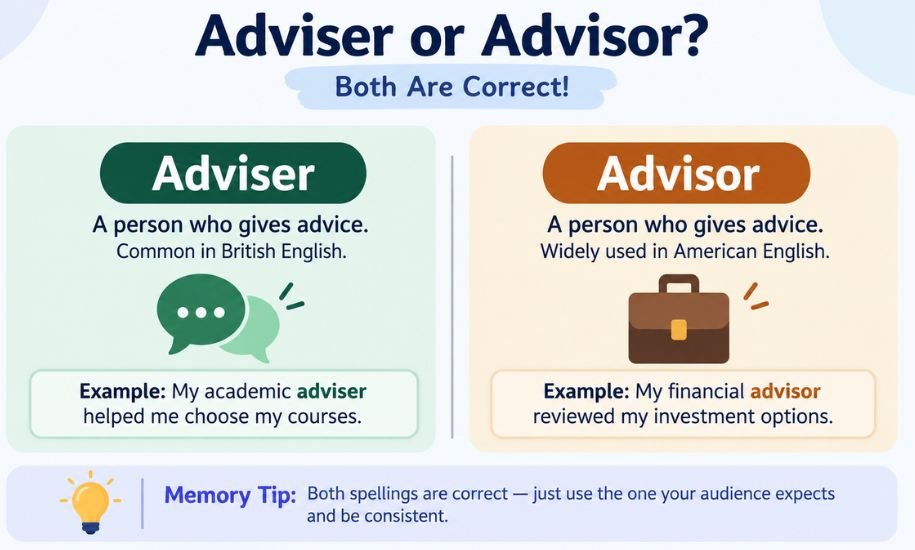
Adviser and advisor are both correct spellings. They mean the same thing: a person who gives advice. “Adviser” is traditionally common in British English and is preferred by some style guides, while “advisor” is widely used in American English and in many official titles.
Adviser vs. Advisor: The Key Difference
There is no major difference in meaning between adviser and advisor. Both are nouns referring to someone who provides advice, guidance, or recommendations.
| Feature | Adviser | Advisor |
|---|---|---|
| Correct spelling? | Yes | Yes |
| Meaning | A person who gives advice | A person who gives advice |
| Part of speech | Noun | Noun |
| Common variation | Traditional and widely used | Widely used, especially in American contexts |
| Plural | Advisers | Advisors |
| Example | She is my academic adviser. | She is my academic advisor. |
So, if you are asking is it advisor or adviser, the answer is that either can be correct.
The important thing is to follow the spelling expected by your audience, publication, employer, school, or organization.
What Does “Adviser” Mean?
Adviser is a noun for someone who gives advice or guidance.
For example:
- My academic adviser helped me choose my courses.
- The president met with several senior advisers.
- She works as a financial adviser.
- We asked an experienced business adviser for guidance.
The word can describe many different kinds of people, including academic advisers, financial advisers, political advisers, legal advisers, and personal advisers.
The spelling ending in -er is particularly well established in British English, although it is also used in American English.
What Does “Advisor” Mean?
Advisor has the same basic meaning as adviser. It describes a person who provides advice or guidance.
Examples include:
- My college advisor recommended several courses.
- The company hired a technology advisor.
- She is a senior policy advisor.
- We spoke to a financial advisor before making a decision.
The -or spelling is especially familiar in American professional and institutional usage. It also appears in British English, so it should not be treated as an exclusively American word.
Adviser or Advisor Spelling: Why Are Both Correct?
The difference is primarily a matter of spelling rather than meaning.
English contains many words with alternative spellings that developed through different usage traditions. Adviser and advisor are one such pair.
A useful way to think about them is:
adviser → advice + -er
advisor → advice + -or
However, these patterns do not mean that one spelling is grammatically superior to the other. Both have established usage.
If a dictionary, organization, or style guide specifically prefers one form, follow that preference. Otherwise, either spelling can be used in standard English.
American and British English Usage
Regional preference can influence which version you encounter most often.
Adviser has a strong traditional presence in British English. For example:
She spoke to her financial adviser about her pension.
Advisor is also used in British English, particularly in some official, professional, and institutional contexts.
In American English, advisor is very common, particularly in educational and professional settings:
I met with my academic advisor yesterday.
But American English also uses adviser. It would therefore be inaccurate to say that advisor is the only American form or that adviser is exclusively British.
The safest rule is to consider style and consistency, rather than assuming that one spelling is universally tied to one variety of English.
Financial Advisor or Adviser?
Both financial advisor and financial adviser are correct expressions.
For example:
We hired a financial advisor to review our investment options.
We hired a financial adviser to review our investment options.
Neither sentence contains a spelling error.
The choice can depend on the country, organization, publication style, or official professional title involved. If you are referring to a particular company or professional whose official title uses financial advisor, retain that spelling. If your publication’s style uses financial adviser, use that consistently.
The same principle applies to related expressions such as:
- investment adviser / investment advisor
- tax adviser / tax advisor
- legal adviser / legal advisor
- academic adviser / academic advisor
- business adviser / business advisor
Advisers or Advisors: Which Plural Is Correct?
The plural depends on the singular form you choose.
If the singular is adviser, the plural is:
advisers
If the singular is advisor, the plural is:
advisors
Both are grammatically correct.
For example:
The company employs several experienced advisers.
or:
The company employs several experienced advisors.
A common mistake is mixing the two forms unnecessarily. If you have chosen adviser throughout a document, it is generally clearer to write advisers rather than switching to advisors halfway through.
Examples of Correct Usage
Here are some natural examples showing how either spelling can work.
Adviser
- Her career adviser helped her prepare for the interview.
- The minister consulted his senior advisers.
- I arranged a meeting with my financial adviser.
- The school assigned each student an academic adviser.
Advisor
- Her career advisor helped her prepare for the interview.
- The minister consulted his senior advisors.
- I arranged a meeting with my financial advisor.
- The university assigned each student an academic advisor.
The meaning does not change simply because the spelling changes.
Is One Form More Formal?
You may sometimes hear that advisor is more formal or that adviser is the more traditional spelling. There is some variation in institutional preferences, but this should not be treated as a universal grammar rule.
Some organizations deliberately use advisor in official job titles. Others use adviser.
For example, if an institution officially calls someone a Senior Policy Adviser, changing the title to Senior Policy Advisor would alter the organization’s chosen wording even though the two forms have the same basic meaning.
When referring to an official title, use the organization’s actual spelling whenever possible.
How Do You Spell Advisor or Adviser?
If you are wondering how to spell the word, remember that there are two accepted forms:
- adviser
- advisor
Neither should automatically be marked as a misspelling.
The choice is more like choosing between an established spelling variant and another established spelling variant. The most important consideration is consistency.
For formal writing, check the relevant style guide if one applies. If you are writing for a particular company, school, government body, or publication, check whether it has an established preference.
Common Mistakes to Avoid
1. Assuming one spelling is wrong
It is incorrect to claim that advisor is always wrong or that adviser is always wrong. Both are established English spellings.
2. Treating the words as different professions
An adviser and an advisor do not represent two different types of professionals simply because their titles are spelled differently.
3. Mixing plural forms
Use:
adviser → advisers
and:
advisor → advisors
4. Changing an official title
If an organization’s official title says Financial Adviser, do not automatically change it to Financial Advisor merely because you prefer the other spelling.
5. Assuming the regional rule is absolute
It is useful to associate adviser with traditional British usage and advisor with widespread American usage, but neither spelling belongs exclusively to one variety of English.
An Easy Way to Remember the Difference
There is no complicated grammar rule to memorize.
Just remember:
Adviser and advisor both give advice.
The only difference in the words themselves is the final spelling:
advis + er → adviser
advis + or → advisor
For the plural, simply keep the same ending:
adviser → advisers
advisor → advisors
If you are following a style guide, use its preferred form consistently.
Frequently Asked Questions
Is “adviser” or “advisor” correct?
Both are correct. Adviser and advisor are alternative spellings of a noun meaning someone who gives advice. Your choice can depend on regional usage, a style guide, or an organization’s official terminology.
Is “advisor” or “adviser” more common in American English?
Advisor is widely used in American English, particularly in academic, business, and professional contexts. However, adviser is also standard American English and is preferred by some publications and style guides.
Is “adviser” British English?
Adviser is strongly established in British English, but advisor is also used in Britain. Therefore, it is better to describe adviser as a traditional or common British form rather than saying that advisor is incorrect in British English.
Should I write “financial advisor” or “financial adviser”?
Either can be correct. Use the spelling preferred by your audience, style guide, or the professional organization you are referring to. Both expressions describe someone who provides financial advice.
Are “advisers” and “advisors” both correct?
Yes. Advisers is the plural of adviser, while advisors is the plural of advisor. Both are grammatically correct.
Which spelling should I use in formal writing?
Choose the form required by your publication, employer, institution, or style guide. If there is no specific requirement, either spelling is acceptable; consistency is more important than choosing one as universally correct.
The Bottom Line
Adviser and advisor are both correct. They have the same basic meaning, and the main difference is spelling and usage preference. Adviser is traditionally common in British English, while advisor is widely used in American professional and institutional contexts, but the forms overlap across varieties of English. For polished writing, follow the relevant style guide or official terminology and remain consistent. For more clear explanations of easily confused English forms, Grammarifyr helps you know the difference and use the right words.
You may also Read : Busing or Bussing: Meaning and Correct Usage