Lier or Liar: Difference, Meaning and Usage
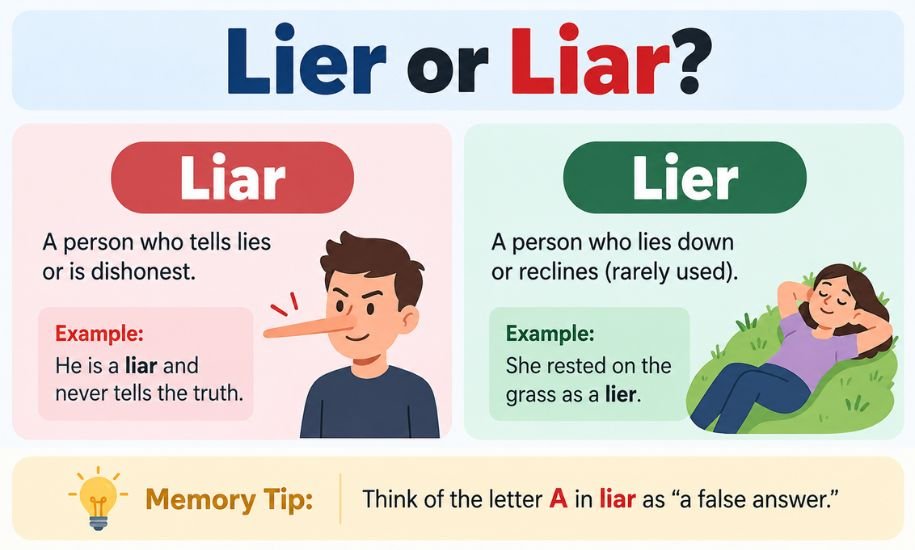
Have you ever wondered whether to write lier or liar when describing someone who tells lies? Although these two words look and sound almost identical, they have different meanings. Liar is the standard word for a person who deliberately tells untruths, while lier is a real but uncommon word associated with someone who lies down or lies in wait. Understanding this distinction can help you avoid spelling mistakes and choose the right word in everyday conversations, academic writing, and professional communication.
Quick Answer
Liar is the correct and standard spelling when referring to someone who tells lies or makes false statements. Lier is also a real English word, but it is rarely used and generally refers to someone who lies down or lies in wait. If you are talking about dishonesty, always use liar.
Lier or Liar: What’s the Difference?
The main difference between these words is their meaning and how they are used. Both are nouns, and both are pronounced approximately the same way, but they are not interchangeable.
| Feature | Liar | Lier |
|---|---|---|
| Meaning | A person who tells untruths | Someone who lies down or lies in wait |
| Part of speech | Noun | Noun |
| Spelling | Standard for dishonesty | Correct but rare |
| Pronunciation | LYE-er | LYE-er |
| Everyday usage | Common | Uncommon |
| Example | He is a liar. | The term can describe one who reclines. |
| Related verb | Lie (tell an untruth) | Lie (recline or remain in position) |
In ordinary writing, liar is the word you need when describing a dishonest person. Although lier exists in dictionaries, it is uncommon in modern everyday English, and more natural expressions are usually available when referring to someone reclining or lying in wait.
What Does Liar Mean?
A liar is a person who deliberately says something that is not true, often to mislead someone, hide information, or avoid responsibility. The word is a noun derived from the verb lie, meaning to tell an untruth.
It can describe someone who tells a single deliberate lie or someone who repeatedly makes false statements. The context determines how strongly the word is being used.
Examples of liar in sentences:
- He is a liar who makes up stories to impress his friends.
- Sarah called her colleague a liar after discovering the truth.
- Nobody believed the habitual liar because he had repeatedly deceived them.
- The witness was accused of being a liar, but no evidence supported the accusation.
- I do not want to be known as a liar, so I always try to tell the truth.
The plural form of liar is liars. It can be used in casual conversations, stories, news reports, and formal writing when the description is appropriate and supported by the context.
For example:
- Singular: The liar apologized for his actions.
- Plural: The liars eventually admitted that they had fabricated the story.
It is worth remembering that calling someone a liar implies deliberate dishonesty, rather than simply being mistaken.
Is Lier a Real Word?
Yes, lier is a real English word, although it is rarely used in modern conversation and general writing. It is formed from the verb lie in the sense of reclining or remaining in a position, rather than telling an untruth.
A lier may refer to someone who lies down or reclines. The word can also be used for someone or something that lies in wait, although these meanings are uncommon.
Examples of lier in context:
- The old dictionary used lier to describe someone who reclines.
- In a historical text, the word lier may refer to a person lying in wait.
- The unusual term appeared in a literary passage describing someone resting on the ground.
These examples illustrate the word’s dictionary meanings, but they are not typical expressions in present-day English. Most writers would say a person lying down, someone reclining, or someone lying in wait instead.
Therefore, lier is not simply a misspelling of liar. It is a legitimate but rare word with a different meaning.
Why Are These Two Words Confused?
The confusion between lier and liar mainly comes from their similar spelling, pronunciation, and connection to the verb lie.
There are two different meanings of lie in English:
- Lie (to tell an untruth): To deliberately say something false.
- Lie (to recline): To rest or remain in a horizontal or particular position.
Both words are formed in relation to these different meanings. A liar tells untruths, whereas a lier is associated with reclining or lying in wait.
Their pronunciation is also very similar. Both are generally pronounced LYE-er, so the difference is not obvious when speaking. This makes it particularly easy to confuse them when writing from memory.
The best way to avoid mistakes is to consider the intended meaning before choosing the spelling.
Lier or Liar in a Sentence
Seeing the words in context makes their difference easier to understand. The following examples demonstrate how to use liar correctly and where lier may appear in its rare sense.
Examples using liar:
- My brother admitted that he had been a liar about the missing money.
- The politician was called a liar by his opponent, who disputed his statement.
- She does not trust him because he has a reputation as a liar.
- A liar may lose the confidence of friends and family.
- He felt guilty about being a liar and decided to confess.
Examples relating to lier:
- The word lier can describe a person who reclines.
- The historical passage used lier for someone who lay in wait.
- The dictionary listed lier as a rare noun related to lying down.
Correct vs. incorrect usage
- Correct: He is a liar because he repeatedly tells false stories.
- Incorrect: He is a lier because he repeatedly tells false stories.
- Natural: The man is lying on the grass.
- Rare: The man is a lier.
The distinction is especially important in formal writing, where using the wrong word may confuse the intended meaning.
Liar Synonyms and Related Words
If you want to avoid repeating liar in your writing, several related words may be suitable. However, their meanings are not always identical, so choose one according to the situation.
| Synonym | Meaning |
|---|---|
| Deceiver | Someone who misleads another person |
| Fibber | Someone who tells lies, often minor or trivial ones |
| Fabricator | Someone who invents false information or stories |
| Dishonest person | Someone who behaves without honesty |
| Fraudster | Someone who uses deception, often for financial or personal gain |
| Impostor | Someone who pretends to be another person or to have an identity they do not possess |
| Mendacious person | Someone who is habitually or deliberately untruthful |
For example, fibber is often used in a lighter or less serious context, while fraudster generally suggests deception involving some form of fraudulent activity. These words can add precision to your writing when liar does not fully express the intended meaning.
Easy Way to Remember the Difference
A simple way to remember the distinction is to associate liar with lie as in telling an untruth.
- Liar: A person who tells lies.
- Lier: A rare word associated with lying down or lying in wait.
You can also remember the letter A in liar by associating it with a false answer. When someone deliberately gives a false answer, they may be described as a liar.
If you are writing about dishonesty, liar is the spelling to choose.
Common Mistakes to Avoid
Even though the difference is straightforward, some mistakes occur when writers use these words.
- Using lier to describe a dishonest person: The standard spelling is liar. For example, write “He is a liar,” not “He is a lier.”
- Assuming lier is always incorrect: It is a genuine but uncommon word, so it should not be dismissed as a spelling error in every context.
- Confusing lying with liar: Lying is the present participle of lie, while liar is a noun referring to a person who tells untruths.
- Calling every mistaken person a liar: A person can be wrong without deliberately lying. A liar implies intentional dishonesty.
Understanding these distinctions helps you communicate more accurately and avoid unnecessary confusion.
Frequently Asked Questions
1. Is it lier or liar?
Liar is the correct spelling when referring to a person who tells lies. Lier is also a valid but rare English word associated with someone who lies down or lies in wait. The two words have different meanings and should not be used interchangeably.
2. Is lier a real word in English?
Yes, lier is a real English noun found in dictionaries. It is associated with the physical meaning of lie, such as reclining or lying in wait. However, it is rarely used in modern everyday English, where expressions such as lying down are more natural.
3. What is the plural of liar?
The plural of liar is liars. For example, “The liars eventually admitted that they had told false stories.” The word follows the usual English rule of adding -s to form the plural of most nouns.
4. What is the difference between lying and liar?
Lying is a verb form that describes the act of telling an untruth or, in another sense, reclining. Liar is a noun describing someone who deliberately tells untruths. For example, “He is lying to his parents” describes an action, while “He is a liar” describes the person.
5. Are lier and liar pronounced the same?
Yes, in standard English, lier and liar are generally pronounced the same way, as LYE-er. Their similar pronunciation is one reason they are easily confused in writing. The intended meaning determines which spelling is appropriate.
6. What is another word for liar?
Some alternatives to liar include deceiver, fibber, fabricator, and dishonest person. The best choice depends on the context. For instance, fibber can describe someone who tells minor lies, while deceiver can refer to someone who misleads others more broadly.
Final Verdict: Lier or Liar?
The right choice depends on what you want to express. Liar is the standard spelling for someone who deliberately tells untruths, while lier is a rare, legitimate word associated with reclining or lying in wait. For everyday conversations, schoolwork, and professional writing about dishonesty, use liar. Understanding this small but meaningful difference is another way to know the difference and use the right words with Grammarifyr.
You may also Read : Indigo vs Violet: Key Differences Explained

One Comment