Indigo vs Violet: Key Differences Explained
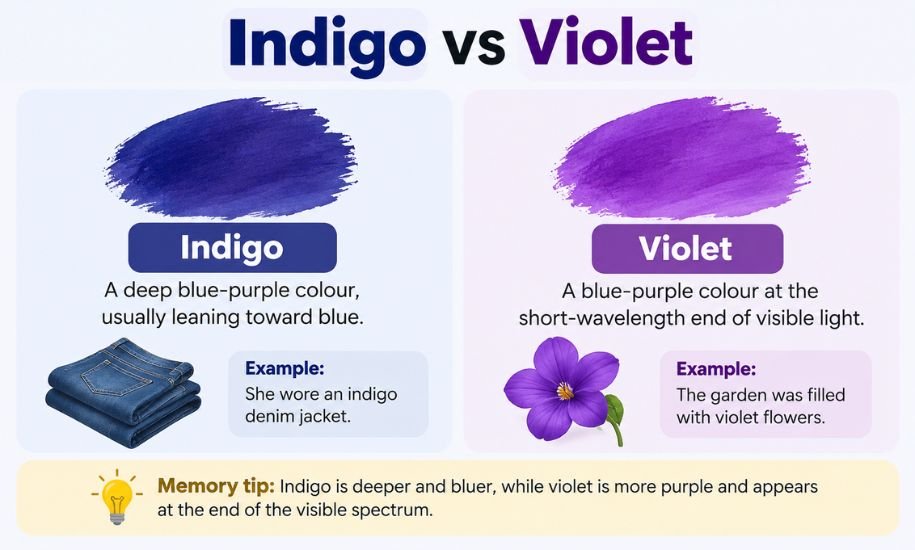
Indigo and violet are two closely related colors that are often confused because they both have a mixture of blue and purple tones. They appear next to each other in the traditional rainbow and share similar characteristics, but they are not exactly the same. The main difference is that indigo is generally a deeper, bluer shade, while violet is usually brighter and more distinctly purple. Their differences also relate to light wavelength, colour perception and how they are used in art, fashion and design. Understanding these distinctions makes it easier to identify, compare and use both colours correctly.
Quick Answer
Indigo is a deep blue-purple colour, while violet is a more distinctly purple colour associated with the shortest wavelengths of visible light. Both are traditionally included in the rainbow, with indigo appearing between blue and violet. Although their shades can overlap, indigo generally looks darker and bluer, whereas violet often appears brighter and more purple.
Indigo vs Violet: What’s the Difference?
The primary difference between indigo and violet is their appearance and position in the visible light spectrum. Indigo is usually described as a dark blue-violet shade, while violet is associated with a more pronounced purple hue and the short-wavelength end of visible light.
Indigo
Deep, dark blue-purple
Hex: #4B0082
Violet
Brighter, more vivid purple
Hex: #7F00FF
Digital colour examples. The appearance of each shade may vary between screens and lighting conditions.
| Feature | Indigo | Violet |
|---|---|---|
| Appearance | Deep blue with a purple tint | Blue-purple or vivid purple |
| Typical shade | Darker and bluer | Often brighter and more purple |
| Rainbow position | Between blue and violet | At the violet end |
| Approximate wavelength | 425–450 nm | Around 380–450 nm, depending on classification |
| Frequency | Generally lower | Generally higher |
| Common associations | Denim, dyes and deep blue tones | Flowers, spectral light and purple hues |
| Digital colour example | #4B0082 | #7F00FF |
| Common uses | Clothing, textiles and interiors | Art, graphics, fashion and decoration |
These are general distinctions rather than strict rules. Colour names such as indigo and violet cover a range of shades, and their boundaries are not universally fixed.
What Is Indigo?
Indigo is a deep colour that sits between blue and violet in traditional colour classifications. It combines the richness of blue with a noticeable purple undertone, creating a dark and distinctive appearance.
The name also refers to a natural dye historically obtained from plants that produce indigo pigment. This dye has been used to colour fabrics for centuries and is particularly associated with traditional textiles and denim.
Indigo can appear slightly different depending on the material, lighting and colour mixture. Some shades look almost navy blue, while others have a stronger violet appearance.
Examples of indigo in everyday life include:
- Denim: Deep blue jeans and other indigo-dyed garments.
- Interior design: Dark blue-purple walls, cushions and decorative fabrics.
- Art: Paints, inks and pigments used to create deep blue-violet tones.
- Nature: Some flowers and plants display shades that are described as indigo.
For example:
- She wore a dark indigo jacket with black trousers.
- The artist used indigo paint to create depth in the night sky.
- The curtains were made from rich indigo fabric.
Indigo is also traditionally listed as one of the seven colours of the rainbow, although its status as a separate spectral band is not universally accepted.
What Is Violet?
Violet is a colour found at the short-wavelength end of the visible light spectrum. It appears after blue and indigo in the traditional rainbow sequence and is often described as a vivid blue-purple shade.
Unlike indigo, which is commonly associated with dark blue tones, violet is often represented by brighter and more noticeable purple hues. However, violet can also be pale, muted or dark, depending on the particular shade.
Violet is visible in nature, especially in flowers, and is also widely used in painting, graphic design, clothing and decoration.
Examples of violet in everyday life include:
- Flowers: Violet-coloured petals and other purple-blue floral shades.
- Art: Bright violet pigments used in paintings and illustrations.
- Fashion: Violet dresses, accessories and decorative patterns.
- Lighting: Violet light produced by suitable light sources.
For example:
- The garden was filled with beautiful violet flowers.
- She chose a violet scarf to complement her outfit.
- The artist added violet to the painting to create a vivid effect.
In physics, violet is a spectral colour, meaning it corresponds to a region of visible light with relatively short wavelengths. It should not be confused with every shade of purple, as many purple colours are created by combining different wavelengths of light.
Indigo vs Violet: Wavelength and Light
One of the scientific differences between indigo and violet relates to wavelength. Wavelength describes the distance between successive peaks of a light wave and helps determine the colour of visible light.
Traditional rainbow colour sequence
Simplified illustration; the actual visible spectrum is continuous.
| Property | Indigo | Violet |
|---|---|---|
| Approximate wavelength | 425–450 nm | 380–450 nm |
| Relative wavelength | Generally longer | Generally shorter |
| Frequency | Generally lower | Generally higher |
| Photon energy | Generally lower | Generally higher |
The wavelength ranges used to describe these colours vary between sources and overlap. In reality, visible light forms a continuous spectrum, so there is no single universally accepted point where indigo ends and violet begins.
Because violet light generally has a shorter wavelength than indigo light, it has a higher frequency and greater energy per photon. This is part of the reason violet is positioned at the high-frequency end of the visible spectrum.
Indigo vs Violet in the Rainbow
Indigo and violet appear next to each other in the traditional seven-colour rainbow. The usual sequence is red, orange, yellow, green, blue, indigo and violet.
When sunlight passes through raindrops, it is refracted and dispersed into its component colours. This produces a continuous range of visible wavelengths rather than seven separate bands.
Indigo is traditionally placed between blue and violet, but its inclusion as a distinct rainbow colour is sometimes debated. Some modern explanations use six main colour categories because indigo can be difficult to distinguish from neighbouring blue and violet shades.
Violet, on the other hand, is more clearly associated with the shortest wavelengths of visible light. It lies next to ultraviolet radiation, which is outside the visible spectrum.
Indigo vs Violet vs Purple
Indigo, violet and purple are related colours, but they have different meanings in colour science and everyday language.
| Colour | Main characteristic |
|---|---|
| Indigo | Deep blue-purple, usually leaning toward blue |
| Violet | A spectral colour at the short-wavelength end of visible light |
| Purple | A broad colour category commonly produced by combining red and blue light |
Violet and purple are often used interchangeably in everyday conversation. However, in physics, spectral violet refers to light within a particular wavelength range, whereas purple is generally a nonspectral colour created by combining light from different parts of the visible spectrum.
Indigo is typically darker and bluer than vivid violet or purple shades. Nevertheless, the exact appearance depends on the colour model, pigment or digital values being used.
Why Are Indigo and Violet Often Confused?
Indigo and violet can be difficult to tell apart because they are neighbouring colours and share blue and purple characteristics. Their appearance can also change according to lighting and the materials or displays used to reproduce them.
There are several reasons why the distinction is not always obvious:
- Similar appearance: Both colours contain blue and purple tones, making some shades look almost identical.
- Overlapping classifications: The boundaries between colour names are not scientifically fixed in the way that individual wavelengths are measurable.
- Lighting conditions: Natural and artificial lighting can change how blue-purple shades appear.
- Digital displays: Screen brightness, colour calibration and display technology can affect the appearance of each shade.
- Different colour systems: Artists, designers and scientists may classify these colours differently depending on whether they are discussing pigments, digital colours or light.
For this reason, a colour that one person describes as indigo might be called violet by someone else, particularly when the shade falls between the two categories.
How Are Indigo and Violet Used in Art and Design?
Both colours are useful in visual design, but their typical shades can create different effects.
Indigo in design
Indigo is often used for denim, upholstery, wall accents, textiles and branding. Its deeper blue appearance makes it useful when a design calls for a rich, dark colour. It can also be combined with white, beige, grey and lighter blue shades.
Violet in design
Violet is used in fashion, illustration, floral arrangements, packaging and digital graphics. Brighter violet shades can create a vivid appearance, while lighter or muted variations can provide softer colour combinations.
Neither colour has one universal meaning. The effect of indigo or violet depends on its shade, surrounding colours, cultural associations and the context in which it is used.
Easy Ways to Remember the Difference
A simple way to distinguish these colours is to focus on their typical appearance:
- Indigo = deeper and bluer: Think of dark indigo-dyed denim or a deep blue-purple fabric.
- Violet = more distinctly violet: Think of violet flowers or the short-wavelength end of the rainbow.
- Rainbow order: Remember that indigo traditionally comes after blue and before violet.
These are practical visual clues, not strict scientific definitions. Some indigo and violet shades overlap, so the colour’s exact appearance may not always provide a definitive answer.
Common Mistakes When Comparing These Colours
One common mistake is assuming that indigo and violet are simply two names for exactly the same shade. Although their meanings overlap in everyday usage, they have different traditional positions in the rainbow and different typical colour appearances.
Another mistake is treating all purple shades as spectral violet. Purple is a broader colour category, and many purple shades are created by mixing red and blue light rather than using a single wavelength.
It is also inaccurate to assume that every violet shade is brighter than every indigo shade. A dark violet can appear deeper than a light indigo, depending on the specific colours being compared.
Finally, wavelength ranges should not be treated as absolute dividing lines. The visible spectrum is continuous, and colour boundaries depend partly on how colours are classified.
Frequently Asked Questions
Is indigo darker than violet?
Indigo is generally represented as a darker, bluer shade than vivid violet. However, the brightness of each colour depends on its exact shade, saturation and lighting conditions. Some dark violet shades can appear deeper than lighter indigo tones.
Is violet more blue or purple?
Violet is generally described as a blue-purple colour. Spectral violet is a specific region of visible light, while violet pigments and digital shades can vary from blue-leaning to more distinctly purple.
Is indigo a real colour in the rainbow?
Yes, indigo is traditionally recognised as one of the seven rainbow colours. However, the visible spectrum is continuous, and some modern scientific explanations do not classify indigo as a separate band because it is difficult to distinguish from blue and violet.
Which has a shorter wavelength, indigo or violet?
Violet generally has a shorter wavelength than indigo. Violet light is located toward the short-wavelength end of the visible spectrum, giving it a higher frequency and greater energy per photon than longer-wavelength indigo light.
Are indigo and violet the same as purple?
No. Indigo is usually a deep blue-purple shade, while violet is associated with a specific region of the visible spectrum. Purple is a broader colour category that commonly results from combining red and blue light.
Why do indigo and violet look similar?
They look similar because they occupy neighbouring regions of the traditional colour spectrum and share blue-purple characteristics. Lighting, screen settings, pigments and individual colour perception can make their differences less noticeable.
Final Verdict: Indigo or Violet?
Indigo and violet are closely related but have distinct characteristics. Indigo is generally a deeper, bluer shade, while violet is associated with the short-wavelength end of visible light and often appears more distinctly purple. Both are traditionally included in the rainbow, although their precise boundaries are not fixed.
Understanding these differences can help you identify and use each colour more accurately in science, art and everyday life. At Grammarifyr, knowing the difference between closely related terms makes it easier to describe colours clearly and use the right words in the right context.
You may also Read : Cancelling or Canceling: Grammar and Spelling Guide

One Comment