Verbiage or Verbage: Meaning and Correct Usage
If you have ever hesitated between “verbage” and “verbiage,” you are not alone. The two forms look almost identical, and their pronunciation can make the spelling even harder to remember. However, there is a clear standard form to use in formal English. The distinction is especially useful when you are writing about wording, language, or unnecessarily complicated text.
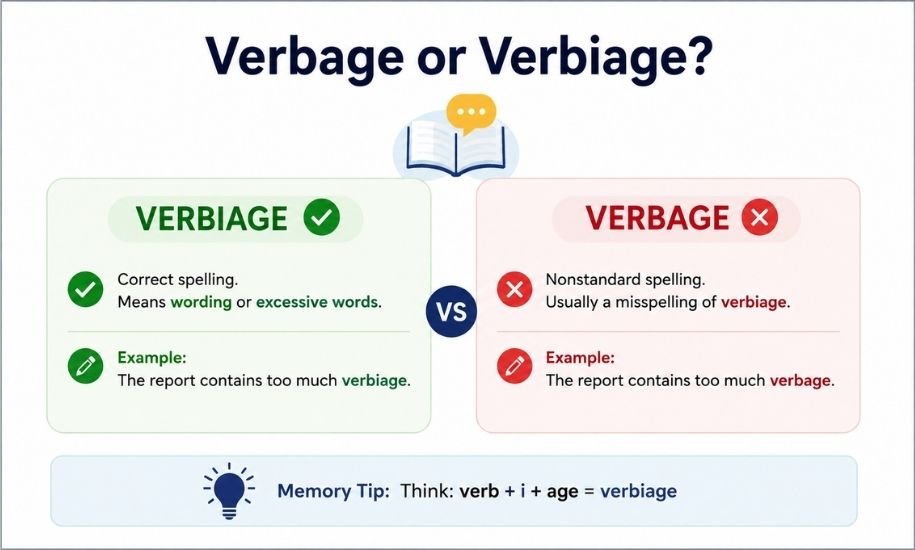
Verbiage is the standard spelling. “Verbage” is a nonstandard form that is sometimes used when people mean verbiage. In most formal, academic, professional, and edited writing, use verbiage.
Verbage or Verbiage: Which Is Correct?
Verbiage is the established standard word.
The spelling verbage does appear in informal writing, but it is generally considered a nonstandard variant rather than the preferred form. If you are writing an essay, report, email, article, contract, or other formal text, verbiage is the safer and more widely accepted choice.
| Form | Standard? | Meaning | Best choice in formal writing |
|---|---|---|---|
| verbiage | Yes | Wording or an excess of words | Yes |
| verbage | Nonstandard | Usually intended to mean verbiage | No |
So, if you’re asking “is it verbage or verbiage?”, choose verbiage.
What Does “Verbiage” Mean?
Verbiage is a noun with two closely related meanings.
First, it can describe a lot of words, especially words that are unnecessary, complicated, or obscure. This is often the sense intended when someone criticizes a piece of writing.
For example:
- The report contains too much technical verbiage.
- The editor removed unnecessary verbiage from the article.
- The contract is difficult to understand because of its legal verbiage.
Second, verbiage can simply refer to the wording or manner of expression used to communicate something. In this sense, the word does not necessarily carry a negative meaning.
For example:
- Please review the verbiage in the revised agreement.
- We changed the verbiage of the announcement.
- The exact verbiage of the policy is important.
This neutral meaning is particularly useful in professional and American English contexts.
Is “Verbage” a Real Word?
Verbage is encountered in English, but it is not the standard form recommended for general formal use.
People who write verbage usually intend it as a spelling of verbiage. The mistake is understandable because the word sounds as though it might be connected directly to verb or verbal. However, the conventional spelling includes the i:
verbiage
rather than:
verbage
That distinction matters when accuracy and consistency are important.
Correct
The lawyer revised the legal verbiage.
Nonstandard
The lawyer revised the legal verbage.
The second sentence is understandable, but verbiage is the standard choice.
Why Do People Confuse These Spellings?
The confusion mainly comes from the appearance and sound of the word.
Verbiage contains the familiar sequence verb-, which can make verbage seem like a logical spelling. Someone hearing the word without seeing it written might naturally assume that it is formed from verb plus -age.
There is also a pronunciation factor. In ordinary speech, the middle vowel in verbiage is easy to overlook, making the two spellings sound similar.
This is a good example of why English spelling cannot always be reconstructed reliably from pronunciation.
The easiest approach is simply to remember the established spelling:
verbiage = wording or excessive wording
Verbiage vs. Verbosity
Verbiage and verbosity overlap, but they are not interchangeable in every sentence.
Verbiage can refer to the actual wording or language used. It can be either neutral or critical depending on context.
Verbosity specifically emphasizes excessive use of words.
Compare:
The contract uses complicated verbiage.
Here, verbiage refers to the language or wording.
The writer’s verbosity made the explanation difficult to follow.
Here, verbosity describes the tendency to use more words than necessary.
A useful distinction is:
- Verbiage → wording or excessive wording
- Verbosity → excessive wordiness
When Does “Verbiage” Have a Negative Meaning?
Context determines the tone.
When someone says:
“Cut the unnecessary verbiage.”
they are criticizing writing for being too wordy.
Similarly:
“The instructions are buried in technical verbiage.”
suggests that complicated language is getting in the way of understanding.
But consider:
“Please use the exact verbiage provided by the company.”
Here, the speaker simply means the exact wording. There is no necessary criticism.
This difference is worth remembering because it prevents you from assuming that verbiage always means “bad writing.”
Verbiage in a Sentence
Here are some natural examples showing the word in different contexts:
- The editor removed unnecessary verbiage from the introduction.
- Please check the verbiage before the document is published.
- The policy contains a considerable amount of legal verbiage.
- We need to simplify the verbiage so customers can understand it.
- The exact verbiage of the notice should remain unchanged.
- The proposal was clear and avoided excessive verbiage.
Notice that some examples use verbiage negatively, while others use it neutrally to mean wording.
Verbiage or Wording: Are They the Same?
Sometimes, yes.
When verbiage means the particular language used to express something, wording is often a simpler alternative.
For example:
Please change the verbiage of the message.
can become:
Please change the wording of the message.
However, wording is generally more straightforward and neutral. If you simply mean “the words used,” wording may be the clearest choice.
If you want to criticize unnecessarily complicated or excessive language, verbiage can communicate that idea more strongly depending on context.
Common Mistakes to Avoid
1. Writing “verbage” in formal documents
If you mean the standard noun, write verbiage.
Correct:
The report contains unnecessary verbiage.
Avoid:
The report contains unnecessary verbage.
2. Assuming it means only “wordiness”
Verbiage can mean excessive or complicated wording, but it can also mean simply wording or diction.
3. Treating “verbiage” and “verbosity” as identical
They overlap when discussing excessive language, but verbosity specifically emphasizes excessive word use.
4. Using “verbiage” when “wording” would be clearer
There is nothing grammatically wrong with verbiage, but simpler language is often preferable when you merely mean “wording.”
For example:
Please revise the wording of the email.
may be clearer than:
Please revise the verbiage of the email.
An Easy Way to Remember the Spelling
The simplest memory trick is to remember the middle “i”:
verb + i + age = verbiage
It is not spelled verbage in standard usage.
You can also associate it with verbal language:
verbiage → verbal → words
This is not an etymological rule, but it can help you remember the spelling when writing.
Frequently Asked Questions
Is “verbage” or “verbiage” correct?
Verbiage is the standard spelling. Verbage is a nonstandard form that people sometimes use when they mean verbiage. For formal and edited English, choose verbiage.
What is the meaning of verbiage?
Verbiage can mean an excessive amount of words, particularly unnecessarily complicated language. It can also mean the wording or manner of expression used to communicate something.
Is “verbage” a misspelling?
In standard English, verbage is generally treated as a nonstandard form of verbiage. If you want to avoid questions about correctness, use verbiage, particularly in formal writing.
Is verbiage always a negative word?
No. It can have a critical sense when referring to excessive or complicated language, but it can also be used neutrally to mean wording. Context determines which meaning is intended.
Is verbiage the same as verbosity?
Not exactly. Verbiage can mean wording or excessive wording, whereas verbosity specifically refers to excessive use of words. They are related but have different focuses.
Can I use “verbiage” in formal writing?
Yes. Verbiage is a standard English noun and can be used in formal writing. However, when you simply mean “wording,” wording may sometimes be the clearer and more direct choice.
Final Verdict: Verbage or Verbiage?
When choosing between the two spellings, use verbiage. It is the established standard form and can refer either to excessive or complicated language or, more neutrally, to the wording used to express something. Verbage is a nonstandard form best avoided in formal writing.
For more straightforward explanations of easily confused English words and spellings, Grammarify helps you know the difference and use the right words.
You may also Read : Specially or Especially: What’s the Difference?