BC vs BCE: Meaning, Timeline, and Examples
When reading about ancient history, you may see dates written as BC or BCE. Both are used to describe years before the beginning of the Common Era, but their wording reflects different approaches to historical dating. So, is BC older than BCE, and does one represent a different point in history? The answer is simple: BC and BCE refer to exactly the same years. The main difference is that BC means Before Christ, while BCE means Before Common Era. Understanding how these terms work alongside AD and CE makes historical dates much easier to read and interpret.
Quick Answer
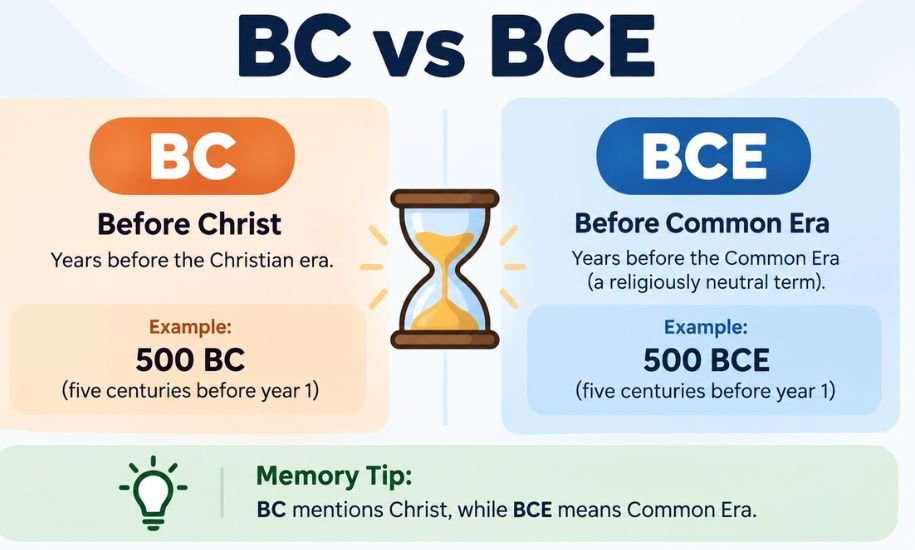
BC means Before Christ, while BCE means Before Common Era. Both refer to the same years before year 1, so 500 BC and 500 BCE represent the exact same date. The difference is that BC uses traditional Christian terminology, whereas BCE is a religiously neutral alternative commonly used in academic and educational writing.
BC vs BCE: What’s the Difference?
The difference between BC and BCE is their meaning and religious association, not their chronological value. Both abbreviations belong to the same historical dating system and use identical year numbering.
BC (Before Christ) is the traditional term for years before the traditionally recognized beginning of the Christian era. It is commonly found in historical books, older publications, and general writing.
BCE (Before Common Era) is an alternative that describes the same period without explicitly referring to Christianity. It is often preferred in academic publications, museums, and educational materials that address people from different cultural and religious backgrounds.
| Feature | BC | BCE |
|---|---|---|
| Full form | Before Christ | Before Common Era |
| Meaning | Years before the Christian era | Years before the Common Era |
| Religious association | Christian terminology | Religiously neutral |
| Dating system | Traditional historical calendar | Same historical calendar |
| Year numbering | Counts backward | Counts backward |
| Example | 500 BC | 500 BCE |
| Common use | Traditional historical writing | Academic and educational writing |
For example, if a history book says an event occurred in 300 BC and another says it happened in 300 BCE, they are referring to the same year. Neither term indicates an earlier or later date.
What Does BC Mean?
BC stands for Before Christ. It is used to identify years that occurred before the traditional starting point of the Christian calendar.
The BC system counts years backward. As the numbers become larger, the dates move further into the past. For example, 2000 BC is earlier than 1000 BC, while 100 BC is much closer to the beginning of the Common Era.
Here are a few examples:
- 500 BC: A year five centuries before AD 1.
- 1000 BC: A year one millennium before AD 1.
- 3000 BC: A date three millennia before AD 1.
- 1 BC: The final year before AD 1.
BC is part of the traditional BC/AD dating system, which developed from Christian chronology. The AD system was introduced by the sixth-century monk Dionysius Exiguus, who worked on calculating the dates of Easter.
Although the terminology has Christian origins, BC is widely understood and continues to be used in historical writing around the world.
What Does BCE Mean?
BCE stands for Before Common Era. It is a religiously neutral term used to identify the same years that are traditionally described as BC.
The term allows historians and educators to discuss events from different civilizations without using explicitly Christian terminology. It is especially common in academic and multicultural contexts.
For example:
- 500 BCE: The same year as 500 BC.
- 1000 BCE: The same year as 1000 BC.
- 2000 BCE: The same year as 2000 BC.
- 1 BCE: The final year before 1 CE.
BCE does not introduce a new calendar or change the order of historical events. It simply provides an alternative way of expressing dates within the established historical dating system.
The expression Common Era has been used in English for centuries, although BCE and CE became more widely adopted in modern academic and educational writing.
BC vs BCE vs AD vs CE
BC and BCE are closely connected to AD and CE. While BC and BCE refer to years before the Common Era, AD and CE refer to years within or after its beginning.
- BC: Before Christ
- BCE: Before Common Era
- AD: Anno Domini, a Latin phrase meaning “in the year of the Lord”
- CE: Common Era
AD and CE represent the same years, just as BC and BCE do.
| Traditional system | Neutral system | Meaning |
|---|---|---|
| 500 BC | 500 BCE | Before the Common Era |
| 100 BC | 100 BCE | Before the Common Era |
| 1 BC | 1 BCE | Final year before the Common Era |
| AD 1 | 1 CE | First year of the Common Era |
| AD 500 | 500 CE | 500th year of the Common Era |
| AD 2026 | 2026 CE | Year 2026 of the Common Era |
One common misconception is that AD means After Death. This is incorrect. AD comes from the Latin Anno Domini, meaning “in the year of the Lord.”
The terms AD and CE do not change the historical dates either. The choice between the traditional and neutral terminology is mainly a matter of writing style and audience.
Which Came First, BC or BCE?
BC came first as a conventional dating label. The BC/AD system was developed in the Christian world, with Dionysius Exiguus introducing the AD year-counting system in the sixth century.
BCE developed as a religiously neutral alternative to BC. However, the expression Common Era itself has a much longer history, with English usage documented as early as the 18th century.
Over time, BCE and CE became increasingly common in educational, historical, and academic publications. Today, both systems are widely understood and used.
It is important to distinguish the history of the terms from the dates they describe. Although BC is the older conventional label, BC and BCE do not represent different historical periods.
Is BC Older Than BCE?
No, BC is not a different or earlier historical period than BCE. Although BC is the older abbreviation, both refer to exactly the same years.
For instance, 2000 BC and 2000 BCE describe the same point in history. Similarly, 500 BC and 500 BCE are interchangeable.
The confusion often comes from assuming that BCE is a new dating system that begins after BC. In reality, BCE is simply an alternative name for the same period.
| Date in BC | Equivalent date in BCE |
|---|---|
| 3000 BC | 3000 BCE |
| 2000 BC | 2000 BCE |
| 1000 BC | 1000 BCE |
| 500 BC | 500 BCE |
| 100 BC | 100 BCE |
| 1 BC | 1 BCE |
Therefore, when comparing two historical dates, the number is what determines their chronological order, not whether the abbreviation is BC or BCE.
How Does the BC and BCE Timeline Work?
The BC and BCE timeline works by counting backward toward the beginning of the Common Era. The higher the number, the further back in history the date falls.
For example, 1000 BCE occurred earlier than 500 BCE, and 500 BCE occurred earlier than 100 BCE. After 1 BCE, the timeline moves directly to 1 CE.
Historical timeline
Moving from the distant past toward the present
1000 BCE
Earlier
500 BCE
1 BCE
1 CE
500 CE
Later
Further into the past
Toward the present and beyond
There is no year zero in the conventional historical calendar.
Why Is There No Year Zero?
In the conventional BC/AD and BCE/CE systems, the sequence moves directly from 1 BCE to 1 CE. There is no year zero.
This is because the traditional year-numbering system was established without a zero year. As a result, calculating the number of years between dates on either side of the boundary requires accounting for this missing year.
For example, the interval between 4 BCE and 6 CE is nine years, not ten:
4 + 6 − 1 = 9 years.
Astronomical year numbering does include a year zero, but it is a different convention used for mathematical and scientific calculations.
Why Do Historians Use BCE Instead of BC?
Historians and educators may choose BCE because it offers a religiously neutral way to discuss historical events. Since history covers civilizations with many different religious and cultural traditions, neutral terminology can be useful in international and academic settings.
Some of the main reasons for using BCE include:
- Religious neutrality: It avoids explicitly Christian wording when discussing dates.
- Inclusive education: It provides terminology that can be used in classrooms with students from different religious backgrounds.
- Academic conventions: Many academic publishers, museums, and educational institutions prefer BCE and CE.
- Consistent terminology: BCE and CE form a matching pair that can be used throughout historical writing.
However, using BCE does not mean that BC is inaccurate or inappropriate. Both terms are accepted. Writers should generally follow the style guide or conventions of their publication.
Examples of BC and BCE in History
Historical dates can be written using either BC or BCE without changing their meaning. The following examples show how these terms appear in discussions of ancient civilizations and historical events.
| Historical event | Approximate date |
|---|---|
| Construction of the Great Pyramid of Giza | 2560 BCE |
| Traditional founding of Rome | 753 BC |
| Beginning of Alexander the Great’s reign | 336 BCE |
| Death of Julius Caesar | 44 BC |
| Eruption of Mount Vesuvius | 79 CE |
For example, the construction of the Great Pyramid of Giza can be dated to approximately 2560 BCE or 2560 BC. Both versions describe the same historical period.
These examples also show that BC and BCE are not tied to specific civilizations or regions. They can be used to describe events from ancient Egypt, Greece, Rome, and other parts of the world.
When Should You Use BC or BCE?
The choice depends on your audience, writing style, and the conventions of the publication.
Use BC when following traditional historical writing, referring to sources that use BC/AD, or writing for an audience familiar with the conventional terminology.
Use BCE when writing academic articles, educational resources, museum descriptions, or materials intended for culturally diverse audiences.
The most important rule is consistency. If you begin an article using BCE and CE, continue using those abbreviations rather than switching to BC and AD without a clear reason.
The placement of these abbreviations also follows different conventions:
- BC: 500 BC
- BCE: 500 BCE
- AD: AD 500
- CE: 500 CE
Both BC and BCE are correct, so neither needs to be avoided in standard historical writing.
Frequently Asked Questions
1. Is BC the same as BCE?
Yes. BC means Before Christ, while BCE means Before Common Era. Both refer to the same years before the Common Era and use identical year numbering. For example, 1000 BC and 1000 BCE represent exactly the same year.
2. Is BCE more accurate than BC?
No. BCE is not more historically or chronologically accurate than BC. Both use the same dating system. BCE is generally chosen for its religiously neutral wording, while BC is the traditional Christian-based term.
3. Which is older, BC or BCE?
BC is the older conventional abbreviation and has been used as part of the traditional BC/AD system for centuries. BCE developed as an alternative designation, although the expression Common Era has a long history of its own.
4. Is 1 BCE the same as 1 BC?
Yes. Both refer to the final year before 1 CE, also known as AD 1. The traditional historical calendar does not include a year zero, so 1 BCE is followed directly by 1 CE.
5. Why is BCE used instead of BC in schools?
Some schools prefer BCE because it is religiously neutral and suitable for teaching world history to students from different cultural and religious backgrounds. However, BC is still accepted and remains in use in many textbooks and educational institutions.
Final Verdict: BC or BCE?
BC and BCE are two different abbreviations for the same historical dates. BC stands for Before Christ, while BCE means Before Common Era. Neither is chronologically older than the other as a period, and both follow the same year-numbering system. The choice comes down to writing preference, audience, and editorial style. Understanding this distinction makes historical dates easier to interpret, and Grammarifyr helps readers understand differences like these and use language with confidence.
You may also Read : Genotype and Phenotype: Differences, Examples and Ratios
One Comment