Signer or Signor: Meaning, Examples, and Usage
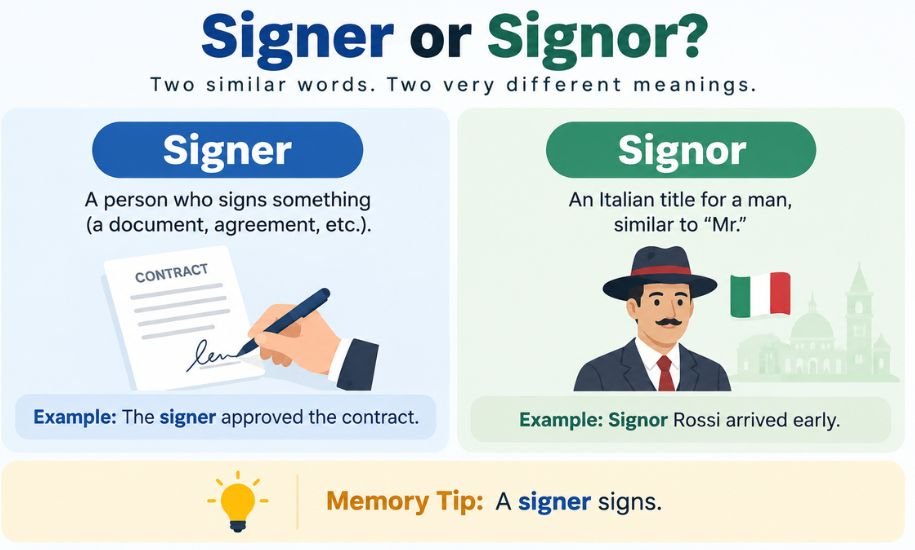
The words signer and signor look and sound similar, but they have completely different meanings. This makes the choice easy to get wrong, especially when writing about contracts, forms, checks, agreements, or official documents. The good news is that the distinction is straightforward: signer refers to someone who signs, while Signor is an Italian title used for a man, similar to “Mr.” in English. Once you connect each word with its meaning, the difference becomes much easier to remember.
Signer is the correct word when you mean a person who signs a document, agreement, check, or other written material. Signor is an Italian title meaning “Mr.” or “Mister.” Therefore, the correct phrase is authorized signer, not “authorized signor.”
Signer or Signor: What’s the Difference?
The simplest way to distinguish the two words is to look at what they describe.
| Word | Meaning | Typical use | Example |
|---|---|---|---|
| signer | A person or entity that signs something | Documents, contracts, agreements, petitions, checks | The signer approved the contract. |
| Signor | An Italian title for a man | Names and Italian contexts | Signor Rossi arrived early. |
Both forms are real words, but they are not interchangeable.
If you are talking about someone putting their signature on a document, use signer.
If you are addressing or referring to an Italian man using a traditional title, Signor may be appropriate.
A simple rule
A signer signs.
That one association solves most cases.
What Does “Signer” Mean?
Signer is a noun formed from the verb sign. It refers to a person, organization, or other party that signs something.
For example:
- The signer must date the agreement.
- Each signer received a copy of the contract.
- The bank verified the identity of the signer.
- The petition had hundreds of signers.
- Both parties were required to be signers of the agreement.
The word is especially common in legal, financial, administrative, and business writing.
A signer does not necessarily have to be an individual. An organization or country can also be described as a signer when it has signed an official agreement.
“Signer” can also have another meaning
The word can also describe someone who uses sign language. In that context, the meaning has nothing to do with signing a written document.
For example:
The community includes both deaf and hearing signers.
So, depending on context, signer can refer either to someone who signs a document or someone who communicates using sign language.
What Does “Signor” Mean?
Signor is an Italian title traditionally used for a man. In English, it is generally understood as equivalent to “Mr.” or “Mister.”
For example:
- Signor Rossi will meet us at noon.
- I received a letter from Signor Bianchi.
- The opera featured Signor Verdi as a character.
Notice that signor has nothing to do with putting a signature on a document.
It belongs to a different vocabulary category altogether.
In Italian, signor is commonly used before a man’s name, as in Signor Bianchi. The related full Italian word signore has several meanings, including “man,” “gentleman,” and the polite title “Mr.” depending on context.
Is It “Authorized Signer or Signor”?
The correct expression is authorized signer.
An authorized signer is a person who has been given official permission to sign or carry out specified transactions for an account, organization, or other party.
For example:
- Maria is an authorized signer on the company account.
- Only an authorized signer can approve this transaction.
- The bank asked the authorized signer to provide identification.
- The document requires the signature of an authorized signer.
The word signor does not fit these sentences because the writer is describing someone with authority to sign, not an Italian title.
Correct vs. incorrect
Correct: The authorized signer approved the payment.
Incorrect for this meaning: The authorized signor approved the payment.
The same principle applies to phrases such as authorized check signer, authorized document signer, and authorized account signer.
What About “Authorized Signatory”?
You may also encounter authorized signatory, particularly in formal legal, corporate, and administrative writing.
A signatory is a person, organization, or country that signs an agreement or official document. It is therefore closely related to signer, although the two words can have slightly different stylistic preferences.
Compare:
- The signer signed the contract.
- The signatory to the agreement accepted the terms.
- The company appointed an authorized signatory to execute the document.
In everyday business English, signer is simple and natural. Signatory often sounds more formal and is particularly common when discussing agreements, treaties, contracts, and official commitments.
Why Are “Signer” and “Signor” Confused?
The confusion is mainly caused by their similar spelling and pronunciation.
Both words begin with sign-, and their endings look similar. Someone who has heard one word but rarely seen it written may easily choose the wrong spelling.
There is also a natural connection between the verb sign and the noun signer, so it is tempting to assume that signor is simply another version of the same word.
It is not.
Think of the two as belonging to different language systems:
- signer → English word connected to sign
- Signor → Italian title connected to Mr.
Once this distinction is clear, phrases such as “authorized signer” become much easier to spell correctly.
Is It Signer or Signor in Legal Documents?
For someone who signs a legal document, the correct word is generally signer.
Examples include:
- contract signer
- document signer
- agreement signer
- petition signer
- check signer
- authorized signer
You might also use signatory, especially in formal legal or diplomatic contexts.
For example:
Each signatory agreed to the terms of the treaty.
But signor would not mean “person who signed” in this sentence.
If you see Signor in a legal or historical text, it is likely being used as a title or as part of a person’s name rather than referring to their signature.
Examples of “Signer” in Sentences
Here are some natural examples:
- The signer must initial each page of the agreement.
- The bank contacted the authorized signer before processing the transaction.
- Every signer received a digital copy of the contract.
- The petition attracted thousands of signers.
- The company requires two authorized signers for certain transactions.
- The witness and the signer both dated the document.
- The final signer completed the agreement yesterday.
In each example, the word refers to someone who signs or has signed something.
Examples of “Signor” in Sentences
By contrast, Signor is used as a title:
- Signor Romano greeted the guests.
- I spoke with Signor Ferrari yesterday.
- The letter was addressed to Signor Conti.
- Signor Bianchi requested a meeting.
- The character is introduced as Signor Lorenzo.
Here, the word is connected with a person’s name rather than with a signature.
Common Mistakes to Avoid
1. Writing “authorized signor”
When you mean someone who has permission to sign, use authorized signer.
Correct: The authorized signer completed the form.
2. Treating “signor” as another spelling of “signer”
These words do not represent American and British spellings of the same term.
Signer and Signor have different meanings.
3. Using “signor” for a contract signer
If John signs a contract, John is a signer or, in a more formal context, a signatory.
He is not a signor simply because he signed something.
4. Confusing a title with a role
Signor identifies or addresses a man in an Italian context.
Signer identifies a role: someone who signs.
That difference is important in formal writing.
Is It “Signor or Signer”?
If you’re asking is it signor or signer for someone who signs a document, the answer is signer.
For example:
Correct: The signer signed the agreement.
Correct: The authorized signer approved the transaction.
Correct: The contract has three signers.
But if you’re referring to an Italian man by title:
Correct: Signor Rossi is waiting outside.
The choice depends entirely on meaning.
How to Remember the Difference
The easiest memory trick is:
Signer = someone who signs
Look at the ending:
sign + er = signer
The -er ending frequently forms a noun for someone who performs an action:
- teach → teacher
- drive → driver
- write → writer
- sing → singer
- sign → signer
You do not need to memorize a complicated rule. Just ask yourself:
“Does this person sign something?”
If the answer is yes, signer is the word you need.
If you are addressing or referring to an Italian man with a title, use Signor.
Signer vs. Signatory
One additional distinction is useful for formal writing.
Signer is a straightforward term for someone who signs.
Signatory is a more formal noun for a person, organization, or country that signs an agreement or official document.
For example:
The signer completed the form.
The countries became signatories to the agreement.
Both words can refer to parties that have signed something, but signatory is especially natural in formal discussions of treaties, agreements, and official documents.
Neither should be confused with signor.
Frequently Asked Questions
Is “signer” the correct word for someone who signs a document?
Yes. Signer is the standard noun for a person or other party that signs a document, agreement, petition, or similar material. In formal contexts, signatory can also be appropriate.
Is “signor” a misspelling of “signer”?
No. Signor is a real word, but it has a different meaning. It is an Italian title equivalent to “Mr.” or “Mister.” It is not an alternative spelling for someone who signs a document.
Is it “authorized signer or signor”?
The correct phrase is authorized signer when you mean someone who has been given permission to sign or perform an authorized transaction. “Authorized signor” does not express that meaning.
Can “signer” and “signatory” be used interchangeably?
Often, yes, when referring to a person or entity that has signed an official document. However, signatory is more formal and is especially common with agreements and treaties, while signer is more direct and general.
Is “Signor” used before a name?
Yes. Signor can be used as an Italian title before a man’s name, similar to “Mr.” For example, Signor Rossi means approximately “Mr. Rossi.”
What is the easiest way to remember the difference?
Remember “A signer signs.” The word signer is directly related to the English verb sign. Reserve Signor for the Italian title.
The Bottom Line
When choosing between signer or signor, use signer whenever you mean someone who signs a document or agreement. Use Signor when referring to the Italian title for a man. For formal agreements, signatory is another useful word, but it does not replace signor. Keeping these meanings separate will help you avoid errors in contracts, business writing, and everyday English. For more clear explanations of easily confused words, Grammarifyr helps you know the difference and use the right words.
You may also Read : Catalog or Catalogue: Meaning and Correct Usage
One Comment