Barbeque or Barbecue? British and American English
If you have ever wondered whether to write barbeque or barbecue, you are not alone. Both spellings appear in everyday English, restaurant names, recipes, and food advertisements. However, one form is preferred in standard written English. Understanding the difference helps you choose the right spelling for articles, menus, invitations, and everyday conversations. The good news is that the two forms generally refer to the same thing, so the confusion is about spelling rather than meaning.
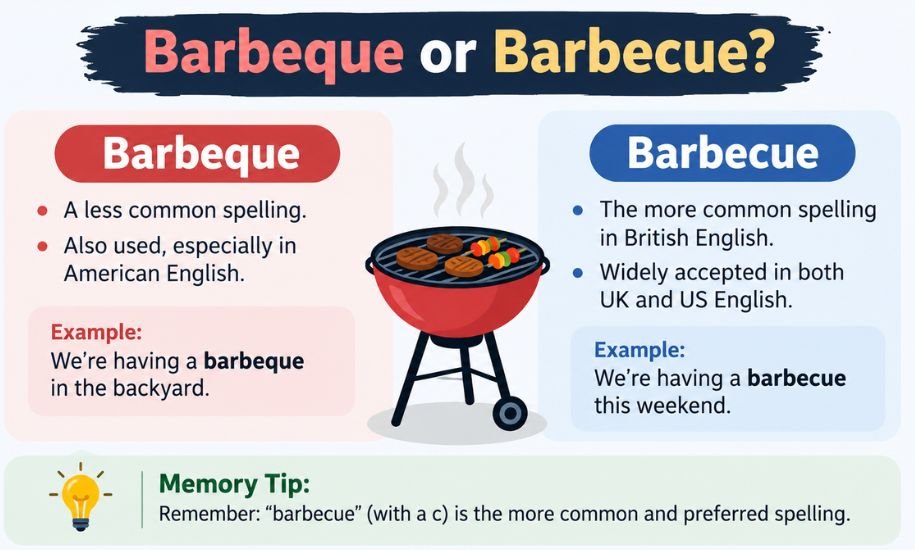
**Barbecue** is the preferred spelling in standard English, in both British and American usage. **Barbeque** is also a recognised alternative, but it is less conventional in formal writing. Use *barbecue* in articles, recipes, and general communication unless you are reproducing a name that uses the alternative spelling.
Barbeque or Barbecue: What’s the Difference?
The main difference is the spelling, not the meaning. Both forms refer to outdoor cooking, the equipment used for it, or a meal or gathering where food is prepared over a fire or heat source.
| Feature | Barbecue | Barbeque |
|---|---|---|
| Spelling status | Standard and preferred | Accepted alternative |
| Meaning | Outdoor cooking, equipment, or an event | Generally the same |
| Formal writing | Recommended | Less conventional |
| British English | Preferred | Also encountered |
| American English | Preferred | Also encountered |
| Example | We are having a barbecue. | We are having a barbeque. |
If you are writing an English article, school assignment, recipe, or business menu, barbecue is the safest choice. Although the alternative is understandable, there is usually no reason to choose it over the conventional spelling.
What Does Barbecue Mean?
The word barbecue can function as both a noun and a verb. Its exact meaning depends on how it is used in a sentence.
Barbecue as a noun
As a noun, it can describe a cooking device, the food prepared using that method, or an outdoor social gathering.
Examples:
- We bought a new barbecue for the garden.
- Our neighbours invited us to a summer barbecue.
- The restaurant serves delicious barbecue with homemade sauce.
- They cleaned the barbecue before the guests arrived.
These sentences show how the word can refer to equipment, an event, or food.
Barbecue as a verb
As a verb, barbecue means to cook food using a barbecue or a suitable cooking method involving heat and, often, smoke.
Examples:
- We will barbecue chicken for dinner.
- He likes to barbecue vegetables during the summer.
- They barbecued fish for their family gathering.
The standard forms include barbecued for the past tense and barbecuing for the present participle.
Is Barbeque a Real Word?
Yes. Barbeque is a recognised spelling variant of barbecue. It is not simply a meaningless collection of letters or a spelling that readers cannot understand.
However, being an accepted variant does not mean that both forms are equally preferred in every context. Barbecue is the conventional dictionary headword and the better option for most formal and edited writing.
You might encounter barbeque in restaurant names, product labels, informal messages, or advertising. In these situations, the spelling may be a deliberate choice rather than an accidental mistake.
For example:
- Standard wording: We are planning a barbecue this weekend.
- Alternative wording: We are planning a barbeque this weekend.
- Business name: The restaurant uses “Barbeque” in its official name.
The first example is the recommended choice for general writing. The second is understandable, while the third should retain the business’s actual spelling.
Is Barbecue British or American English?
Barbecue is the preferred spelling in both British and American English. Unlike pairs such as colour and color, the distinction between barbecue and barbeque is not a straightforward British-versus-American spelling rule.
The preferred form remains the same, although vocabulary and pronunciation can vary between regions.
Consider these examples:
British English: We are having a barbecue in the garden this weekend.
American English: We are having a barbecue in the backyard this weekend.
Both sentences use the standard spelling. The words garden and backyard reflect different common vocabulary choices, but the spelling of barbecue does not change.
If you are writing for a British audience, use barbecue. If your readers are American, the same spelling is appropriate. Keeping one conventional form throughout an article also makes your writing more consistent.
How to Spell Barbeque or Barbecue Sauce
When referring to the condiment served with grilled or smoked food, the standard phrase is barbecue sauce.
Barbecue sauce is a condiment that can be sweet, tangy, smoky, spicy, or a combination of these flavours. Recipes vary, but common ingredients include tomatoes, vinegar, sugar, spices, and seasonings.
Examples:
- She served the ribs with homemade barbecue sauce.
- I prefer a smoky barbecue sauce with grilled chicken.
- The recipe explains how to prepare barbecue sauce from scratch.
You may also see BBQ sauce on packaging and menus. This is a widely understood abbreviation and is appropriate in many informal and commercial contexts.
For formal writing, recipes, and explanatory articles, barbecue sauce is a clear and conventional choice.
Why Are Both Spellings Used?
The spelling variation is partly explained by the way English words are adapted and written over time. The familiar pronunciation of barbecue can encourage alternative spellings that appear to match the sound more closely.
The word has a longer history than its modern spellings might suggest. English adopted it through Spanish barbacoa, a word associated with an Indigenous Caribbean cooking structure. Over time, the spelling used in standard English settled on barbecue.
The abbreviation BBQ also contributes to the confusion. Because the abbreviation ends in Q, some writers assume that the full word should be spelled barbeque. However, BBQ is a conventional abbreviation; it does not determine the spelling of the full word.
The practical lesson is simple: use barbecue as the default spelling, and recognise barbeque as an alternative.
Barbecue vs. Grill: Are They the Same?
Although the words overlap in everyday conversation, barbecue and grill can describe different cooking methods.
Grilling usually involves cooking food relatively quickly over direct, high heat. Barbecue can refer broadly to outdoor cooking, but in some culinary traditions it specifically describes slower cooking at lower temperatures, often with smoke.
For example:
- Grilling: She grilled vegetables over high heat.
- Barbecuing: They barbecued a large cut of meat slowly over several hours.
Usage varies by region. In Britain, barbecue commonly refers to outdoor cooking and the equipment used for it. In parts of the United States, particularly where barbecue traditions are strongly established, the word can refer more specifically to slow-smoked meat.
Therefore, the terms can overlap, but they are not always interchangeable when discussing particular cooking techniques.
Common Spelling Mistakes to Avoid
A few practical guidelines can help you use the word correctly.
1. Assuming that barbeque is always wrong
The alternative spelling is recognised, so it is more accurate to describe it as less conventional rather than universally incorrect.
2. Treating the difference as a UK–US rule
Both British and American writers generally prefer barbecue. Do not label one spelling British and the other American.
3. Changing the spelling unnecessarily
If you have already used barbecue throughout an article, there is no benefit in switching to barbeque midway through it.
4. Confusing BBQ with the full spelling
BBQ is a common abbreviation. It does not mean that barbeque is the preferred full spelling.
5. Altering official names
If a restaurant, product, or business deliberately uses Barbeque in its name, reproduce that spelling when referring to it directly.
Frequently Asked Questions
1. Is barbeque or barbecue correct?
Barbecue is the preferred spelling in standard English. Barbeque is also a recognised alternative and generally carries the same meaning. For formal writing, articles, recipes, and educational content, choose barbecue unless you are using an official name that spells it differently.
2. Is barbeque acceptable in British English?
Yes. Readers will generally understand barbeque, but barbecue is the conventional spelling preferred in British English. If you are writing for a British audience, use the standard form consistently.
3. Is barbeque an American spelling?
No. It is not accurate to classify barbeque as exclusively American. The preferred spelling in American English is also barbecue. The alternative appears in different English-speaking contexts rather than belonging to one specific national variety.
4. Why is barbecue shortened to BBQ?
BBQ is a conventional abbreviation for barbecue. It is commonly used on restaurant menus, product packaging, signs, and informal messages. The Q reflects the familiar sound at the end of the word, but the full standard spelling remains barbecue.
5. Should I write barbecue sauce or barbeque sauce?
Use barbecue sauce in standard writing. The alternative spelling may appear on packaging or in branding, but the conventional phrase uses barbecue. You can also write BBQ sauce when a shorter, more informal expression suits the context.
6. What is the easiest way to remember the correct spelling?
Remember the spelling barbecue with a C near the end. If you are unsure, use this form in your writing. You can still recognise barbeque when you encounter it, but you do not need to adopt the alternative spelling yourself.
Final Verdict: Barbeque or Barbecue?
When choosing between the two spellings, barbecue is the best default for standard English. It is preferred in both British and American writing and works for the cooking equipment, the food, the event, and the verb. Barbeque is an accepted alternative, but it is less conventional in edited text. For clear and consistent writing, follow the standard form and use it throughout your work. At Grammarifyr, our goal is to help readers understand these small but useful language distinctions and choose the right words with confidence.
You may also Read : Honor or Honour? American vs. British English