Allie or Ally: Meaning and Correct Usage
If you are trying to describe someone who supports, helps, or stands with you, the correct word is ally. Allie is usually a person’s name or nickname, so it is not the standard spelling of the noun meaning “supporter.” The confusion is understandable because the two forms look and sound similar in some contexts. There is also another easily confused word, alley, which means a narrow passage or street. Knowing what each word means makes the correct choice much easier.
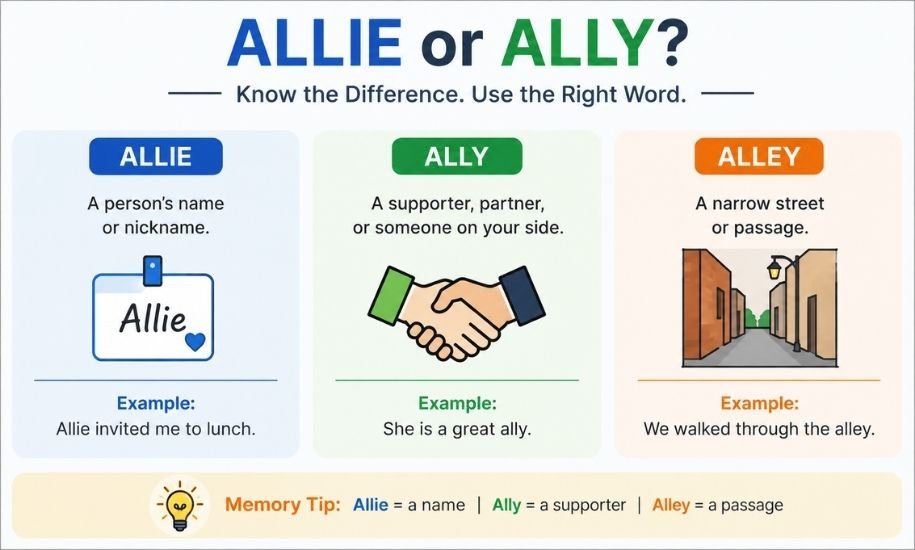
Ally is the correct word when you mean a supporter, partner, or person or group that cooperates with you. Allie is generally a personal name or nickname. If you mean a narrow street or passage, use alley.
Allie or Ally: What’s the Difference?
The easiest way to distinguish the words is to look at their meanings:
| Word | Meaning | Typical use | Example |
|---|---|---|---|
| ally | A supporter, partner, or associate | Common noun or verb | She is a loyal ally. |
| Allie | Usually a person’s name or nickname | Proper noun | Allie called me yesterday. |
| alley | A narrow street or passage | Common noun | We walked through the alley. |
So, if you are writing about someone who is on your side, choose ally.
If you are referring to a person named Allie, use Allie.
If you are describing a narrow passage between buildings, use alley.
What Does “Ally” Mean?
Ally is a noun that means a person, organization, or country that supports or cooperates with another. It can describe anything from a trusted friend to a country that cooperates with another nation.
For example:
- She became an important ally during the difficult negotiations.
- He has always been an ally of the local community.
- The two countries are close allies.
- A good teammate can be a valuable ally.
The word can also be used as a verb. To ally means to join or associate with another person or group for a particular purpose.
For example:
- Several organizations allied to oppose the proposal.
- The two groups allied themselves with local residents.
Related forms include allied, allies, allied with, and alliance.
What Does “Allie” Mean?
Allie is generally a proper name. It may be someone’s given name or a nickname, often associated with names such as Allison, Alison, or Alexandra.
For example:
- Allie is meeting us for lunch.
- I sent the message to Allie.
- Allie works at the library.
Because it is a name, it is normally capitalized.
It would be incorrect to write allie when you mean “supporter” in standard English:
Incorrect: She has always been my allie.
Correct: She has always been my ally.
However, if a person’s actual name is Allie, then the spelling is perfectly correct:
Correct: Allie has always supported me.
This is why calling Allie simply a “wrong spelling” of ally can be misleading. The spelling is wrong only when it is being used in place of the common noun ally.
Ally or Allie: Which One Should You Use?
Ask yourself one simple question:
Am I talking about a person’s name, or someone who supports me?
If it is a name, use Allie:
Allie invited me to the party.
If it means supporter or partner, use ally:
My best friend has been an ally throughout the project.
The distinction is especially important in formal writing because capitalization and meaning both change.
Compare:
I spoke with Allie about the project.
Here, Allie identifies a particular person.
I spoke with an ally about the project.
Here, ally describes the person’s role or relationship.
Ally or Alley: Don’t Mix Up These Two Words
Another common confusion is ally or alley. These are both real English words, but their meanings are completely different.
An ally is someone or something that supports you.
An alley is a narrow road, passage, or walkway, typically between or behind buildings.
Compare:
The organization found an ally in the local council.
We took a shortcut through the alley.
The pronunciation can also help distinguish them. Ally is commonly pronounced like “AL-eye,” while alley is generally pronounced like “AL-ee.”
Their plural forms are different as well:
- ally → allies
- alley → alleys
For example:
The country has several strong allies.
There are several narrow alleys in the old district.
What Is the Plural of Ally?
The plural of ally is allies.
When a noun ends in a consonant followed by y, the y usually changes to ie before adding s.
Examples include:
- ally → allies
- country → countries
- party → parties
- family → families
So:
One ally
becomes:
Two allies
A common mistake is writing allys, but that spelling is not the standard plural form.
Examples of “Allies”
- The two nations became allies.
- She has several allies in the organization.
- The team relied on its allies for support.
Allies or Axis: Why Is “Allies” Sometimes Capitalized?
The word Allies can have a specific historical meaning when it is capitalized.
During World War II, the Allies referred to the coalition of countries that fought against the Axis powers. The principal Axis powers were Germany, Italy, and Japan, while the Allied coalition included major powers such as Britain, the Soviet Union, China, and the United States.
Therefore, these two sentences use the word differently:
The country has several allies.
Here, allies simply means supporters or cooperating countries.
The Allies fought against the Axis powers.
Here, Allies is a historical name for the World War II coalition.
This distinction also helps with questions such as whether a country fought alongside the Allies or Axis during World War II. In that context, the capitalized terms refer to opposing wartime coalitions, not ordinary supporters and opponents.
Arm or Ally: Are They Related?
Arm and ally are completely different words.
Arm can refer to the body part between the shoulder and hand. It can also be a verb meaning to provide weapons or equipment.
Examples:
She injured her arm.
The soldiers were armed with protective equipment.
Ally, by contrast, refers to a supporter or partner:
The country gained a powerful ally.
The two words should not be treated as alternative spellings or forms of the same word. Their meanings and grammatical functions are unrelated.
Ally or Allie in a Sentence
Here are some side-by-side examples to make the distinction clear.
When “ally” is correct
My colleague has been a valuable ally at work.
The smaller country sought a stronger ally.
They became allies after years of cooperation.
The two organizations decided to ally themselves with the campaign.
When “Allie” is correct
Allie left her notebook on the desk.
I called Allie after the meeting.
Allie is helping us organize the event.
When “alley” is correct
The restaurant is hidden down a narrow alley.
They walked through the alley to reach the main road.
These examples show why context matters more than appearance.
Common Mistakes to Avoid
1. Using “allie” for a supporter
Incorrect:
He is a strong allie.
Correct:
He is a strong ally.
2. Using “alley” when you mean a supporter
Incorrect:
She has always been my closest alley.
Correct:
She has always been my closest ally.
3. Writing “allys” as the plural
Incorrect:
Our two allys supported the plan.
Correct:
Our two allies supported the plan.
4. Assuming “Allie” is always incorrect
If Allie is someone’s name, it is correct:
Allie will join us later.
The issue is not the spelling itself; it is whether you are using the word as a name or as the noun meaning supporter.
5. Confusing “allies” with “allied”
Allies is normally the plural noun:
Our allies supported the agreement.
Allied can function as an adjective or past-tense form:
The allied forces moved forward.
An Easy Way to Remember the Difference
Use this simple three-word reminder:
Allie = a name
Ally = a supporter
Alley = a passage
You can also remember that an ally is “on your side.” If the word describes someone who helps, supports, or cooperates with you, ally is the spelling you want.
Frequently Asked Questions
Is “Allie” a correct spelling?
Yes. Allie is a perfectly valid spelling when it is someone’s name or nickname. It is not, however, the standard spelling of the common noun meaning a supporter. For that meaning, use ally.
Is “ally” a name?
Yes. Ally can also be used as a personal name. Therefore, capitalization and context matter. If you are referring to a person whose name is Ally, that spelling is correct; if you mean a supporter, ally is also correct as a common noun.
Is “ally” or “alley” correct?
Both are correct words, but they have different meanings. Ally means a supporter or partner, while alley means a narrow street or passage. For example, “She is my ally” and “We walked through the alley” are both correct.
What is the plural of ally?
The standard plural is allies. The spelling changes from y to ie before the plural s, just as in country → countries and party → parties.
What is the difference between an ally and an alliance?
An ally is the person, group, or country involved in cooperation. An alliance is the partnership or agreement between them. For example, “Canada is an ally” identifies a participant, while “The countries formed an alliance” describes their relationship.
Does “Allies” always refer to World War II?
No. Lowercase allies can simply mean supporters or partners. The Allies, with a capital A, can refer specifically to the coalition that fought the Axis powers during World War II. Context and capitalization tell you which meaning is intended.
Final Verdict: Allie or Ally?
Use ally when you mean a supporter, partner, or someone who cooperates with you. Use Allie when referring to someone whose name is Allie, and use alley for a narrow street or passage. Remembering “Allie = name, ally = supporter, alley = passage” will prevent most mistakes. For more clear, practical explanations of confusing English words, Grammarify helps you know the difference and use the right words.
You may also Read : Compliment or Complement? Easy Difference Explained
One Comment