Grammie or Grammy: Meaning and Key Differences
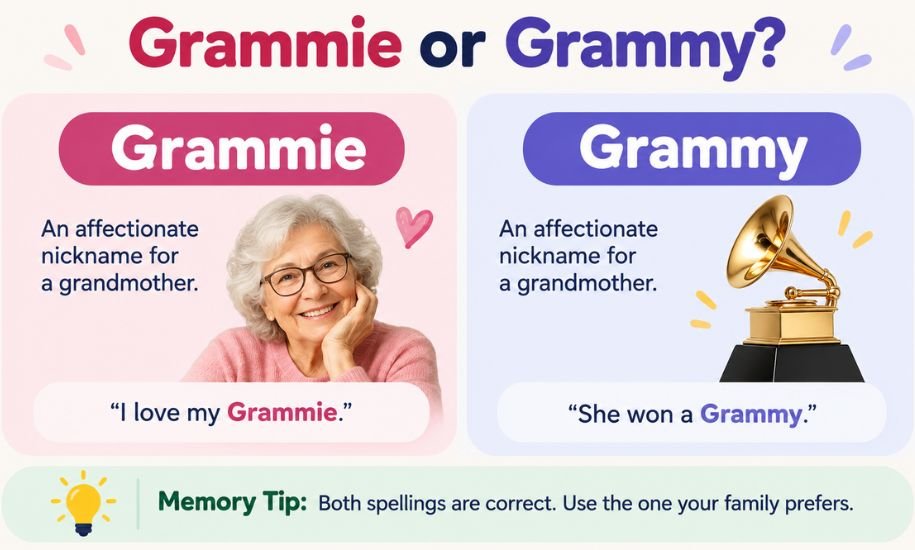
When referring to a grandmother, both Grammie and Grammy are acceptable affectionate nicknames. Although they sound exactly alike and have the same meaning, their spelling differs. The choice usually depends on family tradition, personal preference, or how a grandmother wants to be addressed. However, Grammy has another meaning: it is also the name of a prestigious music award. Understanding these differences can help you choose the right spelling for a birthday card, family message, social media post, or everyday conversation.
Quick Answer
Both Grammie and Grammy are correct spellings when used as affectionate nicknames for a grandmother. Grammy is a widely recognized form and is also used for the famous music awards, while Grammie is an alternative spelling commonly chosen as a personal family name. Use whichever spelling your grandmother prefers.
Grammie or Grammy: What’s the Difference?
The main difference between Grammie and Grammy is their spelling, not their meaning. Both are informal terms of endearment for a grandmother, and neither is grammatically incorrect when used as a family nickname.
Grammy is a familiar spelling in American English and is widely recognized because of its association with the Grammy Awards. Grammie, on the other hand, is an alternative spelling that some families prefer because it looks more personal or reflects the way they pronounce the name.
| Feature | Grammie | Grammy |
|---|---|---|
| Correct spelling | Yes, as a nickname | Yes |
| Meaning | Grandmother | Grandmother or music award |
| Pronunciation | GRAM-ee | GRAM-ee |
| Word type | Informal noun or nickname | Informal noun or proper noun |
| Usage | Family conversations and personal writing | Family conversations and music-related contexts |
| Formality | Informal | Informal as a nickname |
| Common context | Family names, cards and gifts | Family names, cards, gifts and music awards |
For example, if you write, “I am visiting my Grammie,” you are referring to your grandmother. Similarly, “I am visiting my Grammy” communicates exactly the same thing.
What Does Grammie Mean?
Grammie is an affectionate, informal name for a grandmother. It is often used by children, grandchildren and other family members to express love, warmth and familiarity.
Unlike the formal word grandmother, which is suitable for almost any context, Grammie is generally used in personal and family conversations. It can also be used as a name in greeting cards, personalised gifts, family photographs and social media captions.
The spelling with -ie may appeal to families who want a distinctive or traditional nickname. However, there is no universal rule that assigns it a special meaning or a different family relationship.
Examples of Grammie in sentences:
- My Grammie always makes the best chocolate chip cookies.
- We are going to visit Grammie during the summer holidays.
- My Grammie gave me a beautiful present for my birthday.
- I love listening to my Grammie’s stories about her childhood.
In these sentences, Grammie refers to a grandmother in an affectionate and familiar way.
What Does Grammy Mean?
Grammy is another informal name for a grandmother. It is particularly familiar in American English and is used by families as a loving alternative to Grandma, Granny or Nana.
The word can also refer to a Grammy Award, an award presented to recognise achievements in the music industry. This second meaning makes the context important when interpreting the word.
Examples of Grammy as a grandmother nickname:
- My Grammy lives near the beach.
- I am making a handmade birthday card for my Grammy.
- Grammy taught me how to prepare her favourite family recipe.
- We spent the entire weekend with Grammy.
Examples of Grammy as a music award:
- The singer won a Grammy for her latest album.
- The band received several Grammy nominations.
- He was excited to attend the Grammy Awards ceremony.
Capitalisation and context help readers distinguish between the two meanings. When Grammy is used as a family name or an award name, it is generally capitalised.
Is Grammie a Correct Spelling?
Yes, Grammie is a recognised alternative spelling of Grammy when referring to a grandmother. It is not simply a spelling mistake.
English has many informal names for grandparents, and families often choose spellings that feel natural to them. For example, one family may use Grammie, while another may prefer Grammy, Gramma or Granny.
There is no formal grammatical rule requiring everyone to use the same spelling for a personal nickname. However, in a piece of writing, consistency is important. If a grandmother prefers to be called Grammie, use that spelling throughout the text.
For formal writing, grandmother is usually the more appropriate term unless the nickname is part of a direct quotation, personal name or family-specific context.
When Should You Use Grammy or Grammie?
Choosing between the two spellings depends mainly on the person you are referring to and the context in which you are writing.
Use Grammie for a personal family nickname
Choose Grammie if that is the spelling your grandmother uses or your family has traditionally preferred. It works well in personal letters, greeting cards, family conversations and personalised gifts.
Use Grammy for a familiar nickname or music award
Grammy is appropriate if it is your family’s preferred name for a grandmother. It is also the standard spelling when referring to the music award, as in “She won a Grammy.”
Use grandmother in formal writing
If you are writing an academic paper, a formal report or a general article, grandmother is usually clearer and more appropriate than either informal nickname.
Grammie vs. Grammy: Examples in Sentences
Seeing both spellings in context makes their similarities easier to understand. When they refer to a grandmother, they can generally be substituted for one another without changing the sentence’s meaning.
| With Grammie | With Grammy |
|---|---|
| I love spending time with my Grammie. | I love spending time with my Grammy. |
| Grammie is visiting us tomorrow. | Grammy is visiting us tomorrow. |
| I bought Grammie a birthday gift. | I bought Grammy a birthday gift. |
| My Grammie loves gardening. | My Grammy loves gardening. |
Both forms are appropriate as long as they match the nickname used by the person or family.
However, when referring to the music award, Grammy is the appropriate spelling.
- Correct: She received a Grammy for her performance.
- Incorrect in standard award naming: She received a Grammie for her performance.
Other Popular Names for Grandmother
Grammie and Grammy are just two of the many affectionate names used for grandmothers. The preferred term often reflects a family’s cultural background, language, regional habits or personal choice.
| Nickname | General usage |
|---|---|
| Grandma | A widely used, affectionate name |
| Granny | An informal and familiar nickname |
| Grammy | An affectionate grandmother nickname |
| Grammie | An alternative affectionate spelling |
| Nana | A popular family nickname |
| Gran | A short, informal form |
| Gramma | An alternative spelling of Grandma |
| Mimi | A personal nickname used by some families |
| Nanny | An affectionate name in some families |
There is no single correct nickname for every grandmother. What matters most is that the name feels comfortable and meaningful to the family.
Common Mistakes to Avoid
Although the difference is straightforward, a few mistakes can cause confusion.
- Calling Grammie incorrect: It is an accepted alternative spelling when used as a grandmother nickname.
- Assuming Grammy only refers to music: The word is also widely used as a family name for a grandmother.
- Changing spellings unnecessarily: If someone prefers Grammie, avoid switching to Grammy in the same personal message.
- Confusing a nickname with a formal term: Both are informal, while grandmother is suitable for more formal contexts.
- Ignoring context: In music-related writing, Grammy usually refers to the award, not a grandmother.
Frequently Asked Questions
Is Grammie or Grammy more correct?
Both spellings are correct when used as affectionate nicknames for a grandmother. Grammy is a widely recognised spelling, while Grammie is an established alternative. The most appropriate choice is the one preferred by the grandmother or the family.
Is Grammie a real word?
Yes. Grammie is a recognised alternative form of grammy in the context of a grandmother’s nickname. It is informal rather than a formal term of address, but it is suitable for everyday family use and personal writing.
How do you spell Grammie for a grandmother?
You can spell the nickname either Grammie or Grammy. Both are used to refer affectionately to a grandmother. If you are writing a card, message or personalised gift, use the spelling she prefers.
Is Grammy an American word?
Grammy is particularly familiar in American English as an informal nickname for a grandmother. It is also internationally recognised as the name of the music award. Other English-speaking families may use different nicknames, such as Nan, Nana or Granny.
What is the plural of Grammie?
The plural of Grammie is Grammies. The plural of Grammy as a grandmother nickname is usually Grammys, although Grammies is also used in some contexts. For the music award, Grammys is the standard plural.
Should I write Grammy or Grammie on a gift?
Use the version your grandmother identifies with. If she calls herself Grammie, use that spelling on a mug, sweatshirt, greeting card or other personalised gift. If she prefers Grammy, that is the better choice.
Final Verdict: Grammie or Grammy?
Both Grammie and Grammy are correct affectionate names for a grandmother. They have the same pronunciation and meaning in this context, so the choice comes down to personal preference and family tradition. Grammy also refers to the well-known music award, making context important. When choosing between these spellings, follow the preference of the person you are addressing. For more clear explanations of confusing words and everyday English usage, Grammarifyr helps you know the difference and use the right words.
You may also Read : Traveling or Travelling: US and UK English Explained