Benefited or Benefitted: UK vs American English
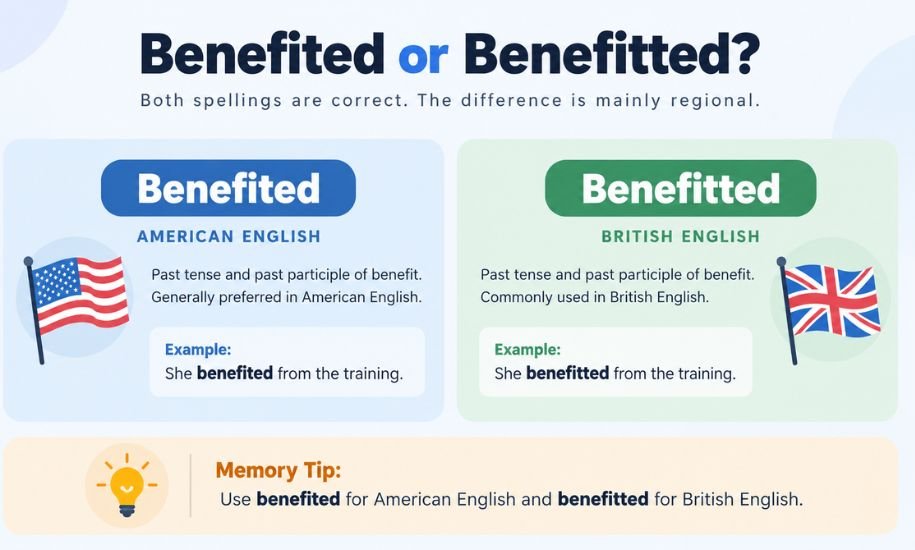
If you have ever hesitated between benefitted and benefited, you are not alone. Both spellings appear in dictionaries and published English, but they are not equally common in every variety of English. The difference is mainly regional: benefited is generally preferred in American English, while benefitted is widely used in British English. Importantly, neither spelling changes the meaning of the verb. The choice usually comes down to the variety of English you are writing in and the style you want to follow.
Both “benefited” and “benefitted” are correct spellings. “Benefited” is generally preferred in American English, while “benefitted” is common in British English. Both forms are the past tense and past participle of “benefit,” and they have the same meaning.
Benefitted or Benefited: Which Is Correct?
The short answer is that both forms are acceptable.
| Feature | Benefited | Benefitted |
|---|---|---|
| Correct spelling? | Yes | Yes |
| Meaning | Received an advantage or gained from something | Same |
| Verb | Benefit | Benefit |
| Past tense | Yes | Yes |
| Past participle | Yes | Yes |
| Common preference | American English | British English |
| Example | She benefited from the course. | She benefitted from the course. |
The important point is not to treat one spelling as a universal error. If you are writing for an American audience, benefited is usually the better choice. If you are following British English conventions, benefitted is a perfectly acceptable choice.
What Does “Benefited” Mean?
Benefited is the past tense and past participle of benefit. It means that someone received an advantage, gained something useful, or was helped by a particular situation.
For example:
- The students benefited from the additional lessons.
- She benefited greatly from the experience.
- The company benefited from the new agreement.
- He has benefited from regular practice.
The word can be followed by from when you want to identify the source of the advantage.
The team benefited from the coach’s advice.
Here, the team gained an advantage because of the coach’s advice.
What Does “Benefitted” Mean?
Benefitted has the same meaning and grammatical function as benefited. It is another accepted spelling of the past tense and past participle of benefit.
Examples include:
- The children benefitted from the new program.
- She benefitted from years of practical experience.
- Local businesses benefitted from the improvement.
- He has benefitted from the additional training.
So, when comparing the benefitted or benefited meaning, there is no difference in meaning. The distinction is primarily related to spelling conventions and regional preference.
Benefitted or Benefited in UK English
In British English, the spelling benefitted is commonly encountered and is a standard form.
For example:
The patients benefitted from the new treatment program.
You may also encounter benefited in British writing. Therefore, it would be misleading to say that British English allows only the double-t version.
If your publication follows British spelling conventions, using benefitted consistently is reasonable.
The same principle applies to the related present participle:
- benefitting
- benefiting
British English can use the double-t form benefitting, while benefiting is also established.
Example in British-style writing
The organization benefitted from increased public support.
The spelling is appropriate when following a British English style.
Benefitted or Benefited in American English
In American English, benefited is generally the preferred spelling.
For example:
The organization benefited from increased public support.
American readers will normally find the single-t form more familiar in standard writing.
That does not mean benefitted is meaningless or impossible in American publications. Rather, benefited is the safer default when your audience or style guide follows American English.
Example in American-style writing
The students benefited from the extra practice sessions.
If you are writing an American English article, essay, report, or website, benefited is usually the form to choose.
Why Are There Two Spellings?
The spelling can be confusing because English has rules governing when a final consonant is doubled before certain endings.
Consider:
- plan → planned
- stop → stopped
- permit → permitted
- benefit → benefited / benefitted
The pattern is not always as straightforward as simply saying, “Double the final consonant before -ed.” Factors such as syllable structure, stress, pronunciation, and regional spelling conventions can affect the form used.
The verb benefit is particularly interesting because both spellings have established usage. As a result, writers may see benefited in one publication and benefitted in another without either being an accidental spelling mistake.
For practical writing, the easiest approach is to follow the English variety and editorial style you have already chosen.
Benefited or Benefitted Grammar: How to Use Them
Both spellings can serve as the simple past tense:
She benefited from the workshop.
She benefitted from the workshop.
They can also function as the past participle after auxiliary verbs:
She has benefited from the workshop.
She has benefitted from the workshop.
The grammar is the same in both cases.
Verb forms at a glance
| Tense/Form | Example |
|---|---|
| Base form | They benefit from the program. |
| Simple past | They benefited from the program. |
| Alternative past | They benefitted from the program. |
| Present participle | They are benefiting from the program. |
| Alternative present participle | They are benefitting from the program. |
| Past participle | They have benefited from the program. |
| Alternative past participle | They have benefitted from the program. |
One useful grammar rule is that after did or didn’t, you should use the base form benefit, not the past forms.
Correct:
Did you benefit from the course?
She didn’t benefit from the arrangement.
Incorrect:
Did you benefited from the course?
She didn’t benefitted from the arrangement.
The auxiliary did already carries the past tense, so the main verb remains in its base form.
Examples of Correct Usage
Seeing both forms side by side makes the distinction easier:
American preference:
The company benefited from the investment.
British preference:
The company benefitted from the investment.
Both sentences communicate the same idea.
Here are some additional examples:
- Thousands of residents benefited from the improvements.
- Thousands of residents benefitted from the improvements.
- She has benefited from regular feedback.
- She has benefitted from regular feedback.
- The business benefited from better planning.
- The business benefitted from better planning.
The spelling changes, but the meaning and grammatical role do not.
Which Spelling Should You Use?
The best choice depends on your intended variety of English.
Choose “benefited” when:
- You are writing primarily for an American audience.
- Your publication follows American spelling.
- You want the generally preferred US form.
Choose “benefitted” when:
- You are following British English conventions.
- Your publication consistently uses British spelling.
- Your audience expects British-style spelling.
The most important thing is consistency. If the rest of your article uses American spellings such as color, center, and organize, then benefited fits naturally. If you consistently use British forms such as colour, centre, and organise, benefitted can fit that style.
Common Mistakes to Avoid
1. Calling “benefitted” a misspelling
Benefitted is not simply a spelling error. It is an accepted form, particularly in British English.
2. Calling “benefited” exclusively American
Although it is strongly associated with American usage and is the preferred US form, benefited can also appear in British English.
3. Writing “did benefited”
After did, use the base verb:
Did she benefit from the change?
Not:
Did she benefited from the change?
4. Mixing spelling conventions unnecessarily
There is no need to switch between benefited and benefitted randomly. Choose the form that matches your overall style and use it consistently.
5. Assuming the meaning changes
There is no meaningful difference in definition between the two spellings. Both describe receiving an advantage or gaining from something.
An Easy Way to Remember the Difference
Think of the distinction as a regional spelling choice:
US English → benefited
British English → benefitted
This is not an absolute rule, but it is a useful practical guide.
If you are unsure which one to use and your audience is American, benefited is a sensible default. If you are writing in British English, benefitted is a natural option.
Frequently Asked Questions
Is “benefitted” a correct spelling?
Yes. Benefitted is an accepted spelling of the past tense and past participle of benefit. It is especially common in British English, although usage can vary by publication and style guide.
Is “benefited” grammatically correct?
Yes. Benefited is a fully correct past tense and past participle form of benefit. It is generally the preferred spelling in American English and is also found in British English.
Is “benefitted” British or American?
Benefitted is commonly associated with British English. American English generally prefers benefited, although the double-t spelling is not inherently meaningless or impossible in US writing.
Which is more appropriate for formal writing?
Either can be appropriate. The important consideration is the English variety and style guide you are following. Use benefited for a typical American English context and benefitted when following a British English convention.
What is the past tense of “benefit”?
The past tense can be benefited or benefitted. For example, “She benefited from the experience” and “She benefitted from the experience” are both grammatically acceptable.
Should I write “benefited from” or “benefitted from”?
Both are correct. Benefited from is generally preferred in American English, while benefitted from is common in British English. Choose the form that matches your overall writing style.
The Bottom Line
When deciding between benefitted or benefited, you do not need to worry that one is automatically wrong. Both are correct forms of the verb benefit; the main difference is regional and stylistic preference. American English generally favors benefited, while British English commonly uses benefitted. For clear, consistent word choices and practical grammar guidance, Grammarifyr helps you know the difference and use the right words.
You may also Read : Was or Were? Simple Rules, Examples and Common Mistakes
One Comment