Beside or Besides? Examples and Common Mistakes
“Beside” and “besides” look almost identical, but they do not always mean the same thing. The difference is easy to remember once you understand how each word works in a sentence. Beside usually means “next to” or “at the side of,” while besides generally means “in addition to” or “moreover.” Both are correct English words, so choosing the right one depends on what you want to say. Understanding their meanings, grammatical roles, and common expressions will help you use them accurately in everyday writing.
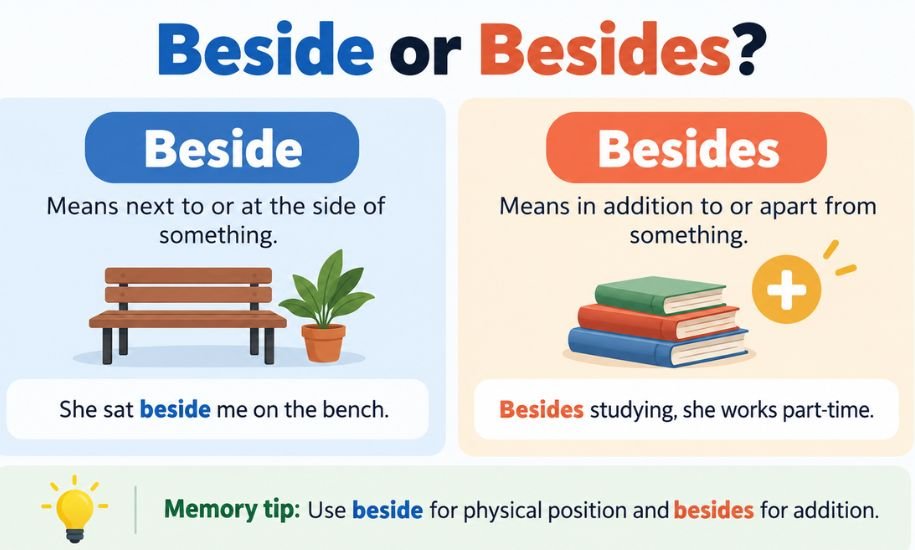
Both “beside” and “besides” are correct words. Use “beside” when you mean next to something or someone, as in “She sat beside me.” Use “besides” when you mean in addition to or furthermore, as in “Besides English, he speaks French.”
Beside vs. Besides: Key Differences
The main difference is that “beside” usually describes position, while “besides” adds information, items, or reasons. However, “beside” also appears in figurative expressions, and “besides” can sometimes mean “apart from” or “except for.”
| Feature | Beside | Besides |
|---|---|---|
| Main meaning | Next to; at the side of | In addition to; furthermore |
| Part of speech | Primarily a preposition | Preposition or linking adverb |
| Typical purpose | Describes position or a relationship | Adds information or another consideration |
| Example | The bag is beside the chair. | Besides the bag, I bought a suitcase. |
| Common expression | Beside the point | Besides that |
The easiest way to choose is to consider the intended meaning. If you are describing where something is, “beside” is usually appropriate. If you are adding another item or introducing another reason, “besides” is generally the better choice.
What Does “Beside” Mean?
“Beside” is primarily a preposition meaning next to or at the side of a person or thing. It can describe the physical position of objects and people. It can also appear in expressions that have figurative meanings.
Examples of “Beside” in Sentences
- The teacher stood beside the whiteboard.
- My brother sat beside me during dinner.
- There is a small pharmacy beside the supermarket.
- She placed her notebook beside the laptop.
- His recent achievement looks impressive beside his earlier work.
In the first four examples, “beside” identifies a position or relative location. In the final example, it expresses comparison.
Common Expressions With “Beside”
Some expressions use “beside” in a figurative sense rather than describing physical location.
Beside the point: Something irrelevant to the main issue.
Example: The colour of the packaging is beside the point; we need to check the product’s quality.
Beside oneself: Experiencing an overwhelming emotion.
Example: He was beside himself with joy when he received the award.
Beside the question: Something irrelevant to what is being discussed.
Example: Whether the journey was comfortable is beside the question; we need to know whether the train arrived on time.
These expressions are useful to recognize because their meanings cannot always be understood by interpreting the word literally.
What Does “Besides” Mean?
“Besides” has two major uses. It can function as a preposition meaning “in addition to” or “apart from,” and it can function as a linking adverb meaning “moreover” or “furthermore.”
1. Besides Meaning “In Addition To”
Use “besides” when you want to include something extra or mention another person, activity, or consideration.
Examples:
- Besides mathematics, she enjoys studying history.
- Besides his regular salary, he receives a travel allowance.
- What do you like doing besides watching films?
- Besides Sarah, three other students completed the assignment.
- Besides coffee, the café serves tea and fresh juice.
In these sentences, the word introduces something additional to what has already been mentioned.
2. Besides Meaning “Moreover” or “Furthermore”
At the beginning of a sentence, “besides” can introduce an additional point, explanation, or reason.
Examples:
- I do not want to drive tonight. Besides, the weather is getting worse.
- The apartment is too expensive. Besides, it is far from my workplace.
- We should leave early. Besides, the roads are usually busy in the evening.
- She is an excellent editor. Besides, she has considerable teaching experience.
When used this way, “besides” often connects an additional thought to the previous sentence. A comma commonly follows it when it introduces a sentence.
3. Besides Meaning “Apart From” or “Except For”
Depending on the context, “besides” can also refer to something outside a particular group or category.
For example:
“Who besides Daniel attended the meeting?”
This asks which people other than Daniel attended.
Because “besides” can express inclusion or exclusion in different contexts, always consider the complete sentence rather than relying on a single translation.
Beside or Besides: Examples Side by Side
Comparing the words in different contexts makes the distinction easier to understand.
| Sentence with “beside” | Sentence with “besides” |
|---|---|
| She stood beside the window. | Besides the window, the room has a balcony. |
| He sat beside his father. | Besides his father, his uncle attended the ceremony. |
| The keys are beside the phone. | Besides the keys, I need my wallet. |
| A tree grows beside the road. | Besides walking, she enjoys cycling. |
| The chair is beside the desk. | Besides the desk, we need another chair. |
Notice how the meaning changes. “Beside” generally identifies a location or relationship. “Besides” introduces an additional person, object, activity, or consideration.
Is “Beside Me” or “Besides Me” Correct?
Both expressions can be correct, but their meanings differ.
Beside me means next to me.
Example: Please sit beside me so we can look at the same screen.
Besides me generally means in addition to me or apart from me, depending on the context.
Example: Besides me, two other volunteers helped organize the event.
The first sentence describes physical position. The second identifies other people who participated.
Common Mistakes to Avoid
Because the words differ by only one letter, it is easy to select the wrong form when writing quickly. The following examples show how to correct typical errors.
| Incorrect or less suitable | Correct version | Explanation |
|---|---|---|
| The lamp is besides the bed. | The lamp is beside the bed. | Use “beside” for physical location. |
| Beside, we have another reason to stay. | Besides, we have another reason to stay. | Use “besides” to introduce an additional point. |
| That is besides the point. | That is beside the point. | “Beside the point” is the established expression. |
| What do you do beside teaching? | What do you do besides teaching? | “Besides” introduces an additional activity. |
The final example assumes the intended meaning is “in addition to teaching.” Different contexts can change how a sentence is interpreted, so focus on the intended meaning rather than memorizing isolated sentences.
Can “Beside” and “Besides” Ever Overlap?
Although the words have distinct primary meanings, some dictionary descriptions recognize overlapping uses, particularly around the idea of being in addition to something.
Nevertheless, “besides” is generally the clearer choice when adding another item or consideration. In contrast, “beside” is the usual choice for describing a physical position.
One expression worth memorizing is “beside the point,” which means irrelevant to the issue being discussed. Adding an “s” changes the established expression and is not appropriate when you intend that meaning.
Synonyms for Beside and Besides
The best synonym depends on which meaning you want to express. Not every alternative can replace either word in every sentence.
Synonyms for “Beside”
When describing location, consider these alternatives:
- Next to: The bicycle is next to the gate.
- Alongside: She walked alongside her friend.
- Adjacent to: The office is adjacent to the library.
- At the side of: A bench stands at the side of the entrance.
“Next to” is usually the simplest alternative in everyday English, while “adjacent to” sounds more formal.
Synonyms for “Besides”
When adding information, these alternatives may work:
- In addition to: In addition to French, he speaks Spanish.
- As well as: She teaches science as well as mathematics.
- Moreover: The proposal is practical. Moreover, it is affordable.
- Furthermore: The equipment is reliable. Furthermore, it is easy to maintain.
- Apart from: Apart from the cost, everything looks satisfactory.
These expressions have different grammatical patterns, so check how the sentence is constructed before replacing one word with another.
An Easy Way to Remember the Difference
Use this simple rule:
Beside = next to.
Imagine two chairs standing side by side. One chair is beside the other.
Besides = something extra.
Imagine adding another item to a shopping list. Besides bread, you need milk and eggs.
You can also test a sentence by replacing the word with a short phrase.
- If “next to” preserves the intended meaning, use beside.
- If “in addition to” or “moreover” fits, use besides.
For example, “The dog slept beside the door” works as “The dog slept next to the door.” However, “Besides the door, we need a new window” works as “In addition to the door, we need a new window.”
This quick substitution method works for many everyday sentences, although figurative expressions such as “beside the point” should be learned as complete phrases.
Frequently Asked Questions
1. Is “beside” or “besides” the correct word?
Both are correct English words. “Beside” usually means next to or at the side of something. “Besides” commonly means in addition to or furthermore. The correct choice depends on the meaning of the sentence, not on American or British spelling conventions.
2. Can “besides” be used at the beginning of a sentence?
Yes. “Besides” can begin a sentence when it introduces an additional point or reason. For example: “Besides, we have already paid for the tickets.” A comma is normally used after the word when it functions as a sentence-level linking adverb.
3. Is “besides” a preposition or an adverb?
It can function as both. In “Besides English, she studies German,” it is a preposition introducing an additional subject. In “Besides, we have plenty of time,” it is a linking adverb that introduces another point.
4. What does “beside me” mean?
“Beside me” usually means next to me, either physically or in a figurative sense. For example, “My friend sat beside me” describes a physical position. The expression should not be confused with “besides me,” which often means in addition to me or apart from me.
5. Is “besides the point” correct?
“Besides the point” is generally not the correct expression when you mean that something is irrelevant. The standard expression is “beside the point.” For example, “His opinion about the colour is beside the point because we are discussing the price.”
6. What is the easiest way to remember the difference?
Associate “beside” with “next to” and “besides” with “in addition to.” If you are describing where something is located, “beside” will usually fit. If you are adding another item, activity, or reason, “besides” is generally the right choice.
Final Verdict: Which Word Should You Choose?
Both words are correct, but they serve different purposes. Use beside for location and expressions such as “beside the point.” Use besides when adding information, mentioning extra items, or introducing another reason. When you are unsure, substitute “next to” or “in addition to” to test which meaning fits. Grammarifyr helps readers understand these subtle differences so they can choose the right words with confidence.
You may also Read : Organization or Organisation: Meaning and Examples