Worst or Worse: Meaning, Examples and Usage
Have you ever wondered whether to use worst or worse in a sentence? Both words describe something negative, but they serve different purposes in English grammar. The confusion usually arises when comparing situations, describing unpleasant experiences, or talking about something that has become more serious. The good news is that the difference is simple once you understand comparative and superlative forms. Learning when to use each word will help you write more clearly, avoid common grammatical mistakes, and choose the right expression in everyday conversations.
Quick Answer
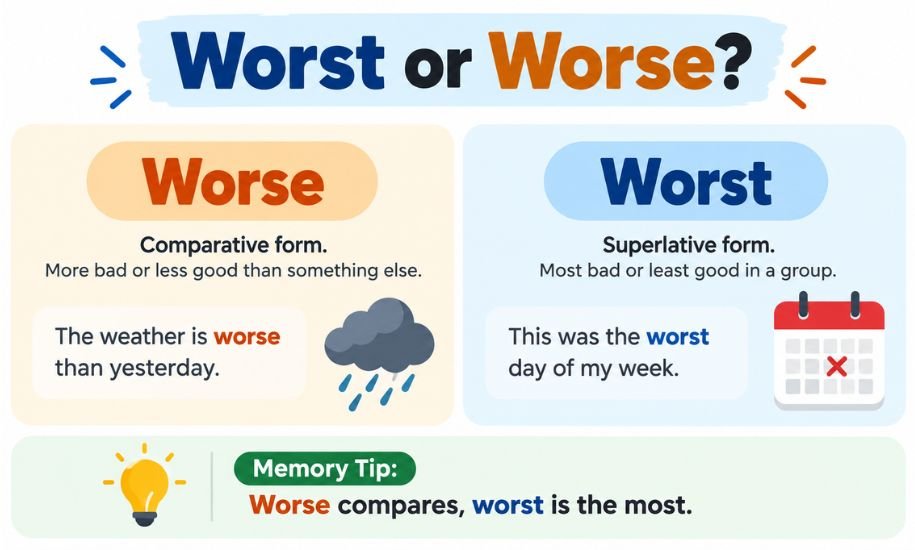
Both worse and worst are correct English words, but they are used differently. Worse is the comparative form of bad, used to compare things or describe a decline. Worst is the superlative form, used to identify the least favourable or most unpleasant option in a group or situation.
- Worse: My headache is worse than it was yesterday.
- Worst: Yesterday was the worst day of my week.
Worst or Worse: What’s the Difference?
The main difference between these words is their degree of comparison. Worse describes something that is more unpleasant, less satisfactory, or more serious than something else. Worst describes the most unpleasant, least satisfactory, or most serious thing within a group or range.
Both words are irregular forms of the adjective bad and the adverb badly. Unlike regular comparative and superlative forms, they do not use more or most.
| Feature | Worse | Worst |
|---|---|---|
| Grammatical form | Comparative | Superlative |
| Root word | Bad / badly | Bad / badly |
| Meaning | More bad or less good | Most bad or least good |
| Typical use | Comparing or describing a decline | Identifying an extreme |
| Common pattern | Worse than | The worst |
| Example | This book is worse than that one. | This is the worst book in the series. |
A simple way to remember the difference is that worse compares, while worst identifies the lowest point or most negative option.
What Does “Worse” Mean?
Worse is the comparative form of bad or badly. It describes something that has a lower quality, causes more difficulty, or is less desirable than another thing. It can also describe a situation that has deteriorated over time.
When using worse to compare two things, it is often followed by than. However, the comparison does not always need to be stated directly if the context is clear.
Examples of “worse” in sentences:
- The weather is worse today than it was yesterday.
- My new laptop performs worse than my old one.
- Her injury became worse after the match.
- The traffic was worse than we had expected.
- I feel worse when I do not get enough sleep.
In these sentences, worse indicates a comparison or a negative change. For example, in “Her injury became worse,” the word describes a deterioration from an earlier condition.
What Does “Worst” Mean?
Worst is the superlative form of bad or badly. It describes the least favourable option or the most negative experience within a group, situation, or range of possibilities.
It is often used with the, as in “the worst mistake,” “the worst experience,” or “the worst day.” It can also appear without the in certain constructions, such as “He performed worst in the final round.”
Examples of “worst” in sentences:
- That was the worst holiday I have ever had.
- This is the worst restaurant in the neighbourhood.
- She received the worst result in the class.
- It was the worst storm of the season.
- He performed worst during the final examination.
In each example, worst identifies the most negative experience, outcome, or performance in the relevant context.
How to Use Them in Everyday Sentences
Understanding the meanings is helpful, but seeing how these words work in everyday situations makes the distinction easier to apply.
Comparing experiences
- Correct: This year’s journey was worse than last year’s.
- Correct: This was the worst journey of my life.
The first sentence compares two journeys. The second identifies one journey as the most unpleasant experience in the speaker’s life.
Talking about health or feelings
- Correct: I feel worse today than I did yesterday.
- Correct: That was the worst pain I had ever experienced.
Worse describes a change or comparison, while worst expresses the most extreme experience.
Describing performance
- Correct: His second presentation was worse than his first.
- Correct: He gave the worst presentation of the day.
The first sentence compares two presentations. The second identifies the lowest-quality presentation in a particular group.
Common Expressions With Worse and Worst
Both words appear in everyday English expressions. Learning these phrases can help you use them naturally in conversations and writing.
| Expression | Meaning | Example |
|---|---|---|
| Get worse | Become more serious or unpleasant | The situation is getting worse. |
| Worse than expected | More negative than anticipated | The results were worse than expected. |
| Make matters worse | Make a difficult situation more difficult | His late arrival made matters worse. |
| Worse off | In a less favourable position | They are financially worse off. |
| For better or worse | Regardless of the outcome | We must accept the decision for better or worse. |
| At worst | In the most negative possible situation | At worst, we will lose a few hours. |
| Fear the worst | Expect a very bad outcome | She feared the worst after hearing the news. |
| Worst-case scenario | The most serious possible outcome | We prepared for the worst-case scenario. |
| The worst of the worst | The most undesirable among an already bad group | This was the worst of the worst. |
| Your own worst enemy | Someone who causes their own problems | He is his own worst enemy. |
One particularly useful expression is if the worst comes to the worst, which means if the most undesirable possible situation happens. It is commonly used in British English.
“Worst or Worse Day”: Which One Is Correct?
Both worse day and worst day are grammatically correct, but they communicate different meanings.
Use worse day when comparing one day with another.
- Today has been a worse day than yesterday.
- I had a worse day at work this week than I did last week.
Use worst day when describing the most unpleasant day within a period or experience.
- Monday was the worst day of my entire week.
- That was the worst day of my life.
The choice depends on whether you are making a comparison or identifying the most negative experience. When using the superlative form, the is generally placed before worst when it functions as an adjective.
Common Mistakes to Avoid
Although the distinction is straightforward, some expressions are frequently used incorrectly.
| Incorrect | Correct | Reason |
|---|---|---|
| This is the worse day of my life. | This is the worst day of my life. | Use the superlative for the most unpleasant day. |
| My condition is worst than before. | My condition is worse than before. | Use the comparative with than. |
| This is more worse than that. | This is worse than that. | Worse is already comparative. |
| He performed the worse in class. | He performed the worst in class. | Worst indicates the lowest performance. |
| This is the most worst experience. | This is the worst experience. | Worst already expresses the superlative degree. |
A common mistake is adding more before worse or most before worst. Since both are irregular comparative and superlative forms, they do not need these additional words.
Also, remember that worse than is the standard comparative expression, not worst than.
An Easy Way to Remember the Difference
The easiest way to remember these words is to learn the three degrees of comparison for bad:
Bad
Positive
Worse
Comparative
Worst
Superlative
Bad → Worse → Worst
- Bad: The original or basic description.
- Worse: Something is less good than another.
- Worst: Something is the least good among the relevant options.
You can also remember the corresponding forms of good: good, better, best. The two patterns work in opposite directions and help you recognise comparative and superlative forms.
For example, “This option is worse than the other one” makes a comparison, while “This is the worst option available” identifies the least desirable choice.
Frequently Asked Questions
1. Is it worse or worst?
Both are correct words, but they have different grammatical uses. Worse is the comparative form of bad, used to compare things or describe deterioration. Worst is the superlative form, used to identify the most negative option or experience.
2. Is it “getting worse” or “getting worst”?
“Getting worse” is the correct expression when something is becoming more unpleasant, serious, or difficult. For example, “The weather is getting worse.” The word worst is not used in this standard construction.
3. Is it “you’re the worst” or “you’re the worse”?
“You’re the worst” is the correct expression when describing someone as particularly unpleasant or behaving badly. Worst is used because the sentence expresses a superlative judgement. “You’re the worse” may occur in a specific comparison, but it is not the usual standalone expression.
4. Is it “worst of the worst” or “worse of the worst”?
“The worst of the worst” is the standard expression. It refers to the most undesirable examples within a group that is already considered very bad. For example, “These are the worst of the worst products on the market.”
5. Is it “worse than” or “worst than”?
“Worse than” is the correct comparative expression. For example, “This movie is worse than the previous one.” Worst is a superlative and is not normally followed by than to make a direct comparison.
6. Can “worst” be used without “the”?
Yes. Although worst often appears with the, it can also be used without it, particularly as an adverb. For example, “She performed worst in the final round.” The correct construction depends on the grammatical role of the word.
Final Verdict: Worst or Worse?
Both worse and worst are correct, but they are not interchangeable. Use worse when comparing things or describing a negative change, and use worst when identifying the most unpleasant or least favourable option. Remembering the sequence bad, worse, worst makes the distinction easier to apply.
With a little practice and attention to context, you can confidently choose the right word in your writing. Grammarifyr helps make these confusing English word differences easier to understand, so you can know the difference and use the right words.
You may also Read : Grammie or Grammy: Meaning and Key Differences