Wracking or Racking: Meaning and Examples
Have you ever found yourself racking your brain to remember something or describing an experience as nerve-racking? The words wracking and racking sound exactly alike, making it easy to confuse them in writing. Although both are correct English words, they have different meanings and uses. The right choice depends on the expression and what you want to communicate. Understanding the difference will help you avoid common spelling mistakes and use both words confidently in everyday conversations, emails, and formal writing.
Quick Answer
Both racking and wracking are correct words, but they are not interchangeable in every context. Racking is preferred in expressions such as racking my brain and racking up points, while wracking is associated with destruction, damage, and ruin. Both nerve-racking and nerve-wracking are accepted, although nerve-racking is generally the safer choice in formal writing.
Wracking or Racking: What’s the Difference?
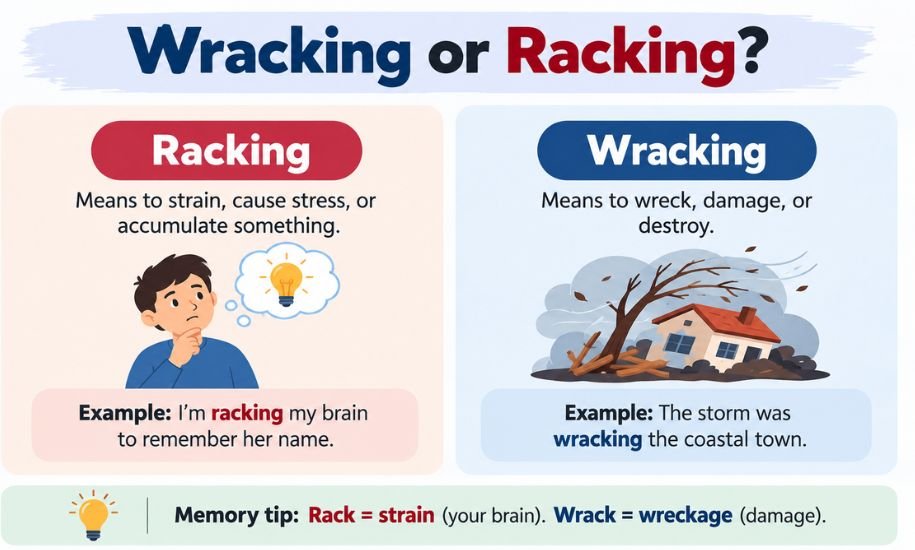
The main difference between these words lies in their meanings and conventional usage. Racking comes from the verb rack, which can mean to strain, torment, or cause intense discomfort. It is also used to describe accumulating something, as in racking up debt.
Wracking comes from wrack, a verb associated with wrecking, damaging, or destroying something. It is particularly connected with expressions such as wrack and ruin.
| Feature | Racking | Wracking |
|---|---|---|
| Root word | Rack | Wrack |
| Main meaning | Straining, tormenting, accumulating | Wrecking, damaging, destroying |
| Mental effort | Racking my brain | Less preferred variant |
| Stress | Nerve-racking | Nerve-wracking is accepted |
| Accumulation | Racking up points | Not standard |
| Destruction | Sometimes used figuratively | Strongly associated |
| Formal writing | Preferred in common expressions | Depends on context |
The important point is that racking is the conventional spelling in many everyday expressions, while wracking is not automatically incorrect. The two forms overlap in certain established phrases.
What Does Racking Mean?
Racking is the present participle of the verb rack. It describes putting someone or something under intense physical, mental, or emotional strain. It can also refer to collecting or accumulating things.
The word is often used figuratively to describe situations that cause considerable discomfort, worry, or mental effort.
Examples of racking in sentences:
- She was racking her brain to remember her childhood friend’s name.
- Waiting for the interview results was a nerve-racking experience.
- The athlete was racked with pain after the difficult competition.
- The company is racking up debt because of its growing expenses.
In the first three examples, the word relates to mental or physical strain. In the last example, racking up means accumulating something.
What Does Wracking Mean?
Wracking is the present participle of wrack, which means to wreck, ruin, or cause serious damage. It is used when describing destruction, devastation, or severe disruption.
Although wrack is less common than rack in everyday writing, it remains part of established English expressions.
Examples of wracking in sentences:
- The violent storm was wracking the coastal region.
- The country was wracked by years of conflict.
- The disaster left the community wracked with uncertainty.
- The coastline was wracked by powerful waves.
The word is particularly associated with phrases involving destruction or severe disturbance. However, wracking also appears as a variant in some expressions describing mental or emotional suffering.
Racking My Brain or Wracking My Brain?
Preferred: Racking my brain
The correct and generally preferred expression is racking my brain. It means thinking very hard to remember something, solve a problem, or find an answer.
The expression comes from the figurative idea of putting the mind under strain to recall information or work through a difficult question.
Examples:
- I have been racking my brain all morning to remember where I put my phone.
- She racked her brain for an answer to the difficult question.
- We were racking our brains to find a solution to the problem.
- He spent hours racking his brain to recall the name of the restaurant.
Wracking my brain is also used and is recognized as a variant, but racking my brain is the safer choice in formal and edited writing.
Nerve-Racking or Nerve-Wracking?
Both are accepted
Both nerve-racking and nerve-wracking are accepted spellings. They describe something that causes extreme nervousness, anxiety, worry, or emotional tension.
Nerve-racking is traditionally preferred in many edited texts, while nerve-wracking is also widely understood and used.
Examples:
- Speaking in front of a large audience can be nerve-racking.
- Waiting for important medical results was nerve-wracking.
- Her first driving test was a nerve-racking experience.
- The final moments of the competition were nerve-wracking for everyone.
Both spellings communicate the same idea. If you are writing an academic paper, professional document, or article, nerve-racking is a reliable choice. The key is to remain consistent throughout your writing.
Racking Up Points or Wracking Up Points?
Correct: Racking up points
The correct expression is racking up points. The phrasal verb rack up means to accumulate, collect, or achieve something over time.
It is frequently used in sports, competitions, business, and everyday conversations.
Examples:
- The team is racking up points in every match.
- She has been racking up achievements throughout her career.
- The player racked up three goals during the tournament.
- Our team is racking up victories this season.
Wracking up points is not the standard expression because wrack does not carry the conventional meaning of accumulating or collecting. The same rule applies to expressions such as racking up expenses, racking up debt, and racking up wins.
Wrack and Ruin or Rack and Ruin?
The traditional expression is wrack and ruin, which means complete destruction, devastation, or a state of severe deterioration.
For example:
- The abandoned house had fallen into wrack and ruin.
- Years of neglect left the old building in wrack and ruin.
- The once-thriving village was reduced to wrack and ruin after the disaster.
You may also encounter rack and ruin, which is a widely used variant. Both forms appear in English, but wrack and ruin is the traditional expression.
This is a useful exception to remember because wrack is not the preferred spelling in most other common expressions involving stress or accumulation.
Common Mistakes to Avoid
Even though both words are valid, using the wrong one in a particular expression can make your writing seem awkward or nonstandard.
| Incorrect or less preferred | Recommended usage |
|---|---|
| Wracking my brain (in formal writing) | Racking my brain |
| Wracking up points | Racking up points |
| Wracking up debt | Racking up debt |
| Nerve-wrecking | Nerve-racking |
| Nerve-raking | Nerve-racking |
| Racking and ruin | Wrack and ruin (traditional) |
Remember that wracking my brain and nerve-wracking are recognized variants, so they should not be treated as universally incorrect. The recommended forms are simply more reliable for standard edited English.
How to Remember the Difference
A simple memory trick can help you choose between these words.
- Rack = strain: Think of putting your brain under strain when you are trying to remember something. This helps you remember racking my brain.
- Wrack = wreckage: Associate wrack with destruction, damage, and ruin, as in wrack and ruin.
- Rack up = accumulate: When you collect points, wins, or debt, use racking up.
If you are unsure which spelling to use, racking is generally the best option for expressions involving mental effort, stress, or accumulation. Use wracking when the context specifically relates to destruction or in established expressions where that spelling is accepted.
Frequently Asked Questions
1. Is wracking a real word?
Yes, wracking is a real word. It is the present participle of wrack, meaning to wreck, damage, or destroy. It is also used as a variant in some expressions relating to mental or physical suffering.
2. Is racking my brain grammatically correct?
Yes, racking my brain is grammatically correct and is the preferred expression in standard English. It means thinking very hard to remember something, solve a problem, or find an answer.
3. Is nerve-wracking incorrect?
No. Nerve-wracking is an accepted spelling variant of nerve-racking. Both describe an experience that causes anxiety, stress, or nervousness. However, nerve-racking is often preferred in formal writing.
4. Is racking British or American English?
Racking is used in both British and American English. It is the conventional spelling in expressions such as racking my brain and racking up points in both varieties. The spelling distinction is not simply a regional difference.
5. Is it racking up debt or wracking up debt?
Racking up debt is the correct standard expression. The phrasal verb rack up means to accumulate something, including debt, expenses, points, or achievements.
Final Verdict: Wracking or Racking?
Both wracking and racking are correct English words, but their usage depends on context. Use racking for mental strain, emotional discomfort, and accumulation, as in racking my brain and racking up points. Use wracking when referring to destruction or in traditional expressions such as wrack and ruin. For more straightforward explanations of commonly confused English words, Grammarifyr helps you know the difference and use the right words.
You may also Read : Worst or Worse: Meaning, Examples and Usage



One Comment