Patient or Patience: Grammar Rules and Usage
The words patient and patience look and sound almost identical, but they have different meanings and grammatical uses. Both are correct English words, yet choosing the wrong one can change the meaning of a sentence or make it grammatically incorrect. For example, you can describe someone as patient, but you can also say that they have patience. One word describes a person’s ability to remain calm, while the other names that quality. Understanding this simple distinction will help you use both words naturally in everyday conversations, emails, and formal writing.
Quick Answer
Both patient and patience are correct words, but they serve different grammatical purposes. Patient is an adjective meaning able to remain calm while waiting or dealing with difficulties, and it is also a noun for someone receiving medical care. Patience is a noun that describes the ability to tolerate delays, problems, or frustration without becoming upset.
Patient vs. Patience: What’s the Difference?
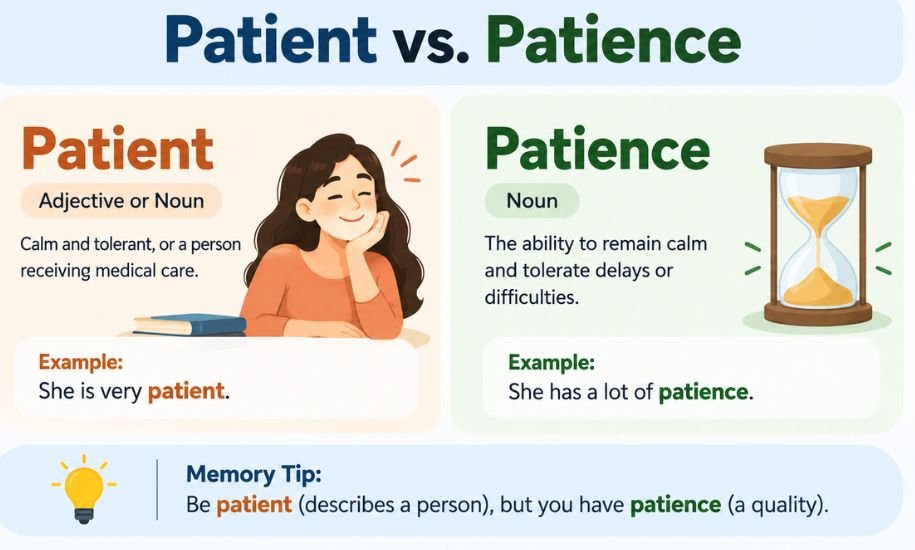
The main difference is that patient describes a person or identifies someone receiving medical treatment, whereas patience refers to the quality of remaining calm and tolerant.
| Feature | Patient | Patience |
|---|---|---|
| Part of speech | Adjective and noun | Noun |
| Meaning | Calm and tolerant; or someone receiving medical care | Ability to tolerate delays and difficulties |
| Common use | Describing a person or a medical recipient | Describing a personal quality |
| Example | She is very patient. | She has great patience. |
| Related word | Patiently | Impatiently / impatient |
For example, in the sentence “My mother is patient with everyone,” the word patient describes her personality. In “My mother has a lot of patience,” the word patience identifies a quality she possesses.
Both sentences are grammatically correct, but they express the idea in different ways.
What Does Patient Mean?
Patient has two common meanings in English. It can be an adjective describing someone who can wait calmly or handle difficult situations without becoming frustrated. It can also be a noun referring to someone receiving medical care.
Patient as an adjective
When used as an adjective, patient describes someone who shows tolerance, understanding, and self-control when faced with delays or challenges.
Examples:
- She is very patient when teaching young children.
- You must be patient while waiting for your results.
- My father is patient with people who make mistakes.
- The teacher remained patient despite the students’ repeated questions.
In these examples, patient describes how someone behaves. It is often used with the preposition with, as in “patient with children” or “patient with me.”
Patient as a noun
As a noun, patient refers to a person who receives medical attention, treatment, or care from a healthcare professional.
Examples:
- The patient is waiting outside the doctor’s office.
- The nurse checked the patient’s temperature.
- The hospital admitted several new patients.
- Every patient should receive appropriate medical care.
The plural form is patients, which refers to more than one person receiving medical care.
What Does Patience Mean?
Patience is a noun that describes the ability to remain calm and composed when dealing with waiting, frustration, difficult people, or challenging circumstances.
It involves tolerance, perseverance, and emotional self-control. Someone who has patience can handle situations that require time and effort without giving up or becoming unnecessarily upset.
Examples:
- Learning to play the piano requires patience.
- She showed great patience while helping her younger brother.
- Thank you for your patience during the unexpected delay.
- He has enough patience to explain complicated ideas clearly.
The word can also describe the ability to continue working toward something even when progress is slow.
For example, “Building a successful business takes time and patience” means that achieving the goal requires persistence and the ability to handle difficulties.
Is It “She Is Very Patient” or “She Is Very Patience”?
The correct sentence is “She is very patient.”
The word patient is an adjective, and adjectives are used after linking verbs such as is, are, was, and were to describe a person or thing.
Patience, on the other hand, is a noun. It cannot normally be used directly after is in this sentence structure.
Correct
- She is very patient with her students.
- She has a lot of patience with her students.
- Her patience helps her deal with difficult situations.
Incorrect in standard English
- She is very patience.
- She has a lot of patient.
- She showed great patient.
If you want to describe someone’s personality, use patient. If you want to talk about the quality itself, use patience.
“Thanks for Being Patient” or “Thanks for Your Patience”?
Both expressions are correct and commonly used, but their grammatical structures are different.
“Thanks for being patient” uses patient as an adjective describing the person receiving thanks. The word being is followed by an adjective that describes someone’s behavior.
“Thanks for your patience” uses patience as a noun. The possessive determiner your indicates whose patience is being acknowledged.
Examples:
- Thanks for being patient while I finish the report.
- Thank you for your patience during the appointment.
- We appreciate you being patient with us.
- Thank you for showing patience while we resolve the issue.
Both expressions are polite and suitable for everyday conversations, professional emails, and customer service messages.
Patient or Patience in a Sentence: Examples
The best way to understand the difference is to see how both words work in different contexts.
| Sentence | Why it is correct |
|---|---|
| Please be patient with me. | Patient describes the person. |
| You need patience to learn a new skill. | Patience names a quality. |
| The patient is feeling better today. | Patient refers to someone receiving care. |
| I admire her patient attitude. | Patient is an adjective describing an attitude. |
| He has little patience for unnecessary delays. | Patience is a noun. |
| The doctor spoke patiently to the patient. | Patiently describes how the doctor spoke; patient refers to the person receiving care. |
| We should be patient during difficult times. | Patient describes how we should behave. |
| Her patience impressed everyone. | Patience is the quality that impressed others. |
These examples show that the correct choice depends on whether you are describing a person, referring to someone receiving treatment, or naming the quality of tolerance.
How to Pronounce Patient and Patience
The two words have similar pronunciations, which is one reason they can be confusing in spoken English.
- Patient: /ˈpeɪ.ʃənt/ (PAY-shunt)
- Patience: /ˈpeɪ.ʃəns/ (PAY-shuns)
Both have two syllables, with the stress on the first syllable. The main difference is at the end: patient finishes with a /t/ sound, while patience finishes with an /s/ sound.
Although the distinction is subtle, listening to the final sound and paying attention to the sentence’s grammar can help you identify the intended word.
Easy Ways to Remember the Difference
A simple rule can help you choose the right word without overthinking the sentence:
You are patient; you have patience.
- Be patient: Use the adjective to describe someone’s behavior.
- Have patience: Use the noun to describe someone’s ability to remain calm.
- The patient: Use the noun when referring to someone receiving medical care.
You can also use a quick grammatical test:
- If the sentence uses very before the word, patient is usually correct: “He is very patient.”
- If the sentence uses much, more, or a lot of to describe the quality, patience is usually correct: “She has a lot of patience.”
Remembering these patterns makes it easier to use both words correctly in writing and conversation.
Common Mistakes to Avoid
Even though the difference is straightforward, a few mistakes occur frequently.
- Using a noun instead of an adjective: “He is very patience” should be “He is very patient.”
- Using an adjective instead of a noun: “I have no patient” should be “I have no patience” when referring to tolerance.
- Confusing a medical patient with a personal quality: “The patience is waiting for the doctor” should be “The patient is waiting for the doctor.”
- Using the wrong related form: “She waited patient” should be “She waited patiently,” because an adverb is needed to describe how she waited.
Checking the grammatical role of the word in a sentence will help you avoid these errors.
The Bottom Line
Patient and patience are both correct words, but they are not interchangeable. Use patient to describe someone who remains calm or to refer to a person receiving medical care. Use patience when talking about the ability to tolerate delays, frustration, or difficulties. Remembering the simple rule “be patient, have patience” will make the distinction easier to apply. At Grammarifyr, understanding these small differences helps you know the difference and use the right words with confidence.
Frequently Asked Questions
1. Is patient or patience correct?
Both words are correct. Patient is an adjective describing someone who remains calm and tolerant, as well as a noun for someone receiving medical care. Patience is a noun referring to the ability to remain calm during difficult or frustrating situations.
2. Is it “Please be patient with me” or “Please have patience with me”?
Both are correct. “Please be patient with me” uses an adjective to describe how someone should behave. “Please have patience with me” uses a noun to refer to the quality of tolerance. Both are natural ways to ask someone to be understanding.
3. Is patience a noun or an adjective?
Patience is a noun. It names the quality of remaining calm and tolerant when facing delays, difficulties, or frustration. The adjective form is patient, as in “She is patient with her colleagues.”
4. Is patient a noun?
Yes. Patient can be a noun referring to someone receiving medical treatment. For example, “The patient is recovering in the hospital.” It can also be an adjective, as in “The doctor is patient with every patient.”
5. How do you use patience in everyday conversation?
You can use patience when talking about tolerance or the ability to wait calmly. For example, “Thank you for your patience,” “I need more patience,” and “It takes patience to learn a new language” are all correct and natural expressions.
6. What is the adverb form of patient?
The adverb form is patiently. It describes an action performed in a calm or tolerant way. For example, “The teacher patiently explained the lesson” means the teacher explained it calmly without showing frustration.
You may also Read : Persue or Pursue: Meaning, Spelling and Examples

One Comment