Galinda or Glinda: What’s the Difference in Wicked?
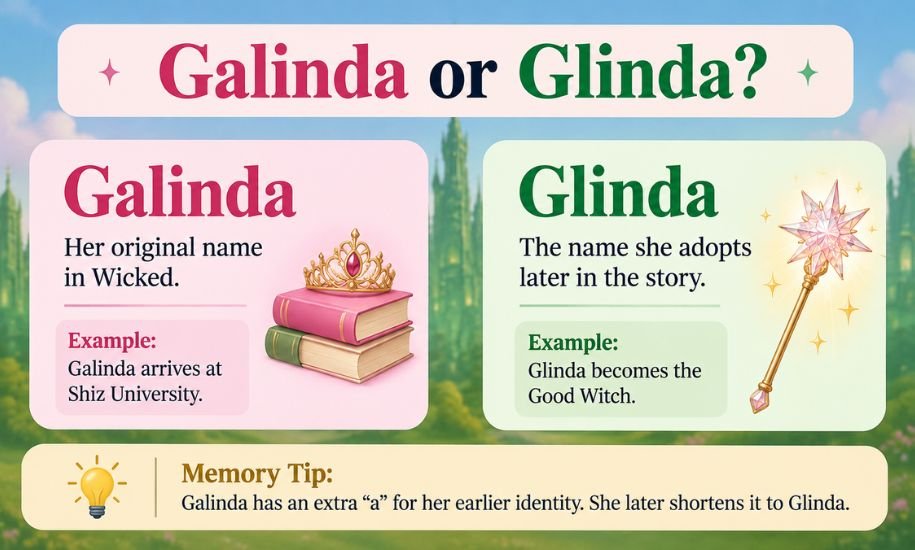
If you have watched Wicked, you may have noticed that Glinda is sometimes called Galinda. Are these two different characters, or is one name incorrect? The answer is that both names refer to the same character. Galinda is her original name in Wicked, while Glinda is the name she adopts later in the story. This small change has a meaningful connection to her character development, her relationship with Elphaba, and the familiar Good Witch from The Wizard of Oz.
Both Galinda and Glinda are correct names for the same fictional character in Wicked. Galinda is her original name, and she later shortens it to Glinda. The difference is intentional, not a spelling mistake.
Galinda or Glinda: Which Name Is Correct?
Both spellings are correct in the context of Wicked, the musical and its film adaptations. The appropriate choice depends on which part of the character’s story you are discussing.
Galinda is the name used before the character changes it. Glinda is the name she uses afterward and the one most people recognize from the Oz stories.
| Feature | Galinda | Glinda |
|---|---|---|
| Correct spelling? | Yes | Yes |
| Refers to the same character? | Yes | Yes |
| Role in the story | Original name | Later name |
| Best used when discussing | Her earlier life and identity | Her later identity and the Good Witch |
| Related to Wicked? | Yes | Yes |
Neither name is a misspelling. If you are writing about the character’s early experiences at Shiz University, Galinda may be more precise. When discussing her later role or the familiar Good Witch, Glinda is generally the better choice.
Why Did Galinda Change Her Name to Glinda?
The name change is a small but significant moment in Wicked. Galinda initially enjoys the advantages of being popular, fashionable and socially influential. As the story develops, however, her experiences challenge the way she views other people and the world around her.
One important event involves Doctor Dillamond, a Goat professor at Shiz University. He faces discrimination as talking Animals become increasingly mistreated in Oz. Galinda’s decision to use the shorter name Glinda is connected to Doctor Dillamond’s pronunciation of her name.
The gesture can be understood as an expression of sympathy and solidarity. It also highlights a central tension in her character: she wants to be admired, but she is gradually confronted with situations in which doing the right thing matters more than maintaining her popularity.
The name change therefore serves several purposes:
- Character development: It marks a shift in how Galinda understands herself and others.
- Friendship: Her experiences with Elphaba influence her perspective.
- Identity: The change connects her original identity to the person she eventually becomes.
- Symbolism: It helps bridge the character’s early life in Wicked with her familiar identity as Glinda the Good Witch.
The moment does not mean that Galinda suddenly becomes a completely different person. Instead, it represents one step in a more complicated journey.
Who Plays Galinda or Glinda in Wicked?
Ariana Grande portrays Glinda in the 2024 film adaptation of Wicked. She plays the same character throughout the story, including the period when she is known as Galinda.
Grande’s portrayal emphasizes the character’s polished appearance, comic timing, social confidence and emotional vulnerability. Although Glinda initially seems focused on popularity and status, her relationships and experiences reveal more complicated motivations.
The Broadway version of Wicked also has a notable connection to Kristin Chenoweth, who originated the role of Glinda in the original 2003 production. Her performance helped establish the character’s recognizable combination of humor, charm and theatrical glamour.
When discussing the actress, use Ariana Grande’s name for the 2024 film rather than suggesting that Galinda and Glinda are played by different performers. They are two stages of one character’s life.
How Does Glinda Connect to The Wizard of Oz?
Glinda was already a familiar character before Wicked was published. L. Frank Baum introduced Glinda, the Good Witch, in his 1900 novel The Wonderful Wizard of Oz.
Gregory Maguire’s 1995 novel Wicked: The Life and Times of the Wicked Witch of the West reimagines the world of Oz from a different perspective. Rather than presenting its characters only through the traditional division between good and evil, Maguire explores their backgrounds, relationships and moral complexities.
The name Galinda belongs to this expanded interpretation of the character. It gives readers a glimpse of her earlier identity before she becomes the Glinda associated with the wider Oz tradition.
This distinction is useful because Wicked is not simply a retelling of the original story. It provides a different perspective on familiar characters, including Glinda and Elphaba.
What Does the Name Galinda Mean?
In the context of Wicked, Galinda is best understood as the character’s original name rather than as a word with a clearly established dictionary definition.
The significance of the name comes primarily from the story. Its transformation into Glinda reflects the character’s experiences and creates a connection between her earlier life and her later identity.
It is important to distinguish this fictional explanation from claims about the name’s historical origin. Without reliable etymological evidence, it would be misleading to assign Galinda a definite traditional meaning.
For readers interested in the character, the most useful point is that the difference between the names has a narrative purpose. It helps explain how the familiar Good Witch develops from the young woman introduced at Shiz University.
Why Do People Confuse the Two Names?
The confusion is understandable because the names differ by only one syllable, and both refer to the same character. Viewers may also encounter the names in different versions of the Oz story.
Three factors explain the uncertainty:
1. The shorter name is more familiar. Glinda is the name associated with the Good Witch in the traditional Oz stories, so readers may not immediately recognize Galinda as an intentional variation.
2. The character changes her name during the story. Someone who remembers only the later scenes may overlook the earlier name.
3. Different adaptations emphasize different details. Discussions of the original novel, stage musical and film may refer to the character at different points in her development.
Online fan discussions also explore what the name change represents. Some viewers interpret it as a sincere gesture, while others see a mixture of personal growth and concern for public image. These are interpretations of the character rather than evidence that either spelling is wrong.
Examples of Correct Usage
Both names can be used correctly when the context makes the distinction clear.
- Correct: Galinda changes her name to Glinda during Wicked.
- Correct: Ariana Grande portrays Glinda in the 2024 film.
- Correct: Galinda’s early experiences help explain her later development.
- Correct: Glinda the Good Witch is a familiar figure in the Oz stories.
- Correct: The difference between Galinda and Glinda reflects a deliberate storytelling choice.
Here are two examples showing how context affects the choice:
When discussing the early story: “Galinda arrives at Shiz University with a strong interest in popularity and social status.”
When discussing the later character: “Glinda must decide how to respond when her public position conflicts with her personal relationships.”
Neither example uses an incorrect spelling. The names simply identify different stages of the same character’s journey.
Easy Way to Remember the Difference
The simplest way to remember the distinction is to associate Galinda with the character’s original identity and Glinda with the name she adopts later.
Think of the extra a as a reminder of her earlier identity. Once she shortens the name, she becomes known as Glinda, the name familiar to audiences from The Wizard of Oz.
This is a story-specific distinction, not a general English spelling rule. You would not normally remove a letter from someone’s name unless that person or the relevant fictional story establishes the change.
Frequently Asked Questions
Is Galinda a real name in Wicked?
Yes. Galinda is the character’s original name in Wicked. It is an intentional part of her fictional identity, not a typo or an incorrect version of Glinda.
Are Galinda and Glinda the same person?
Yes. Both names refer to the same character. She begins the story as Galinda and later uses Glinda, connecting her personal journey to the familiar Good Witch of Oz.
Why does Galinda drop the “a”?
Her adoption of the shorter name is connected to Doctor Dillamond, who pronounces her name that way. The change is associated with her response to the discrimination he experiences.
Who plays Glinda in the Wicked movie?
Ariana Grande plays Glinda in the 2024 film adaptation. She portrays the character before and after the name change. Kristin Chenoweth originated the role in the Broadway musical in 2003.
Is Galinda the same as Glinda the Good Witch?
Yes, within the Wicked storyline. The character’s original name is Galinda, while Glinda is the name associated with her later identity as the Good Witch.
Which spelling should I use in an article?
Use Galinda when discussing the character before her name change and Glinda when discussing her later identity. If you are referring to the character generally, Glinda is usually the more recognizable choice.
Final Verdict: Galinda or Glinda?
Both names are correct, but they serve different purposes in Wicked. Galinda is the character’s original name, while Glinda is the name she adopts as her story develops. Understanding this distinction makes it easier to discuss the character accurately without treating an intentional name change as a spelling error. At Grammarifyr, the goal is to understand the context behind words and use the right form for the right situation. As English Pairs also emphasizes, recognizing meaningful differences is often more useful than assuming that two similar forms are interchangeable.
You may also Read : Woah or Whoa: Meaning, Usage and Examples
One Comment