Losing or Loosing: Correct Usage Explained
It is easy to confuse losing and loosing because the two words look and sound similar. However, they come from different verbs and have completely different meanings. Losing is the form of lose, while loosing is the form of loose. In everyday English, losing is the word you need when talking about defeat, misplacing something, becoming deprived of something, or experiencing a reduction. Loosing is a legitimate but uncommon word used when something is being released, freed, or let loose.
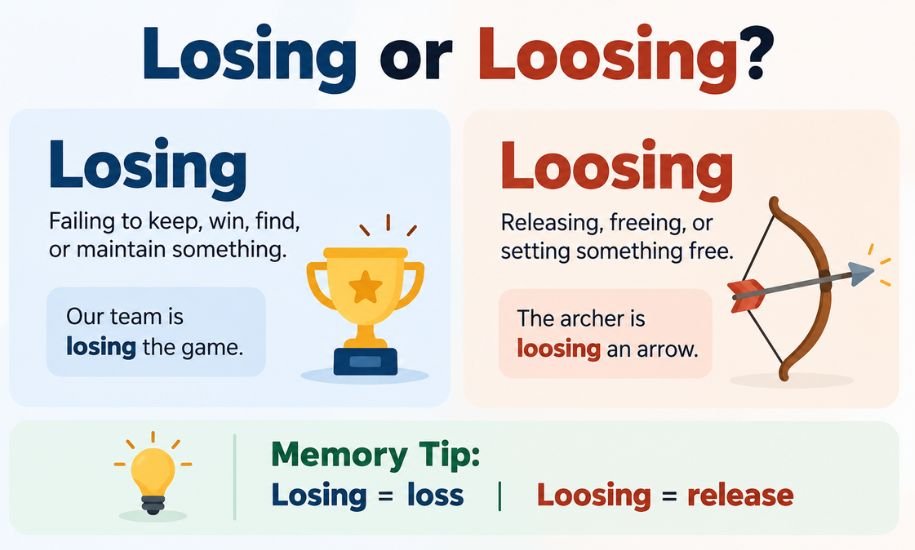
Losing is correct when you mean failing to keep or win something, such as “losing a game” or “losing money.” Loosing is also a real word, but it means releasing or setting something free, as in “loosing an arrow.” For most everyday situations, the correct choice is losing.
Losing vs. Loosing: The Key Difference
The easiest way to understand the distinction is to look at the verbs from which these forms come:
| Word | Base verb | Meaning | Example |
|---|---|---|---|
| Losing | lose | Failing to keep, win, find, or maintain something | “We are losing the game.” |
| Loosing | loose | Releasing, freeing, or setting something free | “The archer is loosing an arrow.” |
The extra o in loosing is not simply an alternative spelling of losing. It signals a different base word.
Lose → Losing
The verb lose has several meanings. It can mean to no longer have something, fail to win, misplace something, or experience a reduction.
Examples:
- I keep losing my keys.
- Our team is losing the match.
- She is losing weight.
- He is losing money on the investment.
- I feel as though I am losing my patience.
Loose → Loosing
The verb loose means to release, free, or let something go. Its -ing form is loosing.
Examples:
- The hunter was loosing the dogs.
- The archer was loosing an arrow.
- The soldiers were loosing the prisoners.
This use is much less common in modern everyday English. In many situations, writers would naturally choose releasing, freeing, or letting go instead.
What Does “Losing” Mean?
Losing is the present participle or gerund form of lose.
The verb lose can describe several types of loss. You might lose a physical object, lose a competition, lose money, lose an opportunity, or lose something abstract such as confidence or interest.
Consider these examples:
- Losing a possession: “I am losing my glasses all the time.”
- Losing a competition: “They are losing the game.”
- Losing money: “The company is losing money.”
- Losing an opportunity: “You could be losing a valuable opportunity.”
- Losing confidence: “She is slowly losing confidence.”
- Losing patience: “I am losing patience with the situation.”
In each case, the idea involves something being lost, reduced, or no longer retained.
What Does “Loosing” Mean?
Loosing is the present participle of loose when loose is used as a verb.
As a verb, loose means to release something or allow something to move freely. It is different from the much more familiar adjective loose, which means not tight or firmly fixed.
For example:
The archer is loosing an arrow.
Here, the archer is releasing the arrow.
Another example is:
The handler is loosing the dogs.
This means the handler is releasing the dogs so they can run freely.
Because this verb is relatively uncommon, readers may encounter loosing less frequently than losing. That does not make it a misspelling when it is being used with the meaning “releasing.”
Is It Losing or Loosing a Game?
The correct expression is losing a game.
Correct: Our team is losing the game.
Incorrect: Our team is loosing the game.
When a player or team is not winning, they are losing because the verb is lose.
The same rule applies to related expressions:
- losing a match
- losing a competition
- losing a race
- losing a tournament
- losing a bet
You would not use loosing in these expressions because nothing is being released.
Is It Losing or Loosing Weight?
The correct expression is losing weight.
“She is losing weight through regular exercise.”
Here, losing means experiencing a reduction in weight. The word comes from lose, not loose.
The same pattern applies to other quantities:
- losing weight
- losing money
- losing energy
- losing strength
- losing interest
- losing motivation
In these expressions, something is decreasing or being lost, so losing is the appropriate form.
Is It Losing or Loosing a Person?
When you mean being separated from someone, no longer having someone in your life, or experiencing someone’s death, use losing.
“She was afraid of losing her best friend.”
“He struggled with the thought of losing someone he loved.”
The meaning is connected to loss, so losing is the natural choice.
Technically, loosing can be used when loose means releasing a person, but that is a different idea. For example, a historical or literary sentence might describe someone loosing a prisoner, meaning setting that prisoner free. In ordinary conversation, releasing a prisoner would usually be clearer.
Losing or Loosing My Mind?
The established expression is losing my mind.
“I have so much work to do that I feel like I’m losing my mind.”
This expression uses losing because it comes from lose. The phrase generally means feeling extremely stressed, confused, overwhelmed, or unable to think clearly.
The spelling loosing my mind is incorrect when you intend this familiar expression.
Losing or Loosing Money?
Use losing money.
“The business has been losing money for several months.”
Here, losing means failing to retain money or experiencing a financial loss.
Other natural examples include:
- “I don’t want to keep losing money.”
- “The company is losing money on that product.”
- “He realized he was losing money every month.”
Loosing money would not express this meaning because money is not being released or set free.
Examples of “Losing” in Sentences
Here are some everyday examples:
- I keep losing my phone.
- The team is losing the final.
- She is losing interest in the project.
- We are losing valuable time.
- He is losing confidence after several setbacks.
- They are losing money on the deal.
- I don’t want to risk losing this opportunity.
- She feels like she is losing control of the situation.
Notice that each example involves something being lost, reduced, or no longer retained.
Examples of “Loosing” in Sentences
Although less common, loosing can be correct when it means releasing something.
Examples include:
- The archer was loosing an arrow.
- The keeper began loosing the hounds.
- The soldiers were loosing the prisoners.
- The character is described as loosing a powerful cry.
- The trainer considered loosing the animals into the enclosure.
These examples use loosing because the action involves releasing or setting something free.
Why Do People Confuse These Words?
The confusion mainly comes from their extremely similar spelling.
Losing contains one o between the l and s:
l-o-s-i-n-g
Loosing contains two:
l-o-o-s-i-n-g
The difficulty becomes greater because lose and loose are themselves easily confused. Adding the ending -ing does not remove that distinction:
lose → losing
loose → loosing
A useful approach is to think about the meaning before choosing the spelling. If something is being lost, the answer is losing. If something is being released, loosing may be appropriate.
An Easy Way to Remember the Difference
Use this simple rule:
Losing = loss
Loosing = release
If you can replace the idea with “not keeping,” “failing to win,” “misplacing,” or “decreasing,” choose losing.
If you can replace it with “releasing,” “freeing,” or “letting go,” then loosing may be the right word.
For example:
- Losing a game = failing to win a game.
- Losing weight = experiencing a reduction in weight.
- Losing money = suffering a financial loss.
- Loosing an arrow = releasing an arrow.
This distinction covers most situations where the two words cause confusion.
Common Mistakes to Avoid
1. Writing “loosing a game”
Use losing a game because a game can be lost, not released.
2. Writing “loosing weight”
Use losing weight because weight is being reduced.
3. Writing “loosing money”
Use losing money when describing a financial loss.
4. Assuming “loosing” is always a spelling error
It is not. Loosing is a legitimate verb form when it means releasing or setting something free. It is simply much less common than losing.
5. Treating “loose” and “lose” as interchangeable
They are different words. Loose commonly describes something that is not tight, while lose refers to failing to keep or win something. Their verb forms therefore have different meanings.
Frequently Asked Questions
Is “losing” the correct spelling?
Yes. Losing is the correct form of the verb lose. It is used when something is being lost, reduced, misplaced, or not won, as in “losing a game” or “losing weight.”
Is “loosing” a real English word?
Yes. Loosing is a real word and is the -ing form of the verb loose. It means releasing, freeing, or letting something go. It is much less common in everyday English than losing.
Is it “losing or loosing weight”?
The correct phrase is losing weight. Weight is being reduced, so the verb is lose: lose → losing.
Is it “losing or loosing a game”?
The correct expression is losing a game. A person or team can lose a game, but loosing would mean releasing something.
Is “losing my mind” correct?
Yes. Losing my mind is the standard expression. It comes from the verb lose, so the correct spelling has only one o after the l.
How can I remember the difference?
Think “losing = loss” and “loosing = release.” If something is disappearing, decreasing, misplaced, or not won, use losing. If something is being set free, loosing can be correct.
Final Verdict: Losing or Loosing?
For almost all ordinary expressions involving defeat, reduction, misplacement, or loss, losing is the word you want: losing a game, losing weight, losing money, and losing your mind. Loosing is also correct, but only when it comes from loose and means releasing or setting something free. Remembering “losing = loss” and “loosing = release” makes the distinction much easier. For more clear explanations of confusing English words, Grammarifyr follows the simple idea: Know the Difference. Use the Right Words.
You may also Read : Monkies or Monkeys? The Correct Plural Explained
One Comment