Persue or Pursue: Meaning, Spelling and Examples
When writing about goals, ambitions, careers, or relationships, you may wonder whether to use persue or pursue. The two spellings look similar, and the difference between them is just one vowel. However, only one is accepted in standard English. Understanding the correct spelling, meaning, and pronunciation can help you avoid mistakes in everyday writing, emails, and academic work. The word also has several uses, from chasing someone to working toward a personal ambition, making it useful to understand in different contexts.
Quick Answer
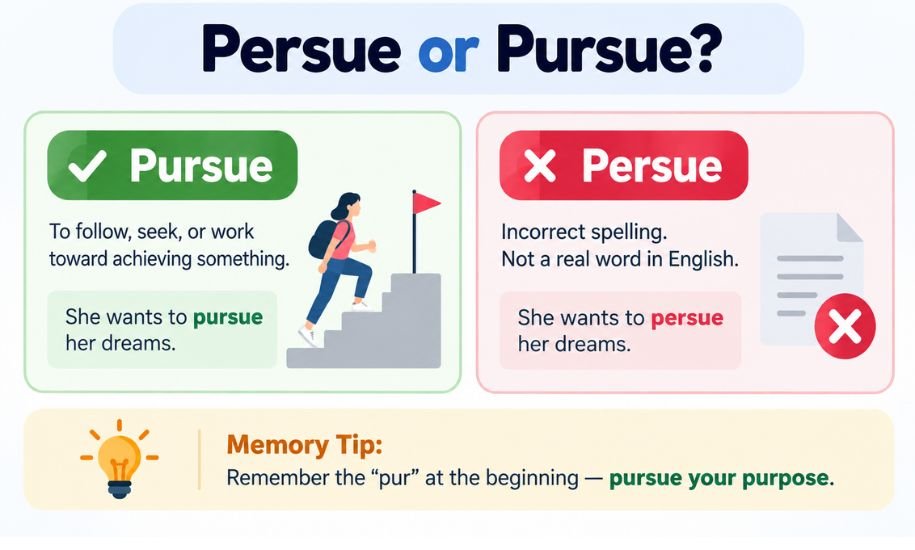
Pursue is the correct spelling, while persue is a misspelling. Pursue is a verb that means to follow, chase, seek, or work toward achieving something. It is used in expressions such as “pursue a career,” “pursue your dreams,” and “pursue a relationship.”
Persue or Pursue: Which Is Correct?
Pursue is the only correct spelling in standard English. Persue is a spelling error and should not be used in formal or informal writing when you mean to follow or achieve something.
The correct word is commonly used when talking about ambitions, professional goals, personal interests, and attempts to reach a particular outcome.
| Feature | Pursue | Persue |
|---|---|---|
| Correct spelling | Yes | No |
| Word type | Verb | Misspelling |
| Meaning | To follow, seek, or work toward something | No standard English meaning |
| Pronunciation | /pəˈsjuː/ (UK), /pɚˈsuː/ (US) | Not applicable |
| Example | She wants to pursue her dreams. | She wants to persue her dreams. |
| Formal writing | Accepted | Incorrect |
For example:
- Correct: He plans to pursue a career in engineering.
- Incorrect: He plans to persue a career in engineering.
Remember that the letter u comes after p in the correct spelling.
What Does Pursue Mean?
Pursue is a verb meaning to follow, chase, seek, or make a determined effort to achieve something. It can describe a physical action, such as following a person, or an abstract effort, such as working toward a goal.
The word has several common uses:
- To chase or follow: To go after someone or something, often to catch up with them.
- To achieve a goal: To make an effort to accomplish something you want.
- To seek an opportunity: To try to obtain something, such as a job, qualification, or business opportunity.
- To continue an activity: To remain involved in an interest, profession, or course of action.
Examples of Pursue in Sentences
- She decided to pursue her dream of becoming a doctor.
- The police pursued the suspect through several streets.
- He wants to pursue higher education abroad.
- The company continues to pursue new business opportunities.
In each example, the word describes an action involving following, seeking, or making an effort toward something.
Is Persue a Real Word?
Persue is not a standard English word. It is a common misspelling of pursue and does not have a separate accepted meaning in standard contemporary English.
Writers may accidentally use this spelling because the two forms look similar. However, dictionaries recognize pursue as the correct verb.
For example:
- Incorrect: I want to persue my passion for photography.
- Correct: I want to pursue my passion for photography.
If you see persue in a message, article, or online post, it is generally safe to assume that the writer intended to use pursue.
How to Pronounce Pursue
The word pursue has two syllables, with the main stress on the second syllable. Its pronunciation varies slightly between British and American English.
Pronunciation guide
pursue
- British English: /pəˈsjuː/
- American English: /pɚˈsuː/
- Syllables: 2
- Stress: Second syllableThe second syllable receives the emphasis. The exact vowel sounds vary by accent.
Although pursue may sound similar to how someone might imagine persue should be pronounced, spelling is not determined by replacing letters based on sound. The standard spelling remains pursue.
Pursue vs. Persuade: What’s the Difference?
Pursue and persuade are both verbs, but they have different meanings. They can be confused because their spellings are similar, particularly when writing quickly.
| Pursue | Persuade |
|---|---|
| To follow, seek, or work toward something | To convince someone to do or believe something |
| Focuses on an action or goal | Focuses on influencing another person |
| She wants to pursue a career in law. | She tried to persuade him to study law. |
| They pursued new opportunities. | They persuaded the client to accept the offer. |
Use pursue when someone is trying to reach a goal or follow something. Use persuade when someone is attempting to change another person’s mind or encourage them to take action.
Pursue Meaning in a Relationship
In a romantic relationship, pursue means to make an effort to develop a romantic connection with another person. This may involve showing interest, initiating conversations, arranging dates, or expressing feelings.
For example:
- He wants to pursue a romantic relationship with her.
- She encouraged him to pursue her if his feelings were genuine.
- They decided to pursue a relationship after getting to know each other.
The phrase “pursue me” generally means that someone wants another person to take the initiative in showing romantic interest.
However, pursuing someone does not mean ignoring their feelings or boundaries. A healthy romantic connection depends on mutual interest, communication, and respect.
Different Forms of Pursue
Pursue is a regular verb. Its past tense and past participle are formed by adding -ed, while its present participle takes -ing.
| Verb form | Correct spelling | Example |
|---|---|---|
| Base form | Pursue | I want to pursue my goals. |
| Third-person singular | Pursues | She pursues her interests. |
| Past tense | Pursued | He pursued a new career. |
| Past participle | Pursued | They have pursued several options. |
| Present participle | Pursuing | She is pursuing a degree. |
Pay attention to the spelling of these forms. Persued and persuing are also incorrect when the intended word is pursue.
Examples of Pursue in Everyday Writing
Here are some additional examples showing how the word works in different situations.
Career and education
- Maya hopes to pursue a career in journalism.
- He is pursuing a master’s degree in computer science.
Personal goals
- You should pursue the activities that genuinely interest you.
- She pursued her ambition despite several challenges.
Physical pursuit
- The dog pursued the ball across the garden.
- The officers pursued the vehicle after it failed to stop.
Relationships
- He decided to pursue a serious relationship.
- She was not interested in pursuing a romantic connection.
These examples demonstrate how the same verb can describe both physical movement and determined efforts toward personal or professional objectives.
Easy Way to Remember the Correct Spelling
A simple way to remember the spelling is to focus on the first four letters: P-U-R-S.
Think of the phrase “Pursue your purpose.” Both words begin with pur, which can help you remember the correct spelling.
Whenever you write about achieving a goal, following someone, or seeking an opportunity, remember to use pursue, not persue.
You can also check the related forms:
- Pursue
- Pursues
- Pursued
- Pursuing
All four retain the pur spelling.
Common Mistakes to Avoid
Even when writers know the meaning of the word, they may make spelling or usage errors.
| Common mistake | Correct form |
|---|---|
| I want to persue my goals. | I want to pursue my goals. |
| She is persuing a degree. | She is pursuing a degree. |
| He persued his dream. | He pursued his dream. |
| They have persued the opportunity. | They have pursued the opportunity. |
| She wants to persue him. | She wants to pursue him. |
Another mistake is using pursue when persuade is intended. For example, “She tried to pursue him to join the team” is incorrect if the meaning is to convince him. The correct sentence is “She tried to persuade him to join the team.”
Frequently Asked Questions
Is it persue or pursue?
Pursue is the correct spelling. Persue is a misspelling and is not accepted as the standard spelling in English. Use pursue when referring to chasing, following, seeking, or working toward something.
What does pursue mean in simple words?
To pursue means to go after something or make an effort to achieve it. For example, pursuing a dream means taking steps to make that dream a reality. It can also mean physically following someone or something.
Is persue an alternative British spelling?
No. Persue is not an accepted British English spelling. Pursue is the standard spelling in both British and American English, although pronunciation may differ between the two varieties.
What is the difference between pursue and pursuing?
Pursue is the base form of the verb, while pursuing is its present participle or gerund form. For example, “I want to pursue a career in teaching” uses the base form, whereas “I am pursuing a career in teaching” uses the present participle.
What does “pursue me” mean?
“Pursue me” often means to take the initiative in expressing romantic interest or trying to develop a relationship with someone. Depending on the context, it can also refer to following someone or seeking their attention for another reason.
Is pursued a correct word?
Yes. Pursued is the correct past tense and past participle of pursue. For example, “She pursued her ambition for several years.” The spelling persued is incorrect.
The Bottom Line
The correct spelling is pursue, not persue. It is a versatile verb that means to follow, seek, chase, or make an effort to achieve something. Remember the pur at the beginning when writing about goals, careers, opportunities, or relationships. With clear explanations and practical examples, Grammarifyr helps you know the difference and use the right words confidently.
You may also Read : Either or Neither: Grammar Rules and Usage
One Comment