Seam vs. Seem: Definitions, Uses and Examples
The words seam and seem look and sound very similar, but they have completely different meanings and grammatical functions. One refers to a joined edge or line, especially in fabric or another material, while the other is a verb used to describe how something appears or gives an impression. Because they differ by only one letter, it is easy to confuse them in writing. Understanding their meanings, sentence patterns, and a simple memory trick can help you choose the right word every time.
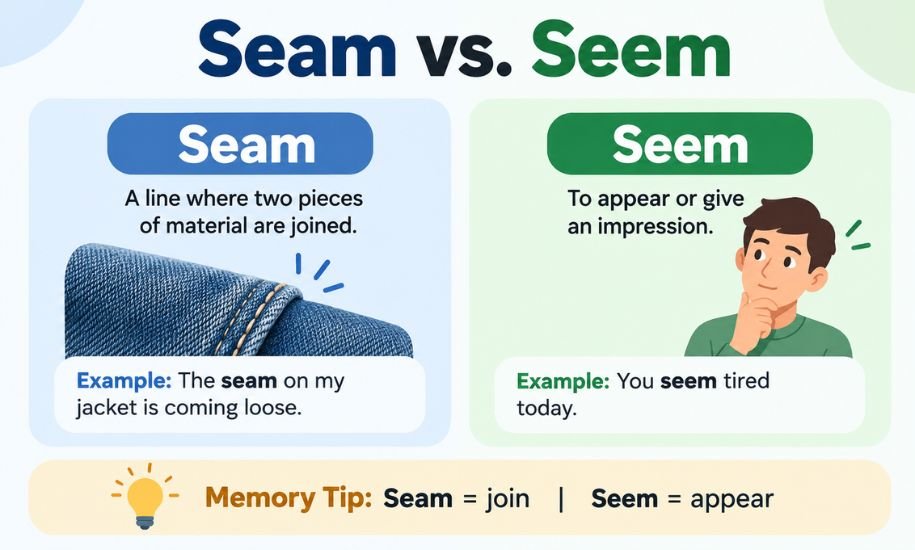
Seam and seem are both correct words, but they mean different things. Seam is usually a noun meaning a line where two pieces of material are joined, while seem is a verb meaning “appear” or “give the impression.” For example, “The seam is coming loose” and “You seem tired” use the words correctly.
Seam vs. Seem at a Glance
| Feature | Seam | Seem |
|---|---|---|
| Correct word? | Yes | Yes |
| Main meaning | A joined line or edge | To appear or give an impression |
| Part of speech | Usually noun; sometimes verb | Verb |
| Common context | Clothing, fabric, construction, objects | Appearance, impressions, opinions |
| Example | “The seam on my jacket tore.” | “You seem worried.” |
The easiest distinction is this: a seam is something that joins, while seem describes how something appears.
What Does “Seam” Mean?
Seam is primarily a noun. It refers to a line where two pieces of material are joined, usually by sewing, stitching, welding, or another method.
The word is especially common when talking about clothing and textiles. A shirt, pair of trousers, dress, or jacket may have several seams where separate pieces of fabric have been connected.
For example:
- The seam on my trousers is starting to come apart.
- The tailor reinforced the seam around the pocket.
- There was a small tear along the seam of her jacket.
- Check the seams before buying the garment.
A seam does not have to involve clothing. The word can also describe a joining line in other materials or structures.
For example:
- Water was leaking through the seam between the pipes.
- The two metal panels were connected along a narrow seam.
- The repaired wall still had a visible seam.
“Seam” as a Verb
Although it is most commonly encountered as a noun, seam can also function as a verb. As a verb, it means to join or provide with a seam.
For example:
- The pieces of fabric were seamed together.
- The manufacturer seamed the panels carefully.
- The material was seamed along the edge.
However, in ordinary writing, the noun form is much more common.
What Does “Seem” Mean?
Seem is a verb. It means to appear to be, to give an impression, or to appear likely or true based on available information.
It is often used when the speaker is describing an impression rather than stating something as an absolute fact.
For example:
- You seem tired today.
- The movie seems interesting.
- She seemed nervous before the interview.
- It seems like a good idea.
- They seem to understand the instructions.
The word can be used with different verb forms depending on the tense and grammatical structure:
- seem
- seems
- seemed
- seeming
Common Patterns With “Seem”
One useful way to understand this verb is to recognize the sentence patterns in which it commonly appears.
Seem + adjective
The child seems happy.
Seem + to + verb
They seem to know the answer.
Seem + like + noun
It seems like a reasonable explanation.
It seems that + clause
It seems that the meeting has been canceled.
These structures are extremely common in everyday English and formal writing.
The Key Difference Between Seam and Seem
The difference is mainly about meaning and grammatical function.
Seam refers to a physical joining line or, in some contexts, the act of joining materials.
Seem describes an appearance, impression, or apparent state.
Compare these sentences:
The seam in my coat is damaged.
Here, seam refers to a physical part of the coat.
My coat seems damaged.
Here, seems means “appears to be.” The sentence describes an impression about the condition of the coat.
Another pair makes the distinction even clearer:
The seam is visible.
The fabric seems expensive.
The first sentence is about a physical joining line. The second expresses an impression about the fabric.
Seam vs. Seem: Examples in Sentences
Seeing the two words in different contexts makes the distinction easier to remember.
Examples With “Seam”
- The seam of the sleeve began to unravel.
- She repaired the broken seam with a needle and thread.
- The trousers split along the seam.
- The designer used decorative stitching along the seam.
- There is a small seam where the two pieces of leather meet.
Examples With “Seem”
- You seem much happier today.
- This exercise seems easier than the previous one.
- He seemed surprised by the announcement.
- The instructions seem clear enough.
- They seem to have forgotten the appointment.
Examples Showing the Difference
- The seam on the shirt is loose.
- The shirt seems too small.
- The seam needs to be repaired.
- The repair seems difficult.
- I examined the seam carefully.
- I seem to have found the problem.
In each pair, the words cannot simply be exchanged because they perform different grammatical jobs.
Is “Seam” a Synonym for “Seem”?
No. Seam and seem are not synonyms.
Synonyms are words with similar or related meanings. These two words have unrelated meanings despite their similar spelling and pronunciation.
Depending on context, possible synonyms for seam include:
- join
- joint
- stitching
- connection
- edge
For seem, possible alternatives include:
- appear
- look
- sound
- appear to be
- give the impression
The best synonym depends on the sentence.
For example:
She seems tired.
can become:
She appears tired.
But replacing seam in:
The seam is coming loose.
with appear would make no sense.
Why Are These Words Confused?
The main reason is their extremely similar spelling and pronunciation.
Both words begin with “se-” and contain the same consonant sounds. In standard pronunciation, seam and seem are homophones: they are pronounced the same way but have different spellings and meanings.
Their vowel spellings are different:
- seam → “ea”
- seem → “ee”
This creates a classic spelling problem. Someone may know the correct pronunciation but choose the wrong spelling when writing.
Context is therefore the best guide. If you are talking about fabric, clothing, or a joining line, seam is likely the word you need. If you are describing how something appears, use seem.
Seam vs. Hem: Are They the Same?
A seam and a hem are related to clothing, but they are not the same thing.
A seam is where two or more pieces of material are joined.
A hem is an edge of fabric that has been folded and finished, usually to prevent fraying or create a neat edge.
For example, the line joining the front and back pieces of a shirt may be a seam, while the finished lower edge of the shirt may be the hem.
So, although both terms are associated with sewing and clothing, they describe different parts of a garment.
How to Remember the Difference
A simple memory trick can make the distinction much easier:
Seam = something sewn or joined.
The “a” in seam can remind you of a seam in a garment.
Seem = appears.
Think of the phrase:
“It seems that way.”
Whenever you are describing an impression, appearance, or apparent situation, seem is the appropriate choice.
You can also remember the basic association:
Seam = join
Seem = appear
That short distinction covers most everyday uses.
Common Mistakes to Avoid
1. Using “seem” for a physical joining line
Incorrect:
The seem on my shirt is broken.
Correct:
The seam on my shirt is broken.
The sentence refers to stitching or a joining line, so seam is required.
2. Using “seam” when describing an impression
Incorrect:
You seam very tired.
Correct:
You seem very tired.
Here, the speaker is describing an impression, so the verb seem is correct.
3. Confusing “seam” with “hem”
A hem is a finished edge, while a seam is generally a joining point between pieces of material. They can occur on the same garment, but they are not interchangeable terms.
4. Assuming the similar pronunciation means the spelling is interchangeable
Because seam and seem are pronounced alike, listening alone will not tell you which spelling to use. You must consider the meaning and context.
Which One Should You Use?
Ask yourself what you are trying to describe.
If you mean a line where two pieces of material are joined, choose seam:
The seam on the bag is coming apart.
If you mean to appear or give an impression, choose seem:
The bag seems expensive.
A useful substitution test can also help. If appear works in the sentence, you probably need seem.
She seems upset.
She appears upset.
If you are talking about stitching or a physical connection, seam is the right choice.
The seam is loose.
Frequently Asked Questions
Is “seam” a correct word?
Yes. Seam is a standard English word. It most commonly refers to a line where two pieces of material are joined, particularly by sewing. It can also be used as a verb meaning to join something with a seam.
Is “seem” a correct word?
Yes. Seem is a standard verb meaning “appear” or “give an impression.” For example, “You seem tired” means “You appear tired.”
Are seam and seem pronounced the same?
Yes. In standard English, seam and seem are homophones, meaning they have the same pronunciation but different spellings and meanings.
What is the difference between a seam and a hem?
A seam is generally where two pieces of material are joined. A hem is a folded and finished edge of fabric. Both are common terms in sewing and clothing, but they refer to different features.
What is a synonym for seem?
Depending on the context, seem can be replaced by words or phrases such as appear, look, or give the impression. For example, “He seems angry” can become “He appears angry.”
How can I remember seam vs. seem?
Remember seam = join and seem = appear. If you are talking about fabric or a physical joining line, use seam. If you are describing how something appears, use seem.
Final Verdict: Seam or Seem?
Both seam and seem are correct English words, but they cannot be used interchangeably. Seam is primarily a noun for a joined line or connection between pieces of material, while seem is a verb meaning “appear” or “give an impression.” Since they sound alike, focus on the meaning rather than the pronunciation. For more clear explanations of easily confused English words, Grammarifyr helps you know the difference and use the right words.
You may also Read : Snuck or Sneaked: British and American English