Snuck or Sneaked: British and American English
If you are unsure whether to write “snuck” or “sneaked,” you are dealing with two accepted forms of the past tense of sneak. The difference is mainly one of regional preference and style. Sneaked is the traditional and generally preferred form in British English, while snuck is especially common in American English and is also used informally by some British speakers. Both forms can be grammatically correct, but your choice may depend on your audience and the level of formality.
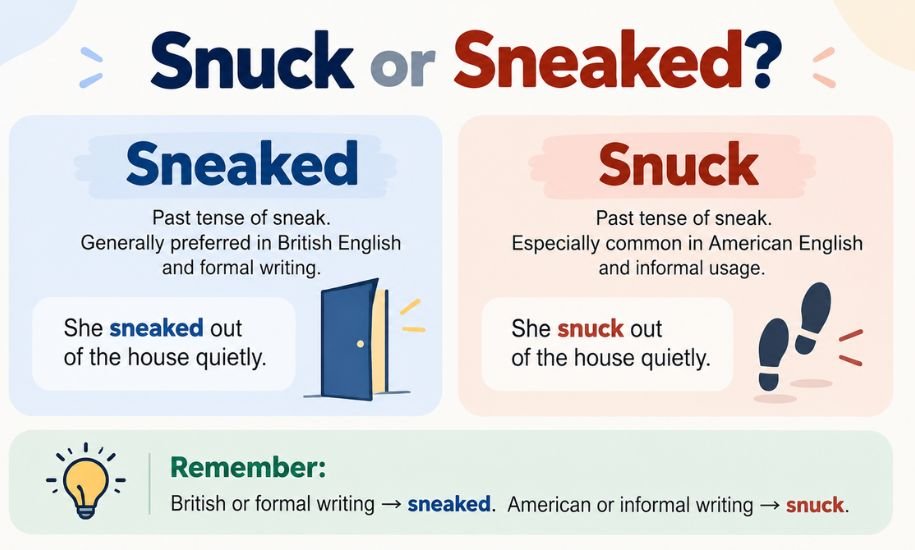
Both “snuck” and “sneaked” are correct. “Sneaked” is generally preferred in British English, especially in formal writing, while “snuck” is particularly common in American English and informal usage. Both forms mean that someone moved secretly or quietly.
Snuck or Sneaked: Which Is Correct?
The short answer is that neither form is simply wrong.
The verb sneak has two recognised past-tense forms:
- sneaked
- snuck
For example:
- She sneaked out of the house after everyone had gone to bed.
- She snuck out of the house after everyone had gone to bed.
Both sentences are grammatically understandable and convey the same basic meaning.
The important distinction is usage. Sneaked is more traditional and is particularly suitable for British English and formal contexts. Snuck is strongly associated with American English, although it has also become familiar and accepted in other varieties of English.
What Does “Sneaked” Mean?
Sneaked is the regular past tense and past participle of sneak. The verb sneak means to move quietly or secretly, usually to avoid being noticed.
Examples include:
- He sneaked into the room while everyone was talking.
- Sarah sneaked out before the meeting finished.
- The children sneaked past their parents.
- I sneaked a quick look at the timetable.
You can also use sneaked with the past perfect:
They had sneaked away before we realised they were gone.
For writers using British English, sneaked is often the safest choice, particularly in formal or edited prose.
What Does “Snuck” Mean?
Snuck has the same basic meaning as sneaked. It is an irregular past-tense and past-participle form of sneak.
For example:
- He snuck into the kitchen.
- She snuck out without saying goodbye.
- The dog snuck past the open door.
- They had snuck away before the others arrived.
The form is especially common in American English. It is also used by some British speakers, particularly in informal speech and writing.
So, if you see someone write “I snuck out,” there is no need to assume that the writer has made a grammatical mistake.
The Difference Between the Two Forms
The main difference is not meaning. Both words describe the same action.
| Feature | Sneaked | Snuck |
|---|---|---|
| Correct form? | Yes | Yes |
| Basic meaning | Moved secretly or quietly | Moved secretly or quietly |
| Grammar | Past tense / past participle | Past tense / past participle |
| British English | Common and preferred | Used, especially informally |
| American English | Correct | Very common |
| Formal writing | Generally a safe choice | May sound more informal |
| Example | She sneaked out. | She snuck out. |
The choice therefore depends more on variety of English and register than on a difference in definition.
Snuck or Sneaked in UK English
For readers asking specifically about snuck or sneaked in UK English, sneaked is usually the better choice.
British English commonly uses the regular form:
The boy sneaked out of the classroom.
However, snuck is not completely alien to British English. It is understood and used by some British speakers, particularly in casual contexts.
Consider these two sentences:
She sneaked into the office before anyone arrived.
She snuck into the office before anyone arrived.
Both are clear. The first sounds more traditionally British, while the second may sound more informal or influenced by American usage.
If you are writing an article, essay, report, or other formal piece for a British audience, sneaked is generally the safer option.
Is “Snuck” the Past Tense of “Sneak”?
Yes. Snuck can function as the past tense of sneak.
The two forms can be shown like this:
| Verb form | Example |
|---|---|
| Present | I sneak into the room. |
| Past | I sneaked into the room. |
| Past | I snuck into the room. |
| Past participle | I have sneaked into the room. |
| Past participle | I have snuck into the room. |
| -ing form | I am sneaking into the room. |
This makes sneak unusual because it can take both a regular and an irregular past form.
You do not need to change the meaning when changing from one form to the other.
Sneaked Out or Snuck Out?
Both “sneaked out” and “snuck out” are correct.
For example:
James sneaked out of the house quietly.
James snuck out of the house quietly.
The meaning is essentially identical: James left secretly or without attracting attention.
For British English, particularly formal writing, “sneaked out” is generally the more conventional choice.
For American English, “snuck out” is extremely natural.
The same distinction applies to phrases such as:
- sneaked in / snuck in
- sneaked away / snuck away
- sneaked past / snuck past
- sneaked around / snuck around
- sneaked up on / snuck up on
Examples in Sentences
Here are some natural examples showing how either form can work.
With “sneaked”
- The cat sneaked into the bedroom during the night.
- We sneaked past the sleeping dog.
- Emily sneaked out before anyone could stop her.
- He sneaked a glance at his phone during the lesson.
- They had sneaked away before the party ended.
With “snuck”
- The cat snuck into the bedroom during the night.
- We snuck past the sleeping dog.
- Emily snuck out before anyone could stop her.
- He snuck a glance at his phone during the lesson.
- They had snuck away before the party ended.
Notice that changing the verb does not change the basic meaning of any sentence.
Why Do People Get Confused?
The confusion comes largely from the fact that sneak has two established past forms.
Many English verbs have only one commonly accepted past form:
- walk → walked
- jump → jumped
- play → played
Because sneak can become either sneaked or snuck, writers may wonder whether one version is a mistake.
There is also a regional factor. American English has long favoured snuck, while British English has traditionally favoured sneaked. Exposure to different forms through books, television, films, online content, and international communication means that many speakers encounter both.
Which Form Should You Use?
Your choice should depend on your audience.
Choose “sneaked” when:
- You are writing in British English.
- You want a traditional or neutral form.
- You are writing formally.
- You want to avoid a distinctly American-sounding choice.
Example:
The journalist sneaked into the building before the doors closed.
Choose “snuck” when:
- You are writing in American English.
- You are writing conversationally.
- The surrounding text already follows American usage.
- You want a natural informal tone.
Example:
He snuck out while everyone was distracted.
The most important rule is consistency. If your article follows British English conventions, sneaked is usually the better fit. If you are writing for an American audience, snuck may sound more natural.
Common Mistakes to Avoid
1. Assuming “snuck” is always wrong
It is not. Snuck is a recognised form of the verb sneak.
2. Assuming “sneaked” is old-fashioned or incorrect
It is also fully correct and remains an especially useful choice in British English.
3. Treating the two forms as different in meaning
In ordinary use, snuck and sneaked have the same basic meaning. The main distinction concerns regional preference and style.
4. Mixing regional styles unnecessarily
There is nothing grammatically wrong with either form, but consistency improves polished writing. A British-English article will generally sound more natural if it uses sneaked consistently.
An Easy Way to Remember
A simple rule is:
British/formal → sneaked
American/informal → snuck
This is not an absolute rule because snuck can appear in British English and sneaked is also valid in American English. Think of it as a useful preference rather than a strict grammatical law.
If you are unsure which one to use for a British audience, choose “sneaked.”
Final Verdict: Snuck or Sneaked?
Both snuck and sneaked are correct past-tense forms of sneak. Sneaked is generally the better choice for British English and formal writing, while snuck is particularly common in American English and informal contexts. Neither should automatically be labelled a mistake.
When consistency with UK English matters, “sneaked” is the safest choice. For more straightforward explanations of confusing English forms, Grammarifyr follows the same principle: Know the Difference. Use the Right Words.
You may also Read : GNG Meaning in Text: What Does GNG Mean?