Rational or Irrational: How to Tell the Difference
When working with numbers, it is easy to wonder whether a number is rational or irrational. The terms sound as though they describe whether a number is sensible or logical, but in mathematics, they have a precise meaning. The difference comes down to whether a number can be written as a fraction of two integers. Once you know the basic rule, classifying most numbers becomes straightforward. But there are a few details—especially with decimals, square roots, π, and 0—that are worth understanding.
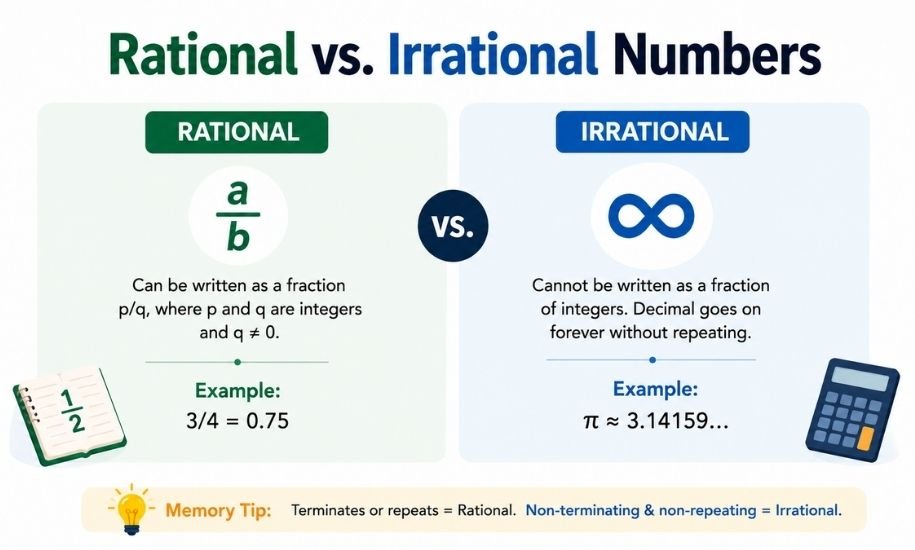
A rational number can be written as p/q, where p and q are integers and q is not zero. An irrational number cannot be expressed in that form. For example, 0, 3/4, and 0.5 are rational, while π and √2 are irrational.
What Is a Rational Number?
A rational number is a number that can be expressed as a fraction:
[
\frac{p}{q}
]
where p and q are integers and q ≠ 0.
The numerator and denominator can be positive, negative, or zero for the numerator, as long as the denominator is not zero.
For example:
- (5 = \frac{5}{1})
- (-8 = \frac{-8}{1})
- (0 = \frac{0}{1})
- (\frac{3}{4})
- (\frac{-7}{2})
All of these are rational because they can be represented as a ratio of two integers.
Are decimals rational?
Yes, some types of decimals are rational.
A terminating decimal is rational because it can always be converted into a fraction.
For example:
[
0.75=\frac{75}{100}=\frac34
]
Repeating decimals are rational, too:
[
0.333…=\frac13
]
So a decimal does not have to end to be rational. It can also continue forever if it follows a repeating pattern.
What Is an Irrational Number?
An irrational number cannot be written as a fraction of two integers.
Its decimal representation goes on forever without repeating a fixed pattern.
Examples include:
- (\pi)
- (\sqrt2)
- (\sqrt3)
- (\sqrt5)
- (e)
For instance:
[
\sqrt2=1.41421356237…
]
The digits continue indefinitely without settling into a repeating sequence. Therefore, √2 is irrational.
The same principle applies to π:
[
\pi=3.14159265358979…
]
The decimal expansion does not terminate or repeat, and π cannot be expressed as a fraction of two integers.
Rational vs. Irrational: The Key Difference
The easiest way to distinguish the two is to ask whether the number can be represented as a ratio of integers.
| Feature | Rational | Irrational |
|---|---|---|
| Can be written as p/q? | Yes | No |
| Decimal representation | Terminating or repeating | Non-terminating and non-repeating |
| Example | 3/4 | √2 |
| Another example | 0.25 | π |
| Includes integers? | Yes | No |
| Includes 0? | Yes | No |
Remember that “non-terminating” alone does not mean irrational. A repeating decimal such as 0.666… is rational.
Is Pi a Rational Number or Irrational Number?
π is an irrational number.
This directly answers questions such as “is pi a rational number or irrational number?” and “is pi an irrational or rational number?”
Pi represents the ratio of a circle’s circumference to its diameter. Its decimal expansion begins:
[
3.141592653589793…
]
It continues indefinitely without repeating, and mathematics has proven that π cannot be expressed as a fraction of two integers.
Therefore:
π → Irrational
What about 22/7?
A common source of confusion is the fraction 22/7.
[
\frac{22}{7}
]
is rational because it is a fraction made from two integers. However, 22/7 is an approximation of π, not π itself.
So:
- π = irrational
- 22/7 = rational
The distinction is important because an approximation of an irrational number can itself be rational.
Is 0 Rational or Irrational?
0 is rational.
At first, this may seem surprising, but the definition makes the answer clear:
[
0=\frac01
]
Both 0 and 1 are integers, and the denominator is not zero. Therefore, 0 satisfies the definition of a rational number.
The fact that zero has no positive or negative value does not prevent it from being rational.
Examples
- 0 → rational
- 1 → rational
- -1 → rational
- 0.5 → rational
- 0.125 → rational
In fact, every integer is rational, because any integer can be written over 1.
How to Tell If a Number Is Rational or Irrational
When you are given a number and need to decide whether it belongs to one category or the other, use these checks.
1. Is it an integer?
If it is an integer, it is rational.
For example:
[
7=\frac71
]
and
[
-12=\frac{-12}{1}
]
Therefore, both are rational.
2. Is it a fraction of integers?
If the number is already written as a fraction with integers in the numerator and denominator, it is rational.
For example:
[
\frac{11}{15}
]
is rational.
3. Does the decimal terminate?
A decimal that ends is rational.
Examples:
- 0.4
- 2.75
- 6.125
- 10.5
For example:
[
2.75=\frac{275}{100}=\frac{11}{4}
]
4. Does the decimal repeat?
A repeating decimal is rational.
Examples:
[
0.777…
]
and
[
0.121212…
]
Both have repeating patterns and can be converted into fractions.
5. Does the decimal continue without repeating?
If a decimal is non-terminating and non-repeating, it is irrational.
For example:
[
\pi=3.14159265…
]
and
[
\sqrt2=1.41421356…
]
are irrational.
What About Square Roots?
Square roots can be either rational or irrational.
The important question is whether the number inside the square root is a perfect square.
For example:
[
\sqrt{25}=5
]
Since 5 is an integer, √25 is rational.
Likewise:
[
\sqrt{36}=6
]
is rational.
But:
[
\sqrt5
]
is irrational because 5 is not a perfect square.
Other examples include:
- √2 → irrational
- √3 → irrational
- √7 → irrational
- √10 → irrational
- √16 → rational
- √49 → rational
- √100 → rational
This rule works for square roots of positive integers: the square root is rational when the integer is a perfect square; otherwise, it is irrational.
Common Examples at a Glance
Here are some numbers you may encounter in a math problem:
| Number | Answer | Reason |
|---|---|---|
| 0 | Rational | (0=0/1) |
| 4 | Rational | (4=4/1) |
| -9 | Rational | (-9=-9/1) |
| 2/3 | Rational | It is a ratio of integers |
| 0.25 | Rational | Terminating decimal |
| 0.444… | Rational | Repeating decimal |
| 3.14 | Rational | Terminating decimal |
| 22/7 | Rational | Ratio of integers |
| √9 | Rational | √9 = 3 |
| √25 | Rational | √25 = 5 |
| π | Irrational | Cannot be expressed as p/q |
| √2 | Irrational | Non-perfect-square root |
| √5 | Irrational | Non-perfect-square root |
| e | Irrational | Non-terminating, non-repeating decimal |
Why a Non-Terminating Decimal Is Not Always Irrational
One of the most important points to remember is that infinite decimal expansion does not automatically mean irrational.
Consider:
[
0.333333…
]
This decimal never ends, but the digit 3 repeats indefinitely. It is equal to:
[
\frac13
]
Therefore, it is rational.
Compare that with √2:
[
1.41421356237…
]
Its digits continue without a repeating pattern, so it is irrational.
The useful rule is:
Terminating or repeating = rational.
Non-terminating and non-repeating = irrational.
Common Mistakes to Avoid
Mistake 1: Thinking every infinite decimal is irrational
This is incorrect. Repeating decimals such as 0.777… are rational.
Mistake 2: Thinking 0 is neither rational nor irrational
Zero is rational because it can be written as 0/1.
Mistake 3: Thinking 3.14 is π
3.14 is a rational decimal. It is an approximation of π, while π itself is irrational.
Mistake 4: Thinking 22/7 equals π exactly
22/7 is rational and is commonly used as an approximation of π. It is not exactly equal to π.
Mistake 5: Assuming a calculator proves a number is rational
A calculator may display only a limited number of decimal places. For example, √2 might appear as 1.41421356, but that displayed approximation does not change the fact that √2 is irrational.
Is It Rational or Irrational? A Simple Test
If you are given a number and asked “is this rational or irrational?”, work through this short checklist:
- Can it be written as p/q using integers?
If yes, it is rational. - Is it a terminating decimal?
If yes, it is rational. - Is it a repeating decimal?
If yes, it is rational. - Is it a non-terminating, non-repeating decimal?
If yes, it is irrational. - Is it a square root?
Check whether the number inside is a perfect square.
This approach makes most basic classification problems much easier.
Frequently Asked Questions
Is π rational or irrational?
π is irrational. It cannot be expressed as a fraction of two integers, and its decimal expansion continues indefinitely without repeating.
Is 0 rational or irrational?
0 is rational. It can be written as (0/1), so it meets the definition of a rational number.
Is 22/7 rational or irrational?
22/7 is rational because it is a fraction consisting of two integers. Although it is a useful approximation of π, it is not equal to π.
Is 0.5 rational or irrational?
0.5 is rational because it is a terminating decimal and can be written as (1/2).
Is √2 rational or irrational?
√2 is irrational. It cannot be expressed as a fraction of two integers, and its decimal expansion is non-terminating and non-repeating.
Can an irrational number be written as a decimal?
Yes. Irrational numbers can be written as decimals, but their decimal expansions continue forever without repeating a fixed pattern. Examples include π and √2.
The Bottom Line
The easiest way to remember the distinction is to focus on fractions and decimal patterns. A rational number can be expressed as a ratio of two integers and has a terminating or repeating decimal representation. An irrational number cannot be expressed that way and has a decimal expansion that continues without repeating. π and √2 are irrational, while 0, integers, terminating decimals, and repeating decimals are rational. For more clear explanations of easily confused terms and concepts, Grammarify helps you know the difference and use the right words.
You may also Read : Lying or Laying: Meaning and Usage Explained