Lying or Laying: Meaning and Usage Explained
“Lying” and “laying” are both real English words, but they come from different verbs and are used in different situations. The confusion becomes even greater because lay is also the past tense of lie. That is why sentences such as “I am lying down,” “I am laying the book down,” and “I lay down yesterday” can seem surprisingly difficult to sort out.
The good news is that there is a simple way to tell them apart: lie/lying describes someone or something being in a position, while lay/laying describes putting someone or something into that position.
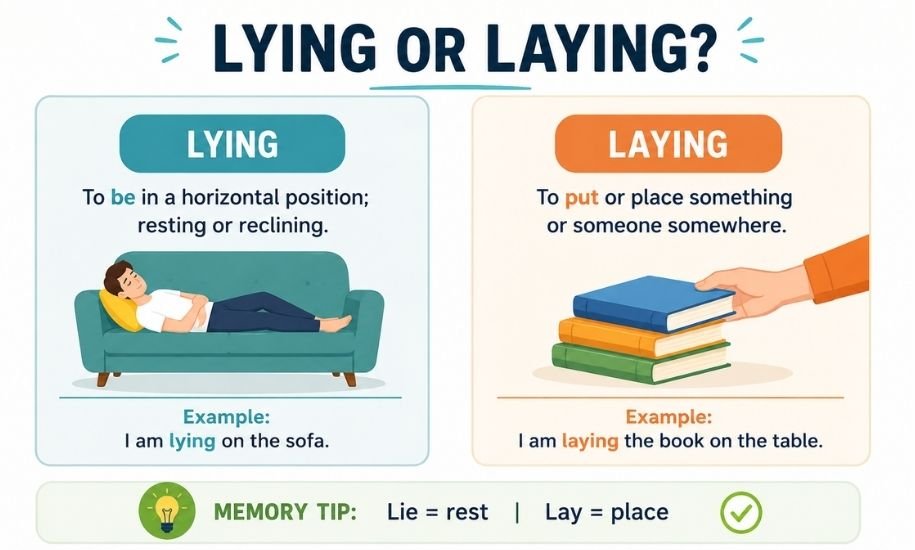
Lying is correct when someone or something is reclining or in a horizontal position: “I am lying on the sofa.” Laying is correct when someone is putting or placing something or someone somewhere: “She is laying the baby on the bed.”
Lying vs. Laying: The Key Difference
The easiest distinction is whether there is a direct object.
| Form | Basic meaning | Object needed? | Example |
|---|---|---|---|
| lying | Being in a horizontal position | No | I am lying on the couch. |
| laying | Putting or placing something | Yes | I am laying the blanket on the couch. |
Lie is an intransitive verb, meaning it does not take a direct object in this sense. Lay is transitive, so it normally takes an object—the person or thing being placed.
Compare these sentences
- The child is lying on the bed.
The child is in a horizontal position. - The mother is laying the child on the bed.
The mother is placing the child there.
The difference is small in spelling but important in grammar.
What Does “Lying” Mean?
Lying is the present participle of lie when lie means to rest or assume a horizontal position. It can describe a person, animal, or thing.
Examples:
- I am lying on the grass.
- The cat is lying under the table.
- She was lying in bed.
- Several books are lying on the floor.
Notice that the subject is the person or thing occupying the position. Nothing is being placed by the subject.
Merriam-Webster gives the forms of this verb as lie → lay → lain → lying.
“Lying” can have another meaning
There is also a separate verb lie, meaning to say something that is untrue. Its forms are different:
lie → lied → lied → lying
For example:
He is lying about what happened.
Here, lying has nothing to do with reclining.
What Does “Laying” Mean?
Laying is the present participle of lay, meaning to put, set, or place something or someone somewhere.
Examples:
- She is laying the plates on the table.
- He is laying the baby in the crib.
- I am laying the documents on your desk.
- They are laying bricks for the wall.
In each case, there is an object:
- laying the plates
- laying the baby
- laying the documents
- laying bricks
Cambridge identifies lay as a verb that takes an object, with laying as its present participle and laid as both its past simple and past participle.
Lying Down or Laying Down?
When you mean that you or someone else is reclining, the standard form is:
lying down
Examples:
- I am lying down for a few minutes.
- She is lying down in her room.
- The dog is lying down beside the chair.
But laying down is correct when an object is being put down:
He is laying the phone down.
She is laying the baby down.
I am laying the book down.
So, if you’re wondering whether it is laying down or lying down, ask yourself:
What is being placed?
If the answer is “nothing—the person is simply reclining,” use lying down.
If something is being placed, use laying down.
Lie Down or Lay Down?
In the present tense, the standard expression for reclining is:
lie down
Examples:
- I need to lie down.
- Please lie down and rest.
- The doctor told him to lie down.
- I’m going to lie down for a while.
Use lay down when an object follows:
Lay the book down.
Lay your coat down here.
Lay the baby down gently.
This is why “I need to lay down” is traditionally considered nonstandard in careful English when the intended meaning is “I need to recline.” Merriam-Webster notes that lay is sometimes used this way in ordinary speech, but lie down is the standard form for the intended meaning.
Lay or Lie? The Forms That Cause Confusion
The biggest problem isn’t actually lying vs. laying. It is the fact that the verb lie changes to lay in the past tense.
Here is the complete pattern:
| Meaning | Present | Past | Past participle | -ing form |
|---|---|---|---|---|
| Recline | lie | lay | lain | lying |
| Put/place | lay | laid | laid | laying |
| Tell an untruth | lie | lied | lied | lying |
For example:
Present:
I lie on the sofa every afternoon.
Past:
Yesterday, I lay on the sofa for an hour.
Present participle:
Right now, I am lying on the sofa.
Past participle:
I have lain here since noon.
For the other verb:
I lay the book on the desk.
Yesterday, I laid the book on the desk.
I am laying the book on the desk.
I have laid the book on the desk.
The CDC provides the same distinction and specifically notes that lay is the past form of lie, while laid is the past and past participle form of lay.
Why “Lay” Is So Confusing
Consider this sequence:
Today I lie on the bed.
Yesterday I lay on the bed.
I am lying on the bed now.
That may seem inconsistent, but it is grammatically correct.
Now compare it with:
Today I lay the blanket on the bed.
Yesterday I laid the blanket on the bed.
I am laying the blanket on the bed.
The two verbs overlap in sound and spelling, especially because lay serves two grammatical roles: it is the present form of the verb meaning “put/place,” but it is also the past tense of lie.
Correct and Incorrect Examples
When talking about reclining
Correct:
I am lying on the couch.
Not standard:
I am laying on the couch.
Why? There is no object being placed.
When talking about putting something somewhere
Correct:
She is laying the clothes on the bed.
Incorrect for this meaning:
She is lying the clothes on the bed.
The clothes are being placed, so laying is needed.
With “down”
Correct:
I want to lie down.
Correct:
Please lay the blanket down.
Correct:
She is lying down.
Correct:
She is laying the baby down.
The presence of an object makes the distinction much easier.
When to Use Lay or Lie
A practical test is to replace the verb with put.
If put makes sense, you probably need lay.
Lay the keys on the table.
→ Put the keys on the table. ✓
But:
Lie on the bed.
→ Put on the bed. ✗
That tells you that lie is the appropriate verb.
Another useful question is:
Is the subject putting something somewhere?
If yes, use lay.
If the subject is simply resting or moving into a horizontal position, use lie.
An Easy Way to Remember the Difference
Think:
Lie = rest
Lay = place
So:
- Lie down yourself.
- Lay something down.
The past tense is the exception that needs to be memorized:
Today I lie. Yesterday I lay.
And:
Today I lay something down. Yesterday I laid it down.
If you remember those two patterns, most cases become much easier.
Common Mistakes to Avoid
1. “I am laying down.”
When you mean that you are reclining, standard English uses:
I am lying down.
But laying down is perfectly correct when an object follows:
I am laying the newspaper down.
2. “I laid on the bed yesterday.”
This mixes up the present verb lay with its past-tense meaning.
The correct sentence is:
I lay on the bed yesterday.
3. “I have lay on this sofa all morning.”
After have, you need the past participle:
I have lain on this sofa all morning.
Although lain is grammatically correct, it can sound formal or uncommon in everyday conversation. Cambridge notes that this form is relatively formal and rarely used.
4. “She is lying the book on the table.”
If she is placing the book there, use:
She is laying the book on the table.
The book is the object being placed.
Frequently Asked Questions
Is it laying or lying?
Both are correct words, but they have different uses. Lying means being or moving into a horizontal position, while laying means putting or placing something or someone somewhere. For example, “I am lying on the bed,” but “I am laying the book on the bed.”
Is it laying down or lying down?
If a person or animal is reclining, use lying down: “The dog is lying down.” Use laying down when something is being placed: “She is laying the blanket down.”
Is it lie down or lay down?
Use lie down when the subject is reclining: “I need to lie down.” Use lay down when an object is being placed: “Lay the book down.” The confusion increases because lay is also the past tense of lie.
Is “I was laying on the bed” correct?
If you mean that you were reclining on the bed, the standard form is “I was lying on the bed.” Laying would normally require an object, as in “I was laying the clothes on the bed.”
What is the past tense of “lie”?
When lie means “recline,” its past tense is lay:
I lie down today.
I lay down yesterday.
Its past participle is lain, and its -ing form is lying.
How can I quickly remember the difference?
Use the simple rule “Lie = rest; lay = place.” If you are resting yourself, use lie. If you are placing an object, use lay. Then remember the unusual past tense: lie → lay → lain.
Final Verdict: Lying or Laying?
Lying is the right choice when someone or something is reclining or already in a horizontal position. Laying is right when someone is putting or placing an object or person somewhere. The key is to look for the object: lie/lying does not take one in this meaning, while lay/laying does.
Once you also remember that lay is the past tense of lie, the confusing forms become much easier to separate. For more straightforward explanations of commonly confused English words, Grammarify helps you know the difference and use the right words.
You may also Read : Flyers or Fliers? Learn the Difference