Left or Right: Political Differences Explained
When people ask whether someone is left or right, they are usually asking where that person, party, or political movement falls on the political spectrum. The terms describe broad differences in views about government, economics, social change, tradition, equality, and individual responsibility. However, the labels are not absolute, and their meaning can vary between countries. A person may also hold left-leaning views on one issue and right-leaning views on another.
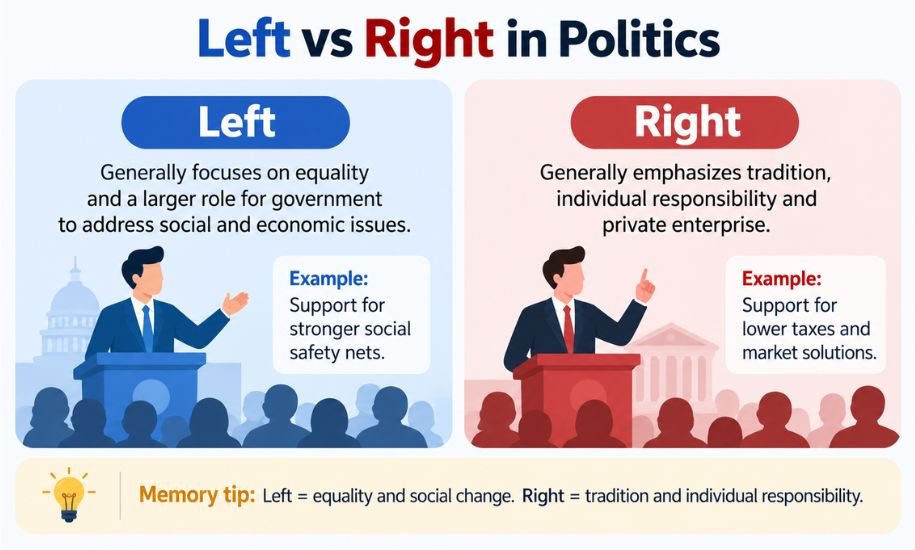
In politics, the left generally emphasizes greater social and economic equality and a larger role for government in addressing inequality. The right generally places more emphasis on tradition, individual responsibility, private enterprise, and social or political stability. These are broad categories, so political parties and individuals do not always fit neatly into one side.
What Does “Left” Mean in Politics?
The left generally refers to political ideas that place a strong emphasis on equality and reducing social or economic disparities. Left-wing movements often support government action to provide public services, protect workers, expand social welfare, and address inequalities.
Depending on the country and political tradition, the left can include social democrats, progressives, democratic socialists, socialists, and other groups.
Typical left-leaning positions may include:
- Greater government involvement in providing public services
- Stronger social safety nets
- Progressive taxation
- Greater emphasis on economic equality
- Stronger labor protections
- Support for progressive social reforms
Not everyone on the left agrees about how much government intervention is appropriate. There can be substantial differences between a moderate center-left politician and a more radical socialist movement.
What Does “Right” Mean in Politics?
The right generally refers to political positions that place greater emphasis on tradition, individual responsibility, private property, markets, social order, and continuity.
Right-wing politics can include several different traditions, including conservatism, classical liberalism, nationalism, and other movements. These traditions do not necessarily agree on every issue.
Typical right-leaning positions may include:
- Greater emphasis on individual responsibility
- Support for private enterprise and market-based economics
- Lower or less progressive taxation in many contexts
- Greater emphasis on traditional institutions
- Support for national sovereignty
- Preference for gradual rather than rapid social change
Again, “right-wing” does not describe one single ideology. A politician can be economically conservative while taking a different position on particular social issues.
Left vs. Right: A Simple Comparison
| Issue | Left-leaning tendency | Right-leaning tendency |
|---|---|---|
| Equality | Greater emphasis on reducing inequality | Greater emphasis on equality of opportunity and individual responsibility |
| Economy | More willingness to regulate markets | Greater preference for market solutions |
| Government | More government involvement in social and economic issues | More limited government involvement in many areas |
| Welfare | Stronger emphasis on public safety nets | Greater emphasis on personal responsibility and targeted assistance |
| Social change | Often more supportive of rapid reform | Often more supportive of tradition or gradual change |
| Labor | Generally stronger emphasis on worker protections | Often greater emphasis on employer flexibility and markets |
These are general tendencies rather than rules. Real political platforms are usually much more complicated.
Where Did the Left-Right Political Divide Come From?
The political use of “left” and “right” has historical roots in the French Revolution. Political groups sitting on different sides of the legislative assembly became associated with different political positions.
Over time, the terms developed into a general way of describing political disagreements. Their meanings have changed as political systems and societies have changed.
That history is important because there is no universal political scale that means exactly the same thing everywhere. What counts as left-wing in one country may be considered moderate or even right-leaning in another.
Is Trump Left or Right?
Donald Trump is generally classified as a right-wing or conservative politician in U.S. politics. His political movement is also frequently described using terms such as right-wing populism and nationalism.
His political positions have included restrictions on immigration, stronger emphasis on national sovereignty, conservative approaches to several social issues, and economic policies that combine elements of traditional Republican policy with populist positions.
It is worth distinguishing between Trump’s political movement and every individual policy position. Political labels summarize broad patterns rather than perfectly describing every position a politician takes.
Therefore, if the question is simply “Is Trump left or right?”, the usual classification is right.
Are Republicans Left or Right?
In the United States, the Republican Party is generally considered a right-wing or conservative political party.
Republicans have traditionally emphasized lower taxes, private enterprise, individual responsibility, conservative social policies, national defense, and limited government in several areas.
However, the Republican Party contains different ideological groups. Some Republicans are strongly conservative, while others are more moderate or libertarian. The party’s positions have also changed over time.
So, while Republicans are broadly on the right side of the U.S. political spectrum, individual Republican voters and politicians can differ considerably.
Are Democrats Left or Right?
The Democratic Party is generally considered left of the Republican Party and is commonly described as center-left or left-leaning in contemporary U.S. politics.
Democrats often support government programs intended to expand access to health care, education, social services, and economic opportunities. Many also support stronger environmental regulation and progressive social policies.
However, the Democratic coalition includes moderates, liberals, and progressives. A moderate Democrat may hold significantly different views from a progressive Democrat.
This is why simply describing every Democrat as “far left” would be inaccurate.
Is Conservative Left or Right?
In the traditional political spectrum, conservative is generally associated with the right.
Conservatism often emphasizes established institutions, social stability, tradition, personal responsibility, and cautious or gradual change.
However, conservatism can mean different things in different countries. For example, economic conservatism, religious conservatism, national conservatism, and fiscal conservatism can overlap but are not identical.
So the simplest answer is:
Conservative = generally right-leaning.
That does not mean every conservative agrees on every political question.
Is the BJP Left or Right?
The Bharatiya Janata Party (BJP) in India is generally classified as a right-wing or right-of-center political party.
Its political identity is associated with Indian nationalism and Hindutva, alongside positions on economic development, national security, governance, and cultural issues.
The Indian political spectrum should not be interpreted exactly like the American one. India’s political parties developed within a different historical and social context, so classifications such as left, right, center, socialist, and nationalist need to be understood within Indian politics.
For that reason, saying simply that the BJP is “right-wing” is broadly useful, but it does not capture every aspect of its political platform.
Am I Left or Right Wing?
If you are trying to determine whether you are left or right wing, looking at one political issue is usually not enough.
Consider your views on several areas:
- Economic policy: Do you generally prefer more government intervention or greater reliance on markets?
- Taxation: Do you favor greater redistribution through taxation or lower taxes and greater individual control over income?
- Social policy: Do you generally favor faster social reform or preserving established traditions?
- Government: Should government play a larger role in providing services and reducing inequality?
- Personal responsibility: How much responsibility should individuals have for their own economic circumstances?
- National issues: How important are national sovereignty, borders, and traditional institutions to your political outlook?
Your answers may not point in exactly the same direction.
For example, someone could favor free-market economics but support progressive social policies. Another person might support generous welfare programs while holding conservative views on social issues.
That is one reason political ideology is often better understood as a spectrum rather than a simple left-versus-right switch.
Why Left and Right Are Not Always Simple
The biggest problem with the left-right model is that politics involves many different issues.
Imagine two people who both favor lower taxes. One might also support liberal social policies, while the other might strongly support traditional social values. Calling both people simply “right-wing” may hide important differences.
Political scientists therefore sometimes use models with multiple dimensions. These can distinguish economic views from social or cultural views instead of putting every belief on one straight line.
The terms are still useful because they provide a quick general description, but they should not be treated as complete political identities.
What About the Political Center?
The center generally describes positions between the traditional left and right.
A centrist may combine policies associated with both sides. For example, someone might support a market economy while also supporting substantial public healthcare and social programs.
There is also a center-left and center-right. These descriptions recognize that political beliefs often fall between the extremes.
The center can therefore be useful when a person or party does not fit comfortably into either a clearly left-wing or clearly right-wing category.
What Does “Left or Right” Mean Outside Politics?
The phrase can also have completely different meanings depending on context.
For example, “left or right” can refer literally to direction:
- Turn left or right at the intersection.
- Which hand is your dominant hand?
- Should the object move left or right?
There is also a Left or Right game, where players may be asked to choose between two alternatives. This usage has nothing to do with political ideology.
Context is therefore essential. When discussing political parties or politicians, “left or right” usually refers to ideology. In ordinary conversation, it may simply describe direction or a choice between alternatives.
Common Mistakes When Using Left and Right
Treating the labels as absolute
Calling someone entirely left-wing or right-wing based on one policy can be misleading. Political beliefs are often mixed.
Assuming the terms mean the same everywhere
The political spectrum differs between countries. A position considered center-left in one country may have a different classification elsewhere.
Equating “right” with “far right”
These terms are not interchangeable. A mainstream conservative position is not automatically far-right.
Equating “left” with “far left”
Likewise, a center-left or liberal position does not necessarily represent far-left politics.
Assuming every party member has identical beliefs
Political parties are coalitions. Their members can disagree on economics, social policy, foreign affairs, and many other issues.
Easy Way to Remember the Difference
A useful starting point is:
Left → greater emphasis on equality and social change.
Right → greater emphasis on tradition, individual responsibility, markets, or stability.
This is only a memory aid, not a complete definition. Real political ideologies are more nuanced.
Frequently Asked Questions
Is left-wing liberal?
Often, particularly in U.S. politics, liberalism is associated with the left or center-left. However, “liberal” has different meanings in different countries and historical contexts, so the two terms should not always be treated as exact synonyms.
Is conservative left or right?
Conservative is generally associated with the right side of the political spectrum. Conservatism commonly emphasizes tradition, stability, established institutions, and gradual rather than rapid change.
Are Democrats left or right?
In contemporary U.S. politics, Democrats are generally considered center-left or left-leaning, although the party includes moderates, liberals, and progressives with different political views.
Are Republicans left or right?
Republicans are generally considered right-wing or conservative in U.S. politics. Individual Republicans can vary considerably in how conservative or moderate they are.
Is Trump left or right?
Donald Trump is generally classified as right-wing, conservative, and often right-wing populist in the context of U.S. politics.
Is the BJP left or right?
The BJP is generally classified as a right-wing or right-of-center party in Indian politics. Its political identity is distinct from the U.S. Republican/Democratic framework.
Final Verdict: Left or Right?
The terms left and right are useful shorthand for broad political differences, but they are not perfect categories. The left is generally associated with equality, social reform, and a greater willingness to use government to address economic and social issues, while the right is generally associated with tradition, individual responsibility, markets, national interests, and stability. The best way to understand any politician or party is to examine its actual policies rather than relying on a label alone. For more clear explanations of confusing terms and distinctions, Grammarifyr provides a useful reference for understanding how similar expressions differ in meaning and use.
You may also Read : Whisky or Whiskey: Which Spelling Is Correct?
One Comment